
Unbiased headlines. Facts, not spin.
Every story is an unbiased news briefing written from 110+ sources across the spectrum — sources linked so you can verify it yourself.
 defense
Notable (6/10)
September 16, 2026 at 10:12 PM
defense
Notable (6/10)
September 16, 2026 at 10:12 PM
Joint Chiefs Chairman Says Military Must Prepare to Fight From Seabed to the Moon, Won't Clarify If That Means Lunar Surface
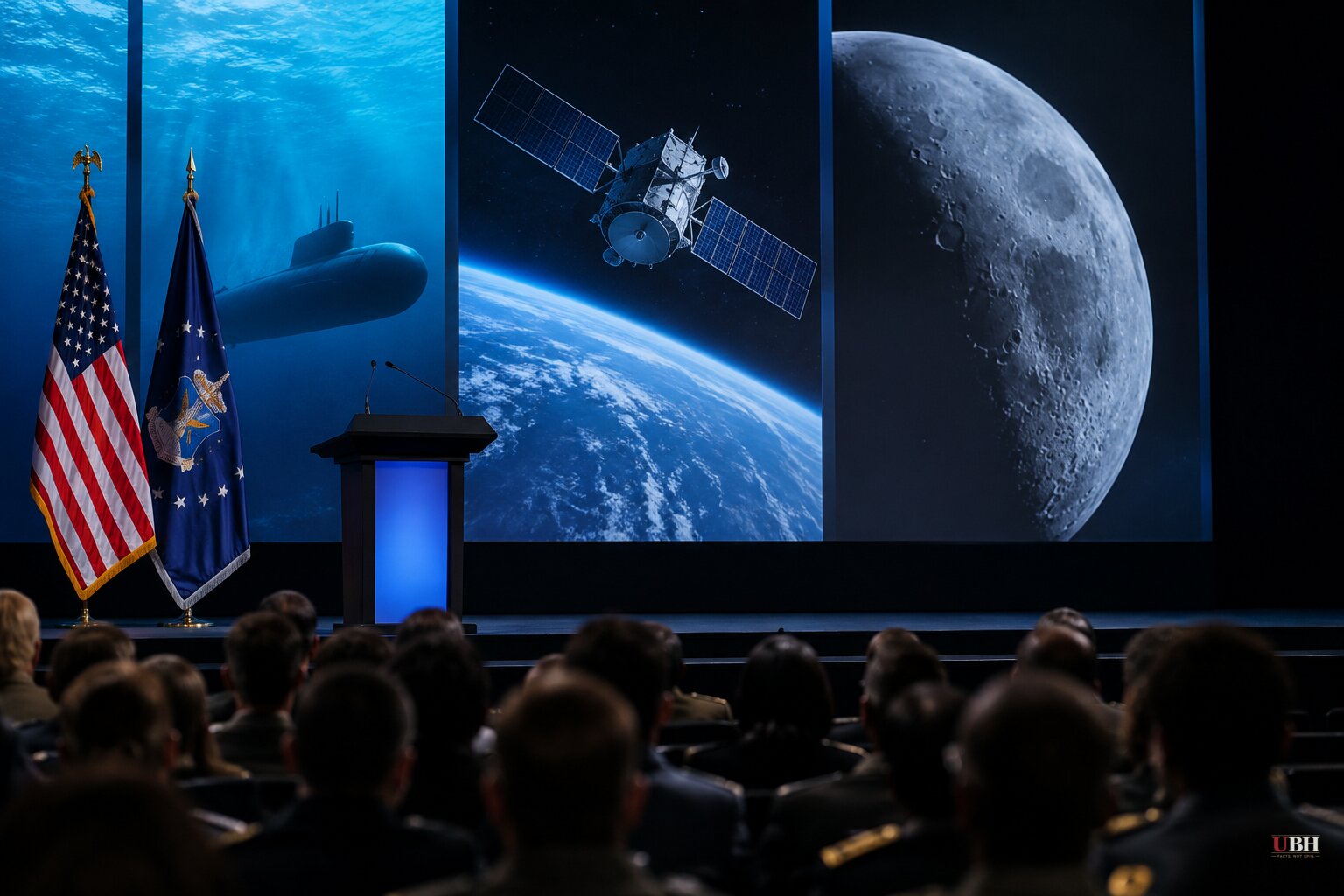
Since the Air Force confirmed this week that U.S. orbital weapons are already circling Earth, the Pentagon's top military officer has taken the next step: telling troops to prepare for combat all the way out to the moon.
Gen. Dan Caine, chairman of the Joint Chiefs of Staff, told airmen, guardians and defense contractors at the Air, Space and Cyber Conference in National Harbor, Maryland that the joint force must "adapt right now" so it's "prepared to fight, endure, and win, in global contested environments, from the seabed to cislunar space," according to Defense One. He repeated the line later in his address, saying "today's modern battlefield operates from the seabed to cislunar space."
What Caine did not do is clarify what that means. Cislunar space is loosely defined in U.S. law as the region "from the Earth out to and including the region around the surface of the moon," according to Defense One. At least one Harvard Law Journal article reads that language as covering combat on the lunar surface itself. The White House's National Cislunar Science and Technology Action Plan, issued in late 2024, explicitly includes the lunar surface in its definition. But the Air Force Research Laboratory's own 2021 "Primer on Cislunar Space" treats the moon's surface and cislunar space as two separate things. Three federal documents, three different answers.
Space Force Says China Is Moving Faster Than Expected
Lt. Gen. Gregory Gagnon, who runs the Space Force's Combat Forces Command, told reporters separately that "humanity is advancing deeper into space" and the Space Force's job is to "help be prepared to defend U.S. interests," according to the Associated Press, whose reporting on the conference was carried by the Boston Globe, the Fort Morgan Times and other outlets.
Gagnon was blunter about the reasoning. "The intelligence community has been clear that potential adversaries have been seeking to extend warfare into space," he said, adding that "our potential adversaries such as the PRC are actively pursuing activities in the system, in parts of space," per the AP report.
Aaron Brynildson, a space law professor at the University of Mississippi, told Defense One the concern is grounded in real activity. "There's a fear that recent Chinese activity on the moon and in cislunar space might outpace the United States." He noted China already operates a relay satellite in cislunar space and is running robotic missions on the moon's far side. China stood up its own military space force in 2024 specifically to manage space-related crises.
China Calls It a Treaty Problem
Chinese foreign ministry spokesperson Guo Jiakun pushed back hard when asked about the U.S. announcements, telling reporters Tuesday that "China always upholds the peaceful use of outer space, maintains outer space security and opposes the weaponization, militarization and an arms race in outer space," according to the Guardian. Guo called on Washington to "stop expanding its military preparations in outer space."
The Outer Space Treaty of 1967, signed by both the U.S. and China, bans "the establishment of military bases, installations and fortifications, the testing of any type of weapons and the conduct of military manoeuvres on celestial bodies," and requires the moon and other celestial bodies be used "exclusively for peaceful purposes." If Caine's cislunar language does extend to combat operations on the lunar surface, as the Harvard Law Journal and the White House's own 2024 action plan suggest it could, that's a direct collision with treaty text the U.S. itself signed.
Nobody in the Pentagon has addressed that collision. No source in this record has any U.S. official explaining how fielding "on-orbit space control weapons" or preparing for lunar combat is consistent with the treaty's peaceful-use clause. That's a gap, not a resolved question.
At the same time, the treaty's fine print does carve out room for military personnel to conduct "scientific research" or other "peaceful purposes" on celestial bodies, which is exactly the kind of ambiguity Beijing and Washington could each exploit depending on how a future mission is labeled. And China's own objections carry less weight given that Beijing has built its own dedicated military space branch and, according to Brynildson, is already running lunar operations the U.S. considers a strategic threat. Both governments are treating the moon as contested ground while publicly citing the same 1967 treaty against the other's actions.
None of the reporting on Caine's remarks says whether Congress has been briefed on what "cislunar space" legally covers, or whether the administration plans to seek clarification of the Outer Space Treaty's application before, not after, the U.S. builds hardware meant to operate there. That's the open question hanging over every one of these announcements: whether America's space weapons program is running ahead of the legal framework meant to govern it, or whether officials simply haven't said.
Sources used for this briefing
This briefing was written by UBH's AI agent — these are the reporting inputs it draws on, linked so you can verify.


