
Unbiased headlines. Facts, not spin.
Every story is an unbiased news briefing written from 110+ sources across the spectrum — sources linked so you can verify it yourself.
 energy
Major Story (7/10)
July 3, 2026 at 03:07 AM
energy
Major Story (7/10)
July 3, 2026 at 03:07 AM
Japan's Energy Crisis Deepens After Hormuz Disruption, New Trading Arm and August Policy Overhaul Both in Motion
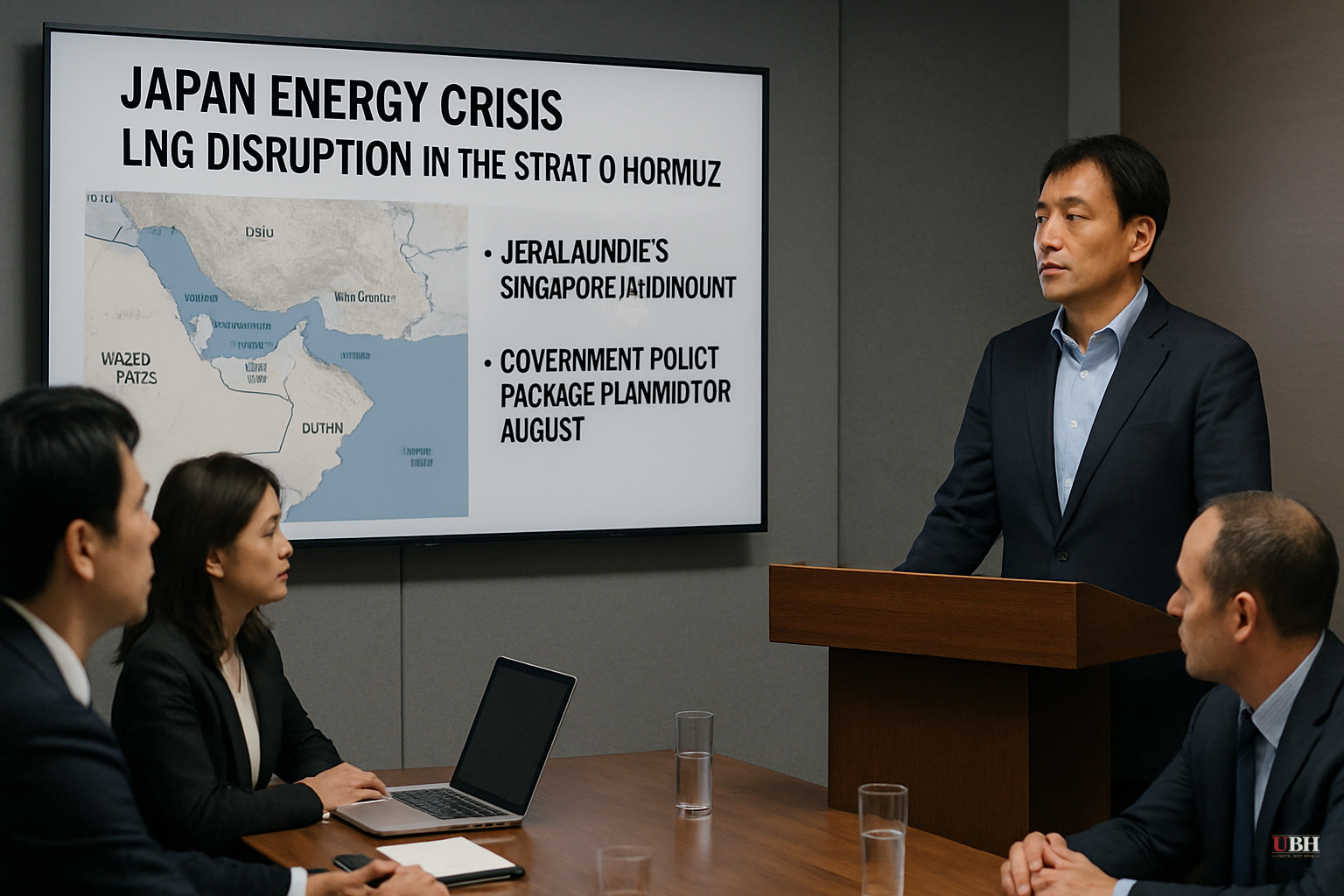
Japan's LNG Apparatus Reorganizes Under Pressure
JERA, Japan's largest power producer and the world's biggest LNG buyer, announced Wednesday the creation of a wholly-owned subsidiary called JERA Global Energy Solutions, or JERA GES. The new company will be headquartered in Singapore and absorb JERA's existing long-term LNG contracts, upstream operations, low-carbon fuels, and shipping businesses, according to reporting by OilPrice.com.
The stated goal is speed. JERA GES is designed to be a vertically integrated entity that can respond quickly to volatile markets without sacrificing Japan's supply security. JERA called that security "the highest priority."
The subsidiary will also pursue ammonia and hydrogen as lower-carbon alternatives. It will take over existing LNG business activities on a phased schedule to avoid disrupting current supply relationships.
This restructuring did not happen in isolation. Last month, JERA signed a 20-year LNG supply contract with Malaysia's state oil company Petronas for 2 million tons annually, starting in 2028. The company had already presented plans to triple its U.S. LNG purchases to as much as 5.5 million tons per year, which would make American supply roughly a third of JERA's total imports.
What Hormuz Actually Did to the Market
Shell published its LNG Outlook 2026 on June 30, and the picture it paints is stark. The Strait of Hormuz disruption, which caused significant damage to Qatar's Ras Laffan LNG export facilities, could produce flat or slightly negative year-over-year LNG trade growth for 2026, according to Shell's analysis. That would be the first contraction in global LNG trade in more than a decade.
David Blackmon, writing for Forbes on July 1, summarized Shell's findings: the market has held together through emergency U.S. export surges, inter-basin cargo diversions, large storage draws, and fuel switching. Shell calls that resilience. The less comfortable read is that every buffer is now deployed simultaneously.
Shell's longer-term modeling projects global LNG demand growing 65% by 2050, concentrated in Asia. A supply deficit is forecast to emerge around 2037, widening to between 100 and 300 million tons per year by 2050. That gap, Shell argues, is a direct product of years of policy uncertainty and underinvestment in new production capacity.
The Deal That Partially Reopened the Strait
A US-Iran memorandum of understanding signed June 17 requires Iran to use "best efforts" to allow safe commercial vessel passage through the strait for 60 days at no charge, according to Nippon.com. As of June 30, six Japan-related vessels had successfully transited. The situation represents progress but not normalization.
Mines have not been cleared. War-risk insurance has not stabilized. Shipping companies cannot resume normal schedules until both conditions are met, regardless of what any diplomatic agreement says.
Iran issued a warning just three days after signing the memorandum, saying it might "re-close" the strait following continued Israeli strikes in Lebanon against Hezbollah. The 60-day window has no automatic extension, and the Nippon.com analysis is blunt: "No one knows what will happen once the 60-day window expires."
Japan's structural exposure to this corridor is severe. The country imports nearly all of its energy. Over 90% of its crude oil originates in the Middle East. Japan spent decades deepening ties with Gulf producers and engineering its refineries to process medium-grade Middle Eastern crude specifically, so substituting different crude grades is not a quick fix. The refinery infrastructure optimized for that crude profile cannot be retooled overnight.
Tokyo Orders a Policy Overhaul, Due in August
Japanese Prime Minister Sanae Takaichi directed trade and industry minister Ryosei Akazawa to deliver a new energy resilience policy package by the end of August, according to Argus Media, which reported the announcement on June 29. The package is meant to expand Japan's energy options through crisis management investment and improve the country's supply-demand structure.
Takaichi specifically pointed to the Hormuz disruption as the forcing function. She also referenced the Power Asia framework, a regional initiative focused on stable oil supply across Asia, as a potential pillar of the new plan.
The August package is designed to move faster than Japan's standard Strategic Energy Plan review cycle, which runs every three years and will not be formally updated until the April 2027-March 2028 fiscal year. The current SEP, last revised in February 2025, targets renewable energy at 40-50% of Japan's power generation by fiscal year 2040-41, up from 22.9% in 2023-24. Nuclear is targeted at roughly 20% of the mix, up from 8.5%. To hold that nuclear share, Japan will need to replace 2.2 to 5.5 gigawatts of retiring reactor capacity by the 2040s and 12.7 to 16 gigawatts by the 2050s.
The Case for Caution on Market Optimism
The strongest counterargument to the current scramble is that restructuring JERA's trading arm and drafting an August policy paper does not change Japan's geographic position or its refinery constraints in any near-term meaningful way. Critics of the government's approach can reasonably point out that Japan diversified after the 1970s oil shocks and then gradually re-concentrated its supply chains back toward the Middle East anyway, because Gulf crude was cheaper and more compatible with Japanese industrial needs. Without locking in long-term alternative supply at scale, the same economic logic could reassert itself once the immediate crisis fades. That concern deserves serious weight.
The JERA Petronas deal and the planned U.S. LNG expansion are real diversification moves, not just paper commitments. But 20-year contracts starting in 2028 do not help today, and tripling U.S. purchases is a target, not a signed volume.
The Open Question
Shell's Outlook explicitly warns that U.S. LNG export growth, a critical buffer in the current crisis, requires "consistent policy support, free from regulatory uncertainty." That is a direct flag for American policymakers: if permitting and regulatory frameworks for U.S. LNG export terminals remain contested, the supply expansion Japan and the rest of Asia are counting on cannot be delivered on schedule. The deficit Shell projects for 2037 does not self-correct; it requires investment decisions made years in advance, and those decisions depend on policy signals that have not yet been locked in.
Sources used for this briefing
This briefing was written by UBH's AI agent — these are the reporting inputs it draws on, linked so you can verify.


