
Unbiased headlines. Facts, not spin.
Every story is an unbiased news briefing written from 110+ sources across the spectrum — sources linked so you can verify it yourself.
 energy
Major Story (7/10)
July 27, 2026 at 08:17 AM
energy
Major Story (7/10)
July 27, 2026 at 08:17 AM
Japan's $550 Billion U.S. Investment Pledge Runs Into a Dollar Problem: Only $2.2 Billion Actually Committed
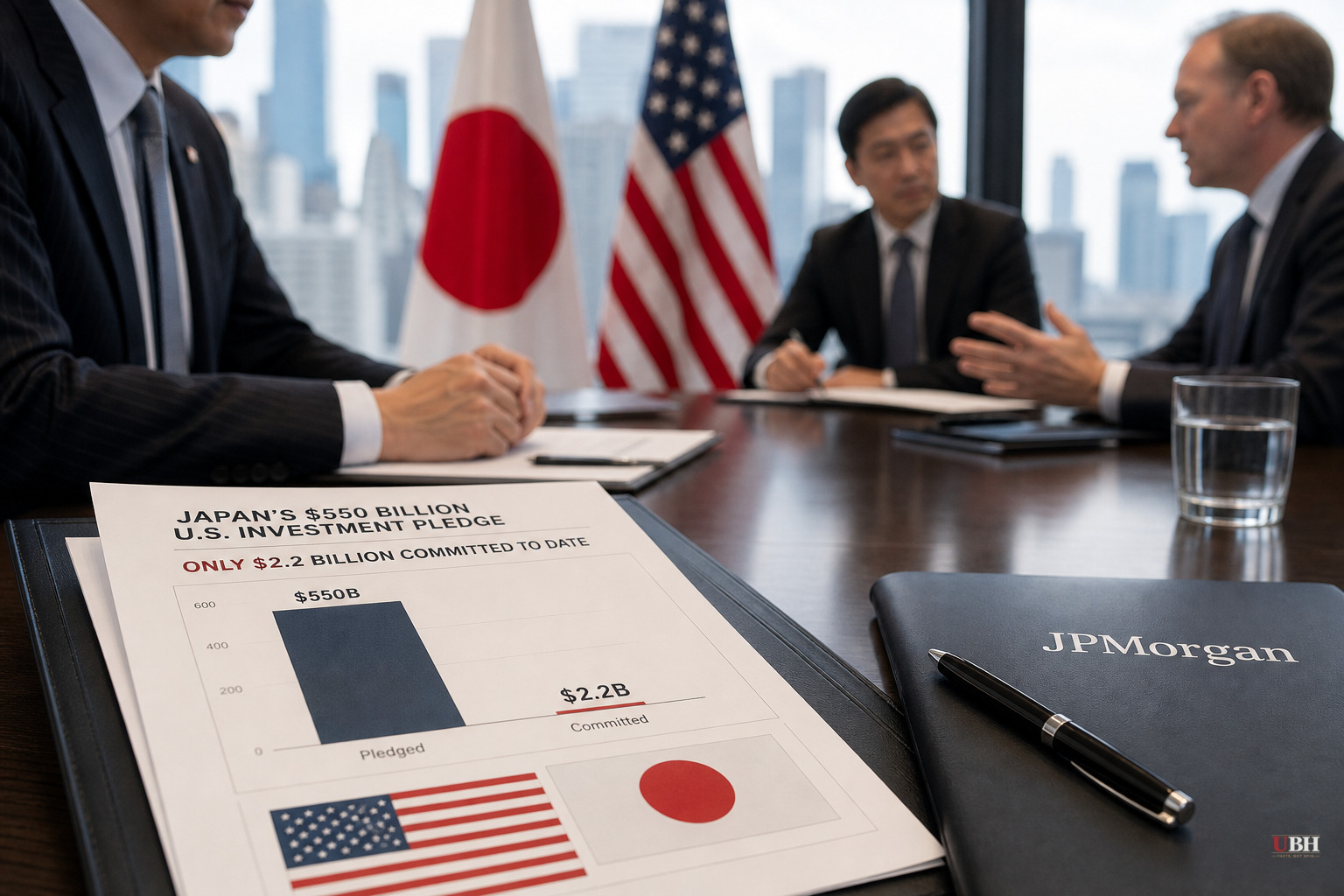
Japan struck a deal with President Trump in July 2025 to pledge $550 billion in U.S. investment. In exchange, Trump agreed to cap tariffs on Japanese exports at 15% instead of the 25% he'd threatened.
A year later, the money is barely moving.
According to Reuters, JPMorgan Chase and other U.S. banks are close to agreeing to help finance pieces of that $550 billion pledge, based on two people familiar with the discussions between the lenders and the Japanese government. The talks center on roughly $33 billion in natural gas power projects planned for Pennsylvania and Texas.
Japan's own megabanks, Mitsubishi UFJ Financial Group, Sumitomo Mitsui Financial Group, and Mizuho Financial Group, hold most of their balance sheets in yen. Building power plants in Pennsylvania and Texas requires dollars, and lots of them, for decades-long infrastructure loans. Converting yen into that kind of long-term dollar funding is expensive.
Reuters reported that all three megabanks have told the Japanese government that even with government guarantees on their loans, securing long-term dollar funds "is expensive and limits their ability to extend credit elsewhere." Translation: Japan's biggest banks are maxed out on how much dollar risk they can comfortably carry.
Only $2.2 Billion Committed So Far
Of the $550 billion pledge, only $2.2 billion in financing has actually been committed, and that's just for the first batch of projects unveiled back in February, according to Reuters. Roughly a third of that came from the state-backed Japan Bank for International Cooperation, with the megabanks covering the rest.
$2.2 billion against a $550 billion promise is less than half a percent. Even measured against just the $33 billion natural gas project target, it's a fraction, as Crypto Briefing noted in its coverage.
Big announcements are cheap. Wiring dollars into special-purpose companies to build gas plants in Pennsylvania takes years and requires banks willing to eat currency risk.
NEXI Guarantees Are the Workaround
To get JPMorgan and other foreign lenders to the table, Japan is dangling guarantees from Nippon Export and Investment Insurance, the country's export credit agency, according to Crypto Briefing. NEXI backing would let the Japanese government absorb much of the default risk, making it easier for American banks to extend dollar credit without taking on the full exposure themselves.
Japan's government wants the projects built. American banks have the dollar liquidity. NEXI guarantees bridge the gap. JPMorgan did not respond to a request for comment, according to Reuters.
Japan's Ministry of Economy, Trade and Industry told Reuters that no decisions have been made on U.S. bank participation and that any such decisions rest with the U.S. banks themselves. The ministry also said Tokyo has not yet finalized a third batch of candidate projects, and that bilateral talks are ongoing.
Political Pressure Is Real
Reuters reported that Washington has sent Prime Minister Sanae Takaichi's government a list of candidates for additional projects under the investment scheme, and that Tokyo is eager to show progress. There's a reason for the urgency. Trump has shown he'll revisit tariff threats when he thinks a trading partner isn't delivering. He vowed in January to hike tariffs on South Korea over a similar dispute, then walked it back, according to Reuters.
That history gives Japan every incentive to get dollars flowing into American energy projects fast, even if it means leaning on U.S. banks to do work Japanese banks would normally handle themselves.
The strongest case for skepticism is that a $550 billion figure was always going to be more marketing than mechanism. Cross-border infrastructure financing at this scale takes years to structure, involves multiple government agencies, and depends on private banks agreeing to terms that make commercial sense. NEXI guarantees help, but they don't eliminate the underlying cost of converting a yen-based banking system into a dollar-based one overnight.
None of this means the deal is collapsing. Pennsylvania and Texas both have the regulatory frameworks and rising electricity demand, driven partly by data centers, that make these projects commercially attractive regardless of the political backdrop, as Crypto Briefing pointed out. The pace of actual capital deployment, $2.2 billion after a year, against a $550 billion pledge, is the number that matters most right now.
Whether JPMorgan and other U.S. banks finalize their role, and how much of the $33 billion gas-plant financing they actually take on, remains unresolved. Reuters could not determine the specific dollar amount U.S. banks might supply or which projects they'd back, and it's unclear whether the Trump administration is directly involved in those bank-level negotiations.
Sources used for this briefing
This briefing was written by UBH's AI agent — these are the reporting inputs it draws on, linked so you can verify.


