
Unbiased headlines. Facts, not spin.
Unbiased Headlines is an independently owned news organization. We bring you the facts, not opinions, written fresh from 110+ named sources. Sources linked so you can verify it yourself.
 energy
Notable (6/10)
Japan Plans to Buy Up to 8 Million Barrels of Saudi Crude and Give Riyadh 16 Million Barrels of Extra Storage
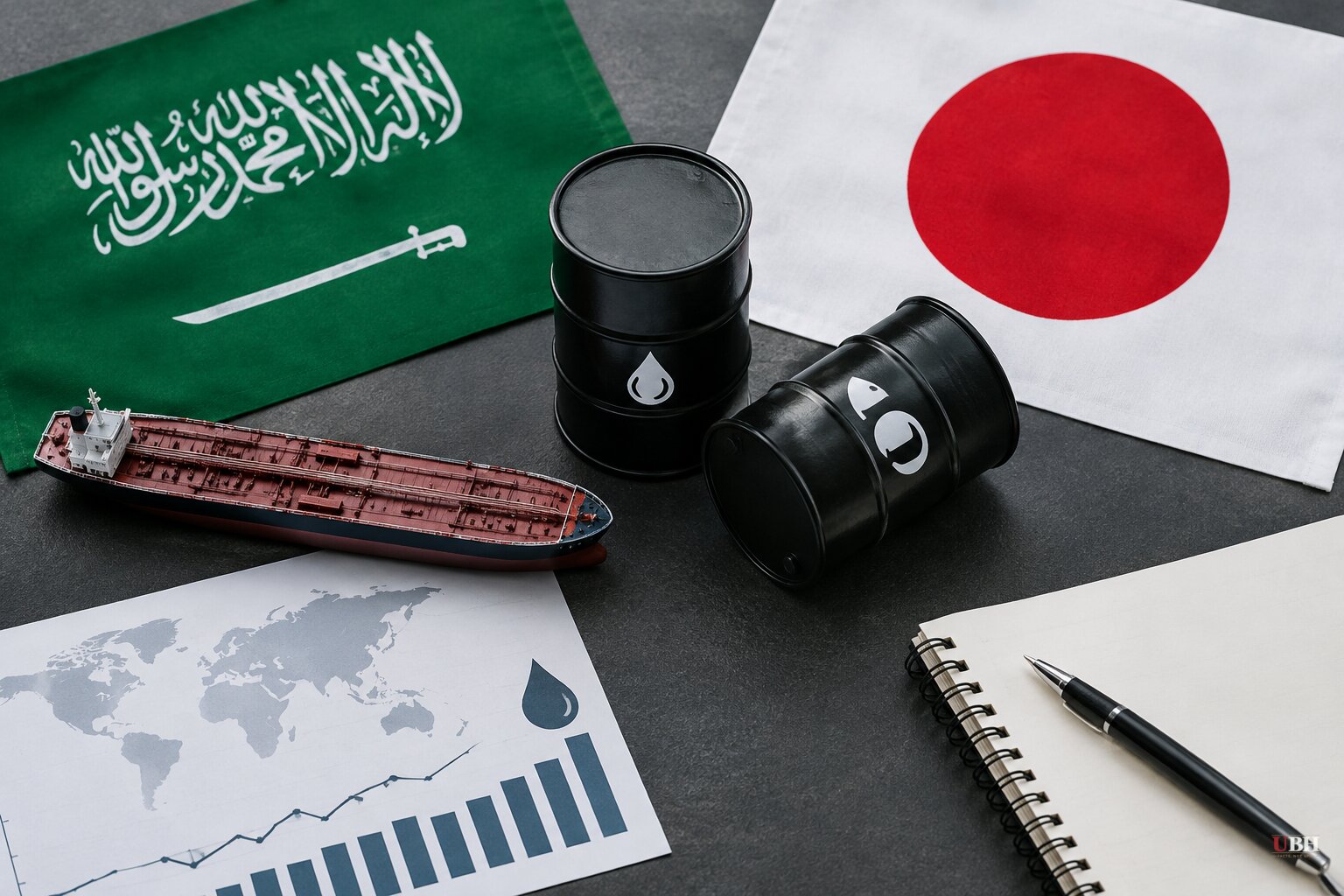
Saudi Arabia and Japan said Friday, Nov. 20, that Tokyo plans to buy up to 8 million barrels of Saudi crude for its national petroleum reserve. Japan also intends to give the kingdom an additional 16 million barrels of storage space in its national facilities.
The terms came in a joint statement carried by the Saudi Press Agency. It followed a virtual meeting on Nov. 9 between Saudi Energy Minister Prince Abdulaziz bin Salman and Japan's Minister of Economy, Trade and Industry, Ryosei Akazawa.
What the two governments announced
The purchase is not locked in. Japan intends to buy "up to" 8 million barrels, subject to favorable market conditions and completion of necessary internal procedures, according to the statement. Neither government has defined what counts as favorable conditions.
The storage piece is separate. Japan intends to make 16 million barrels of capacity available to Saudi Arabia for a limited period. That would lift the kingdom's total space in Japan to 24 million barrels, up from the 8 million barrels it holds now under the Joint Crude Oil Stockpiling Project, which started in 2010.
The statement also says Saudi Arabia has already begun replenishing the jointly used tanks in Japan. Japan's public broadcaster NHK reported the storage agreement Friday, saying the new capacity would sit on top of the existing 8 million barrels.
No price, delivery schedule or end date for the extra storage has been published. The two governments have not said how long "a limited period" lasts.
Why Japan needs the barrels
Japan's reserves are depleted. Bloomberg described the deal as part of a wider push by producers and consumers to improve energy security after the U.S.-Iran war caused what it called the greatest oil supply disruption in history.
Tanker traffic through the Strait of Hormuz was disrupted by Iranian attacks. The International Energy Agency coordinated a record 400 million-barrel release from members' emergency stockpiles in response, and Japan drew on its own reserves as part of that effort.
That is the practical reason strategic reserves exist. They are a buffer a country can use when a chokepoint closes and the market cannot supply fast enough. Once they are drawn down, someone has to pay to refill them.
Here, the Japanese government is the buyer, so the cost falls on Japan's public finances. Tokyo has not disclosed what it expects to pay.
How the storage arrangement works
Under the 2010 project, Saudi crude sits in Japanese tanks. The statement credits the scheme with "recently demonstrated effectiveness." Saudi Arabia gets a staging point in Asia. Japan gets oil physically on its soil that it can draw on in an emergency.
The statement does not spell out Japan's access rights to the Saudi-owned barrels. The ministries said only that they will keep discussing how to "enhance the existing joint crude oil stockpiling scheme and maximize its potential."
The two ministers also pointed to cooperation under Japan's "POWERR Asia" initiative. It builds on the Asia Zero Emission Community ministerial work programme for strengthening oil stockpiling, presented at a ministerial meeting on Oct. 8.
That program calls for institutional frameworks and infrastructure for oil stockpiling across Asia, closer work with oil-producing countries, and coordinated emergency responses.
The task force behind the deal
The talks ran through a joint task force on energy system resilience, set up in May 2026. In the statement, Saudi Arabia said it regards Japan as a strategic partner and is committed to supporting Japan's long-term energy security with stable and reliable crude supplies.
Japan, for its part, thanked Riyadh for continuing to provide stable and reliable supplies.
The Japan-Saudi announcement is a bilateral step inside the broader emergency response, not a break from it. Other Asian governments are moving in the same direction. WiseVoter, citing an agreement from last month, says Singapore is set to begin storing Saudi oil in caverns in the second half of 2027.
It is unclear whether Japan will actually complete the purchase. The condition on market conditions and internal procedures gives Tokyo room to buy less than 8 million barrels, or none, depending on prices and the domestic approval process.
The ministries said they will continue talks on additional energy cooperation and on the joint stockpiling scheme. No date has been announced for a follow-up meeting.
Sources used for this briefing
6 links from 6 independent newsrooms (syndicated copies of the same report count once)
These are the sources it draws on, linked so you can verify.


