
Unbiased headlines. Facts, not spin.
Unbiased Headlines is an independently owned news organization. We bring you the facts, not opinions, written fresh from 110+ named sources. Sources linked so you can verify it yourself.
 finance
Major Story (7/10)
finance
Major Story (7/10)
Jakarta Stocks Fall About 11% in Steepest Drop Since 1998 After MSCI Standalone Proposal
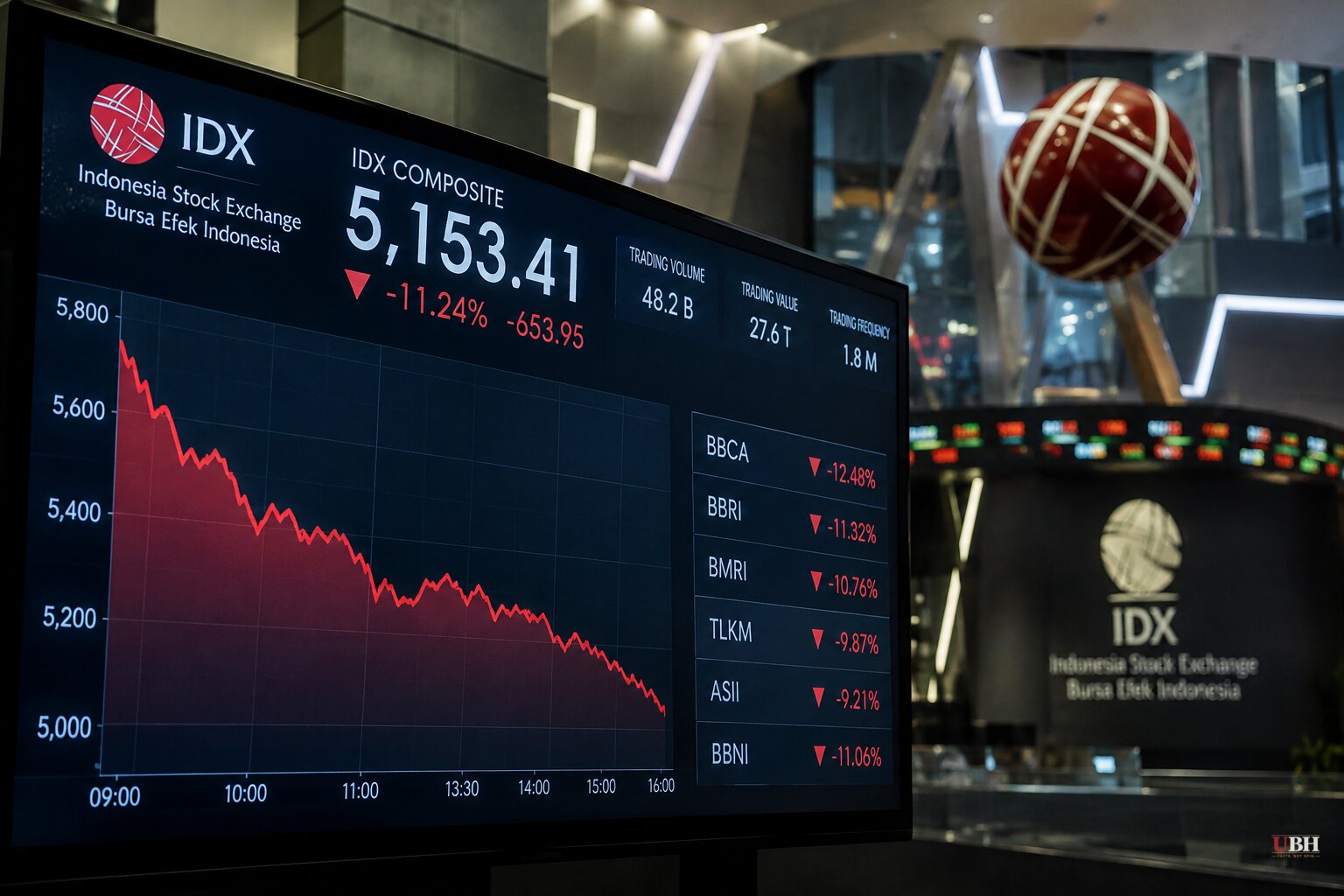
Since MSCI proposed this week to drop Indonesia from its emerging-market indexes, the market's verdict has arrived: the Jakarta Composite Index fell about 11% in Friday trading (Oct. 16), the steepest one-day decline since January 1998.
How the selloff unfolded
The index opened roughly 8% lower, which triggered a 30-minute trading halt. Per NDTV Profit's figures, it opened at 5,393.92 against a prior close of 5,863.78, then slid to about 5,233 by late morning. That is close to its 52-week low of 5,193.22 and well under the 52-week high of 9,174.47. LSEG data show it at a six-year low.
The index is now down roughly 39% to 40% for 2026, depending on the measure, making it the worst-performing major stock market this year. The rupiah slipped about 0.6% to around 18,070 per dollar, its weakest since late July. The record low is 18,209, hit in June.
Foreign investors have net sold between $4.7 billion and $4.9 billion of Indonesian stocks this year, according to Reuters and Bloomberg figures. That puts 2026 on track for record foreign selling.
What MSCI said
MSCI said in its statement that "significant concerns remain around market dysfunction, including continued suspected coordinated trading behavior and lack of evidence of meaningful enforcement." It concluded that Indonesia's continued emerging-market classification is "no longer appropriate."
The index provider also said a downgrade only to frontier status "would not properly recognise the depth of the market problems." It is proposing standalone status instead. Argentina, Lebanon, Palestine, Jamaica and Panama sit in that category. Indonesia would be the first Asia-Pacific market there.
MSCI first threatened a frontier downgrade in January and froze Indonesia's index weightings. That episode set off a rout of nearly $80 billion in market value. Jakarta said in April that it had finished its reforms. MSCI says investors have not seen sufficient, consistent progress.
The freeze on index changes stays in place. MSCI will not raise foreign inclusion factors, add securities to the Indonesia Investable Market Index, or allow upward size migrations. It will keep deleting securities that Indonesian authorities flag under their high-shareholding-concentration framework.
The money at stake
UBS estimates removal could trigger about $4 billion of passive outflows, with active investors potentially adding $15 billion. Citi analysts wrote that standalone status would be "unambiguously worse" than a frontier downgrade. There would be no frontier-fund inflow to offset selling, and every remaining passive dollar benchmarked to emerging markets would have to leave.
Jakarta pushes back
Senior Economic Minister Airlangga Hartarto said there is "a big question mark" over why MSCI never raised standalone status in a meeting with Indonesian officials in Bangkok this week. He spoke ahead of a gathering of the finance minister, the central bank governor and other officials to work out a response.
The Indonesia Stock Exchange said it "respects MSCI's independence" but will ask for clarification of the basis for the announcement. It noted the proposal is part of a consultation open until April 30, 2027, and "does not constitute a final decision." CEO Jeffrey Hendrik said the exchange has taken concrete steps to improve transparency and integrity.
Angus Mackintosh, an ASEAN specialist at Aletheia Capital in Singapore, argued the move does not reflect the health of most listed companies or the economy. "Grouping Indonesia with Lebanon, Palestine, and Argentina does not make sense," he said. He also called the episode "a wake-up call for Indonesia."
MSCI has said it expects to proceed unless the consultation shows "clear evidence of material improvements in market governance and functioning." The reforms on the table include disclosure of holders above 1%, more detailed investor classification, high-concentration reporting and a roadmap to a 15% minimum free float.
Pressure on Prabowo's government
The market shock lands on a government already under strain. Moody's and Fitch both cut their outlooks on Indonesia's sovereign rating to negative this year. Reuters reported that the agencies cited reduced policymaking credibility, and Dow Jones reported they also pointed to expansive government programs that could strain public finances. MSCI's proposal adds a second outside judgment on how Indonesia governs its capital markets.
MSCI scheduled its regular review for November 2026. This move came about a month ahead of it, which Reuters said stunned investors and irked Jakarta officials. The next markers are the outcome of the Indonesian officials' meeting, the exchange's request for clarification, and the April 30, 2027 consultation deadline. MSCI will announce its final decision by June 30, 2027, and may issue an interim update on investor feedback before then.
Sources used for this briefing
8 links from 8 independent newsrooms (syndicated copies of the same report count once)
These are the sources it draws on, linked so you can verify.


