
Unbiased headlines. Facts, not spin.
Every story is an unbiased news briefing written from 110+ sources across the spectrum — sources linked so you can verify it yourself.
 energy
Notable (6/10)
June 21, 2026 at 04:39 AM
energy
Notable (6/10)
June 21, 2026 at 04:39 AM
Iraq Locks In Syria Oil Route as Permanent Strategy, Not Just a Wartime Workaround
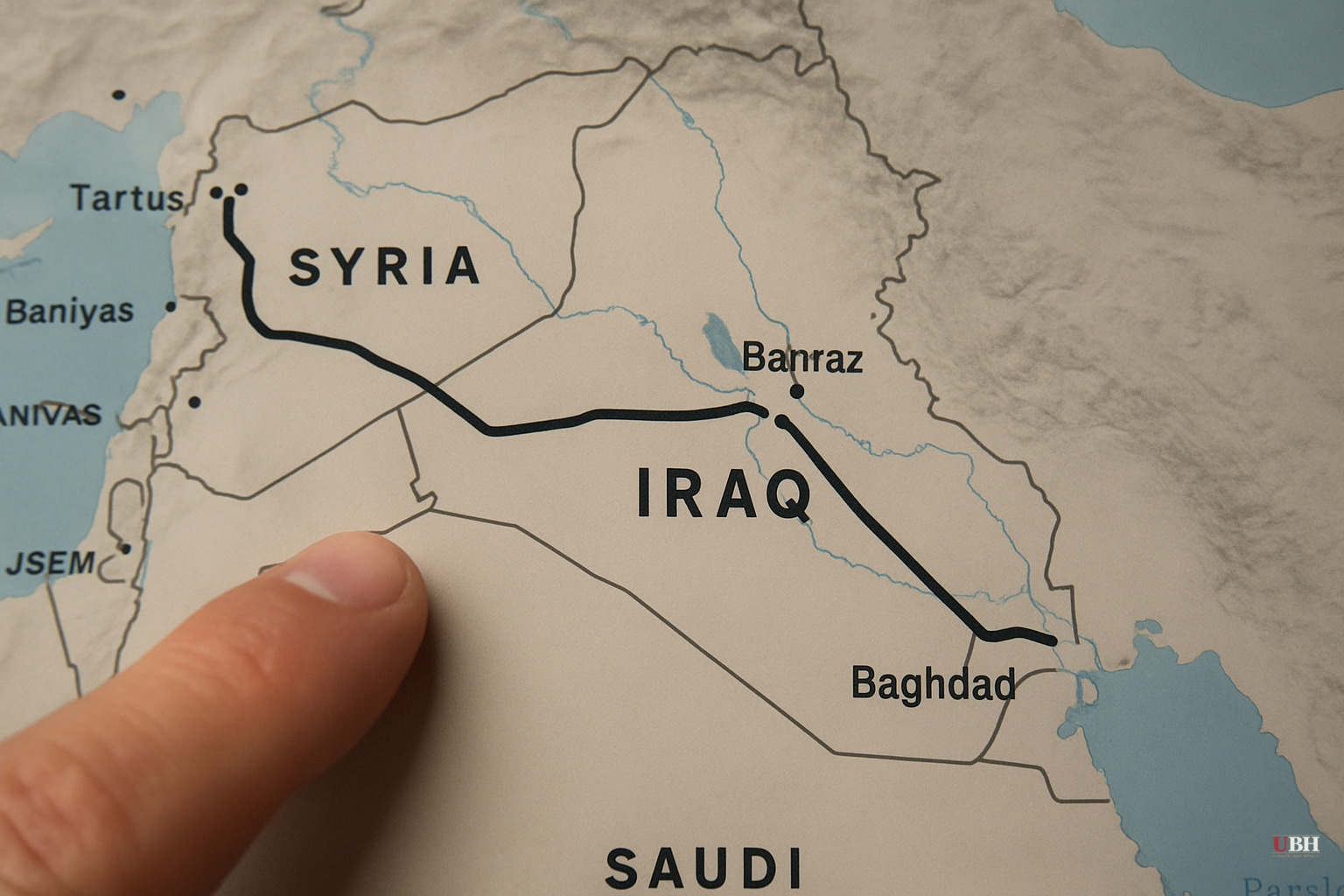
Since the Strait of Hormuz was effectively closed by the U.S.-Iran conflict earlier in 2026, Iraq has been scrambling to get its oil to market through Syria. That scramble has since hardened into deliberate long-term policy.
Iraq's oil ministry spokesperson Saleem Al-Rikabi told Reuters that the Iraqi government "attaches the highest importance to diversifying crude export routes, particularly through Syrian territory." Two Iraqi oil officials confirmed to Arab News that the Syria routing will continue even after the war ends and Hormuz reopens.
The Trucking Operation Is Already Running
The overland route went operational in April 2026. Iraq's State Oil Marketing Organization, SOMO, contracted for 650,000 metric tons of fuel oil per month from April through June, moving by tanker truck across the al-Waleed/al-Tanf crossing into Syria, then to the Mediterranean port of Baniyas.
At peak, 500 to 700 tanker trucks per day were crossing, according to Energy News Beat. Syria's Baniyas port has since expanded capacity to handle an average of 900 trucks per day, according to Syrian Petroleum Company deputy CEO Ahmad Kobbaji and media office head Mohammed Al-Ahdab.
Crude oil and naphtha shipments, distinct from the fuel oil already flowing, are targeted at 50,000 barrels per day once loading infrastructure is ready, with tanker-truck exports expected to begin in early July 2026. SOMO is also set to open offices at Baniyas.
In April, Iraq was moving just 10,000 to 15,000 bpd through alternative channels total. By June, according to Crypto Briefing, that figure had climbed to roughly 140,000 bpd, up from approximately 122,000 bpd in May. Progress, but still a fraction of the 3.4 million bpd that historically flowed through southern Basra terminals.
The Longer Pipeline Play
Trucking is a stopgap. The real ambition is pipeline infrastructure, and Iraq is moving on three fronts simultaneously.
The existing Kirkuk-Baniyas pipeline through Syria has a design capacity of up to 300,000 bpd. War damaged much of it. Iraq and Syria have set up joint technical committees to assess restoration, though Energy News Beat notes the timeline is multi-year and costs are significant.
The Kirkuk-Ceyhan pipeline through Turkey is already moving an estimated 200,000 to 300,000 bpd. The Iraqi cabinet has approved accelerating flows toward 770,000 bpd in phases, according to Energy News Beat.
The most consequential project is the Basra-Haditha pipeline. At roughly 685 to 700 kilometers, connecting southern Basra fields to northern export networks, it would carry up to 2.5 million bpd. Cost estimates run $4.6 to $5 billion. Iraq approved a direct bidding process in 2026 and work has advanced. If built out fully, it would route the bulk of Iraq's southern production to Turkey and Syria without touching the Gulf.
Why Iraq Is Committed Even After Hormuz
Oil revenues account for roughly 90% of Iraq's national budget, according to Crypto Briefing. Depending on a single chokepoint that a regional conflict can shut overnight is not a strategy. It's a vulnerability. Baghdad learned that lesson hard in early 2026.
The strongest counter-argument is operational. These routes are slower, more expensive, and logistically complex compared to supertanker exports through the Gulf. Trucking 900 tanker loads per day is expensive and exposed to road security risks. The Syria-Iraq border region is not exactly a stable operating environment. Critics of the plan could reasonably argue that investing billions in pipeline infrastructure through a country just emerging from civil war, under a government not yet fully consolidated, introduces a different set of political and security risks in exchange for eliminating the Hormuz risk.
Syria's infrastructure is war-damaged. The new Syrian government's stability is unproven at scale. An interdiction or political rupture along the overland route could strand Iraqi crude just as effectively as a Hormuz closure.
But Baghdad's position, stated explicitly to Reuters by Al-Rikabi, is that diversification itself is the point. A second vulnerable corridor is still better than one. And for Iraq, the political calculus is also different from Saudi Arabia or the UAE. Iraq's relationship with Iran means its strategic position inside a Hormuz-dependent framework was always more complicated.
Scale vs. Market Impact
For global oil prices, the math is limiting. Iraq's current 140,000 bpd through alternative routes is effectively invisible against a global market consuming around 100 million bpd, as Crypto Briefing noted. Even the 2.5 million bpd Basra-Haditha pipeline capacity, if fully realized years from now, would matter at the margin only if Hormuz simultaneously remained constrained.
The more immediate unresolved question is whether Syria can sustain and expand the infrastructure it has committed to. Syrian Petroleum Company's Kobbaji acknowledged to Reuters in May that Syria's infrastructure is limited. Two additional unloading areas at Baniyas are reportedly set to open within weeks, but whether Syria can operationalize facilities at the pace Iraq needs, while simultaneously managing its own post-war reconstruction, has not been tested at scale.
SOMO's planned office opening at Baniyas will be a concrete indicator of how seriously Baghdad treats this as permanent. Bureaucracies don't plant flags in cities they plan to leave.
Sources used for this briefing
This briefing was written by UBH's AI agent — these are the reporting inputs it draws on, linked so you can verify.


