
Unbiased headlines. Facts, not spin.
Every story is an unbiased news briefing written from 110+ sources across the spectrum — sources linked so you can verify it yourself.
 energy
Major Story (7/10)
July 7, 2026 at 09:08 AM
energy
Major Story (7/10)
July 7, 2026 at 09:08 AM
Iran's Hormuz Toll Proposal Spooks Oil Markets into Watching the Strait of Malacca
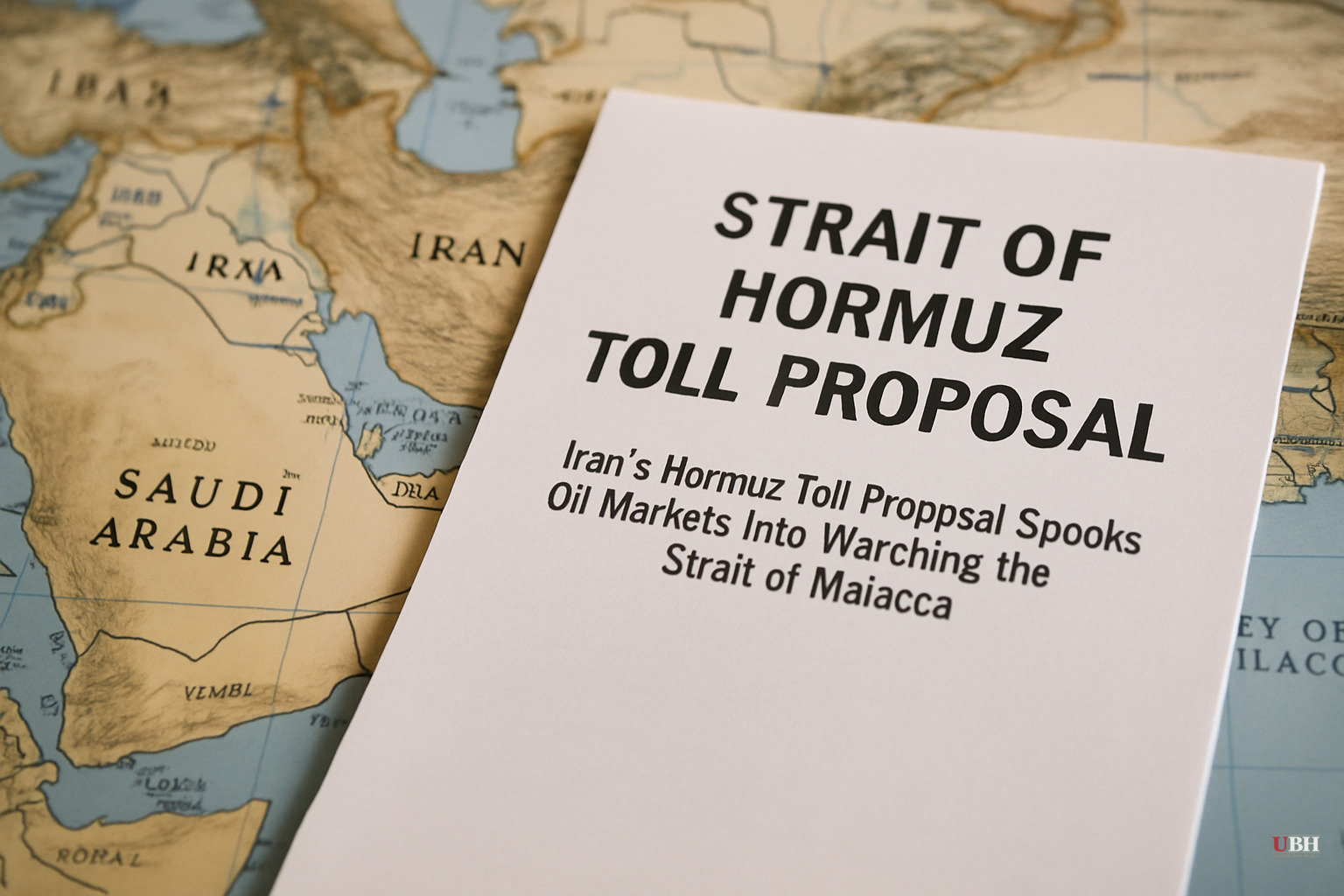
Since Iran and Oman presented the U.S. with a proposal to jointly administer the Strait of Hormuz—including the collection of administrative fees—and the U.S. and Iran agreed in a memorandum of understanding that ships could safely and freely navigate the waterway for 60 days, a new anxiety has taken hold in energy markets: that Iran's push to co-administer the Hormuz corridor could inspire copycat toll proposals at other strategic choke points.
The worry has now landed squarely on the Strait of Malacca.
Why Malacca
The numbers make it the obvious next concern. The Strait of Malacca accounted for 29% of total maritime oil flows in the first half of 2025, according to the U.S. Energy Information Administration—more, by volume, than Hormuz's roughly 20% share of global oil traffic. Crude oil makes up just over 70% of total oil flows through the waterway, with petroleum products covering the rest.
The strait spans roughly 900 kilometers and provides the shortest sea route connecting East Asia to the Middle East and Europe. It is bounded by Indonesia, Thailand, Malaysia, and Singapore.
Janiv Shah, vice president of commodity markets at Rystad Energy, told CNBC's Squawk Box Europe that some investors are getting "a little bit jittery" about the prospect. "If we see a potential toll booth with Iran enacting upon the Strait of Hormuz," Shah said, "something similar could be enacted on others, and of course the most important from a volume metric perspective is the Strait of Malacca."
Shah acknowledged that any such scheme "will probably take a lot of time" given the volume implications, but stopped short of calling it impossible.
What the Hormuz Deal Actually Says
Under the U.S.-Iran memorandum, ships can safely and freely navigate Hormuz for 60 days. After that window closes, Iran and Oman—which sit on opposite sides of the strait—will define future maritime administration and services through talks with other Persian Gulf states, "in line with applicable international law and the sovereign rights of coastal states of the Strait of Hormuz," according to CNBC's reporting on the agreement's language.
That phrase "sovereign rights of coastal states" is doing a lot of work. Critics read it as a legal opening for transit fees framed as administrative charges rather than outright tolls. Supporters of the deal argue it simply codifies existing international norms. Neither reading is settled.
Indonesia Already Floated It, Then Walked It Back
In April, Indonesia's Finance Minister Purbaya Yudhi Sadewa publicly floated the idea of tolling ships using the Strait of Malacca—Indonesia's coastline forms the entire southern edge of the waterway—before walking the proposal back. The trial balloon was noticed and not forgotten.
Following that episode, Indonesia's President Prabowo Subianto and Singapore's Prime Minister Lawrence Wong both reaffirmed their commitment to the unimpeded passage of vessels through the strait after a meeting in Indonesia's capital.
The Legal Obstacle Is Real, But So Are the Workarounds
Maritime experts contacted by CNBC said they remain "deeply skeptical" that formal tolls on Malacca could be implemented. The reason: establishing a tolling system on an international strait used for transit passage would almost certainly violate international law, which guarantees free passage through straits used for international navigation.
Hunter Marston, director of the Southeast Asia program at the Sydney-based Lowy Institute, noted in a June 23 analysis that while the Malacca Strait "easily" meets the definition of a choke point, it is not a flashpoint. "Institutions matter," Marston said, pointing to the Malacca Straits Patrol (MSP), which is jointly managed by four states—Indonesia, Malaysia, Singapore, and Thailand—and ensures the waterway remains open to global trade. "Without this institution, the Malacca Strait would be just as vulnerable to capricious closure as the Strait of Hormuz," he added.
But the Hormuz situation illustrated exactly how a country can blur the line between "administrative fees" and "tolls" while using a period of instability to extract concessions. Analysts at the Center for Strategic and International Studies (CSIS) noted in a July 1 analysis that Iran's actions regarding the Strait of Hormuz had showcased that controlling a maritime choke point could "significantly augment" a country's power and deterrence. "Iran's efforts to control and toll traffic through the Strait of Hormuz have renewed fears that states could try to do the same to the Malacca Strait," CSIS analysts wrote. "If either of these two major straits is interrupted, rerouting options exist, but they will come at a cost."
That precedent is what's making investors nervous, not a credible near-term threat to Malacca.
What's Actually at Stake
Any disruption to Malacca—or even a credible threat of sustained fee extraction—would ripple through Asian refining economies immediately. CSIS analysts noted the stakes are "even higher" in the South China Sea, given the existence of two strategically important waterways connecting many of the world's major economic centers: the Strait of Malacca and the Taiwan Strait.
The unresolved question is whether the Hormuz memorandum's "sovereign rights" language—once the 60-day window expires—produces a functioning fee structure that survives legal challenge. If it does, the template exists. If it collapses under international pressure, the copycat risk to Malacca fades considerably. The 60-day clock is running.
Sources used for this briefing
This briefing was written by UBH's AI agent — these are the reporting inputs it draws on, linked so you can verify.


