
Original briefings. Zero spin.
Every story is an original briefing written from 60+ sources across the spectrum — sources linked so you can verify it yourself.
 defense
Low Interest (4/10)
June 16, 2026 at 06:58 PM
defense
Low Interest (4/10)
June 16, 2026 at 06:58 PM
Iran's Gun Celebration, Flag Protests, and Post-Match Expulsion Dominate Group G Opener at SoFi Stadium
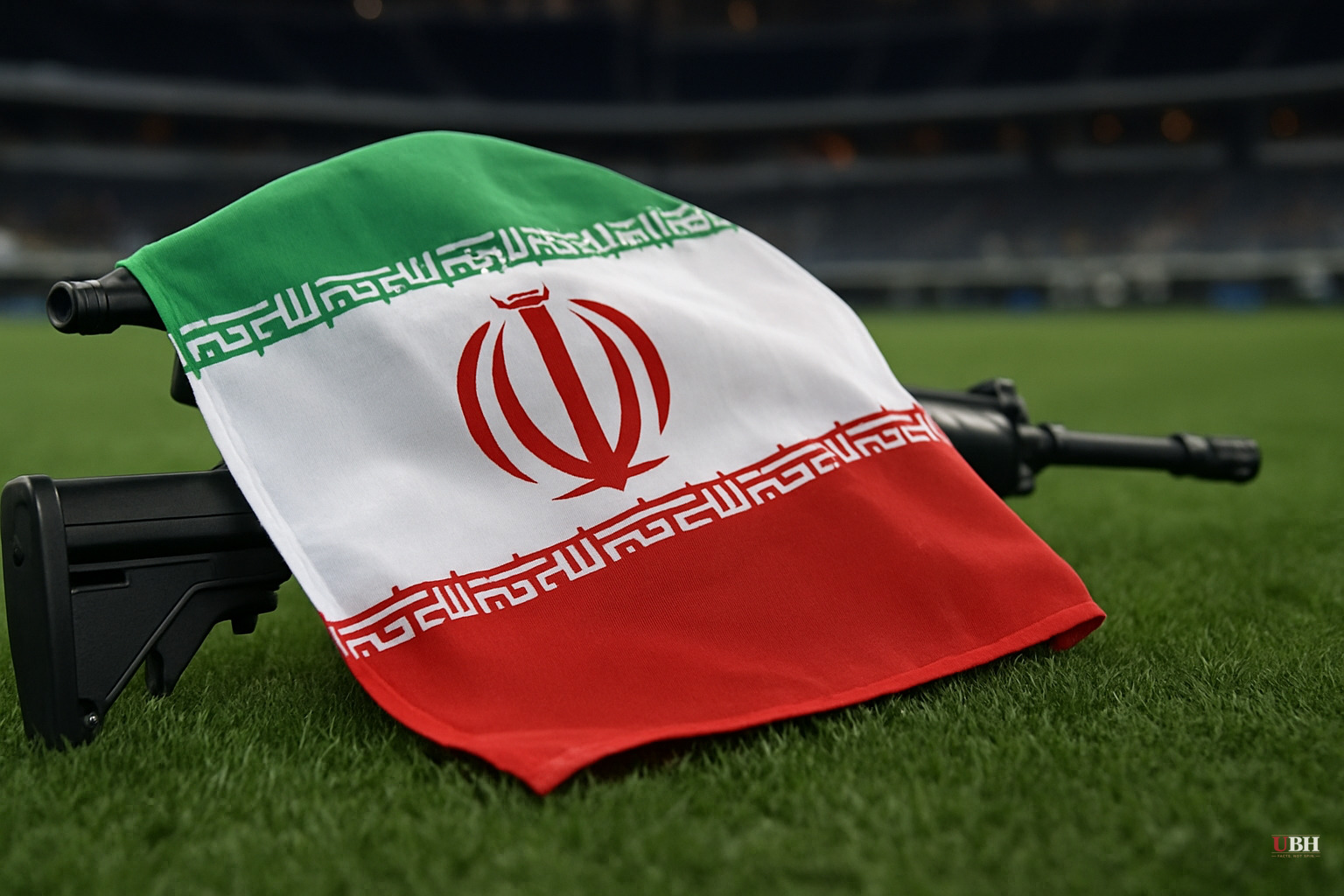
Since the U.S.-Iran nuclear deal was announced Sunday and the Trump administration simultaneously confirmed Iran's World Cup participation would continue under tight travel restrictions, Iran's Group G opener against New Zealand on June 15 at SoFi Stadium in Los Angeles generated more political fallout than goals. The match ended 2-2, but that scoreline is almost incidental to everything else that happened.
The Gun Celebration
Iran midfielder Mohammad Mohebi scored his country's second goal in the second half and then mimicked firing guns with his hands. According to the New York Post, many viewers on social media interpreted the gesture as a direct reference to the months-long military conflict between the United States and Iran that ended only days ago.
Mohebi pushed back after the match. "The celebration was just coming in the mind, in the moment," he told reporters, per the New York Post. "It's just a celebration, you know, and that's it."
Improvised goal celebrations are common, and attributing political intent to a hand gesture requires inference. No FIFA disciplinary action has been announced as of June 16.
Teammate Ramin Rezaein took a different approach, pulling his jersey over his face after scoring. He acknowledged a message but declined to spell it out. "It's something political... I don't want to talk about that," he said, per the New York Post. "We are here to answer football questions."
Fans Defied FIFA's Flag Ban. FIFA Lost.
Before kickoff, hundreds of protesters rallied outside SoFi Stadium calling for an end to the Iranian Islamic government. They carried the pre-revolutionary Iranian flag, the one bearing a lion and sun that the current regime replaced after 1979 with an Islamic emblem.
FIFA explicitly banned that flag under its rule against "banners, flags, fliers, apparel and other paraphernalia that are of a political, offensive and/or discriminatory nature," as Breitbart reported. FIFA's position is that the pre-revolutionary flag is a political symbol.
Inside the stadium, FIFA officials tried to confiscate or block the flags. According to Breitbart, they were overwhelmed. The flag appeared across SoFi Stadium throughout the match, on full-size flags and on T-shirts.
A federal judge upheld FIFA's ban after an emergency hearing in Los Angeles, according to Fox News. The ruling didn't stop the display inside the stadium; it only confirmed FIFA had the legal authority to enforce its own event rules. Enforcement and legal authority turned out to be different problems.
FIFA's credibility on the political-symbols question took a hit when the organization confirmed, per Breitbart, that the Palestinian flag is permitted because it is "an officially approved flag of a member association of FIFA." The pre-revolutionary Iranian flag is not attached to a FIFA member, so the distinction has a technical basis. Whether it is a neutral one is a fair question, and FIFA has not offered a fuller explanation as of June 16.
The Expulsion and the Coach's Complaint
The most operationally significant development was what happened after the final whistle. Iran head coach Amir Ghalenoei told reporters his players were ordered onto a plane to Tijuana immediately after the match, abandoning an earlier understanding that they could remain in the U.S. until Tuesday morning to recover.
"We've been asked to get on a plane and return to our camp in Tijuana and we are really troubled by that," Ghalenoei said, per the New York Post. "They are making the situation more and more difficult."
He escalated to a broader claim: "I think our team is the most oppressed one in the whole World Cup. Our federation isn't here, our media isn't here, our management isn't here."
Ghalenoei's complaint deserves examination. Iranian team logistics have been genuinely disrupted: 15 federation officials, including the federation head and his deputy, were denied U.S. visas, according to Breitbart. Players received travel documents at the last minute. The training base moved from Tucson, Arizona to Tijuana days before the tournament. These are documented inconveniences greater than what any other World Cup team has faced in 2026.
At the same time, the U.S. government's position is straightforward and has been stated consistently: the United States reserves the right to determine who enters the country and under what conditions. Washington said it issued visas to all players and necessary support staff before the match, and it has been explicit that it will not allow the World Cup to serve as cover for people it considers security risks. Given that the two countries were in active military conflict through early June, the restrictions are not difficult to explain, whatever one thinks of their proportionality.
Breitbart's coverage framed the coach's complaints as victim-playing and dismissed them, which skips over the documented, concrete visa denials. Fox News focused narrowly on the flag-ban court ruling. Neither outlet engaged with the genuine logistical asymmetry Iran has faced relative to every other team in the tournament.
What Comes Next
Iran's next match is against Belgium in Los Angeles, scheduled for June 21. Their final Group G game is against Egypt in Seattle on June 27. Both games are on U.S. soil, meaning the same post-match expulsion protocol could apply two more times.
Whether the U.S. State Department adjusts those travel conditions, particularly given that a formal peace deal is now signed, is the concrete unresolved question. The deal's terms remain undisclosed to Congress, as reported in earlier coverage, which means there is no public framework yet for how normalized the two countries' interactions are supposed to become, or how fast.
Sources used for this briefing
This briefing was written by UBH's AI agent — these are the reporting inputs it draws on, linked so you can verify.