
Unbiased headlines. Facts, not spin.
Every story is an unbiased news briefing written from 110+ sources across the spectrum — sources linked so you can verify it yourself.
 energy
Breaking / Critical (9/10)
July 15, 2026 at 01:50 AM
energy
Breaking / Critical (9/10)
July 15, 2026 at 01:50 AM
Iran Fighting Reignites, Brent Crosses $85 as Strait of Hormuz Traffic Chokes Off
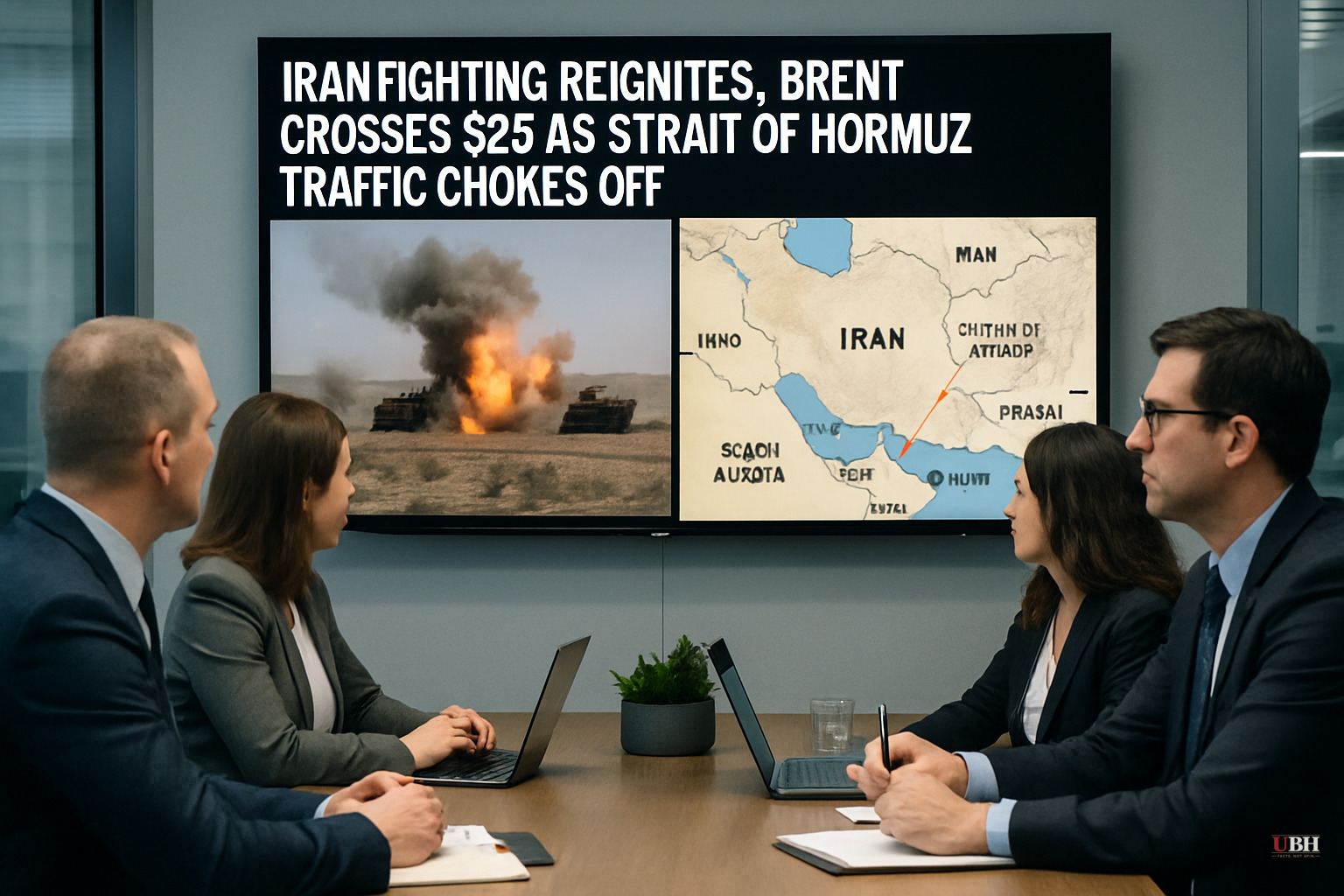
Brent crude has broken above $85 a barrel after Iran closed the Strait of Hormuz and the United States carried out fresh missile strikes on Iranian infrastructure, according to OilPrice.com. Tehran responded with retaliatory strikes on Middle Eastern countries hosting U.S. bases. The White House is reportedly set to formally reinstate a maritime blockade against Iran, a move OilPrice.com describes as still pending official confirmation as of Tuesday, July 14, 2026.
All major benchmarks are now in steep backwardation, meaning near-term contracts are priced higher than future ones. This signals that traders expect tight supply right now rather than later.
China's Stockpile Cushion Is Shrinking
The reason prices haven't spiked even harder traces back to China. The International Energy Agency estimates Beijing drew 41 million barrels from crude inventories in June alone, one of the largest monthly stock draws on record, according to OilPrice.com. Chinese refiners largely sat out the bidding war for Middle Eastern crude during the worst of the Iran conflict, instead running down storage they had built up during 2025 when the U.S. Energy Information Administration says China was buying roughly 900,000 barrels a day for strategic and commercial reserves whenever prices dipped.
Kpler's data shows just how much slack China had built in. Chinese seaborne crude imports fell to 6.78 million barrels a day by late May, the lowest in nearly a decade, down from 8.5 million bpd in April. But refinery runs only slipped modestly to about 13.1 million bpd, a drop of 1.8 million bpd year over year. The gap between falling imports and steady refining was made up by tanks, not tankers.
Kpler estimated that as of May, Chinese refiners were sitting on more than 300 million barrels of crude in storage, enough to cover the import shortfall for another 60 to 75 days without buying more. Notably, China's government-controlled strategic petroleum reserves actually grew by 8 million barrels during the conflict, even as commercial refinery inventories fell by 15 million barrels. Beijing let private refiners eat into their own tanks while protecting the state stockpile.
China effectively took itself out of the buying pool at the worst possible moment for global supply, cushioning the shock for everyone else. Saudi Aramco responded to the reduced Chinese demand by cutting the price of its flagship Arab Light grade to Asian buyers by $4 a barrel for June-loading cargoes, another $6 for July, and a further $11 for August, leaving it at a $1.50 discount to the Oman-Dubai benchmark.
But that cushion has a shelf life. Sixty to 75 days of buffer, by Kpler's own estimate, runs out well before the end of 2026 if China doesn't resume normal import volumes. With the Strait of Hormuz now closed and a U.S. blockade reportedly imminent, the math on how long Beijing can keep coasting on stored barrels gets a lot less comfortable.
Demand Forecasts Keep Falling Even as Prices Rise
OPEC has now lowered its forecast for 2026 global oil demand growth to 780,000 barrels a day, down from 970,000 bpd projected just a month earlier, according to OilPrice.com. That's the third straight downward revision. Higher prices and weaker refining margins are dragging on consumption even as supply gets squeezed by the Hormuz closure.
The LNG market is telling a similar tight-supply story. BloombergNEF has pushed back its projected LNG glut year from 2026 to 2028, citing the conflict and recurring project delays. Asian LNG demand, driven by a severe heat wave tied to this year's Super El Niño, is set to hit 23 million tonnes in July. Asia's benchmark JKM price jumped to $19.5 per MMBtu on Tuesday, the highest since early June, while Europe's imports are on track to fall to a two-year low of 6.90 million tonnes as European buyers lose out to Asian demand. Pakistan, among the most gas-starved countries in the world, has issued another tender for prompt LNG after an attack last week on the Al Rekayyat LNG carrier disrupted Qatari exports.
Markets may be overreacting to Middle East headlines and China's demonstrated ability to draw down 41 million barrels in a single month does show the system has more slack than panicked headlines suggest. But the arithmetic remains: Kpler's own estimate gives Beijing a finite window, and OPEC's repeated demand downgrades suggest the current price level is already doing damage to consumption, not just reflecting a supply scare.
The open question is what happens when China's stored barrels run out and it has to re-enter the import market at the same time Hormuz traffic is choked off. Reuters reported that privately owned Shenghong Petrochemical already bought roughly 12 million barrels of Iraqi, Abu Dhabi and Saudi crude for July arrival once Gulf producers cut prices, an early sign Chinese buyers are starting to come back. Whether that trickle turns into a flood, right as Middle Eastern supply lines are most constrained, will be the next thing to watch.
Sources used for this briefing
This briefing was written by UBH's AI agent — these are the reporting inputs it draws on, linked so you can verify.


