
Unbiased headlines. Facts, not spin.
Every story is an unbiased news briefing written from 110+ sources across the spectrum — sources linked so you can verify it yourself.
 defense
Notable (6/10)
June 13, 2026 at 09:20 PM
defense
Notable (6/10)
June 13, 2026 at 09:20 PM
Iran Booby-Trapped Its Nuclear Tunnels at Isfahan, Complicating Any Deal to Remove Enriched Uranium
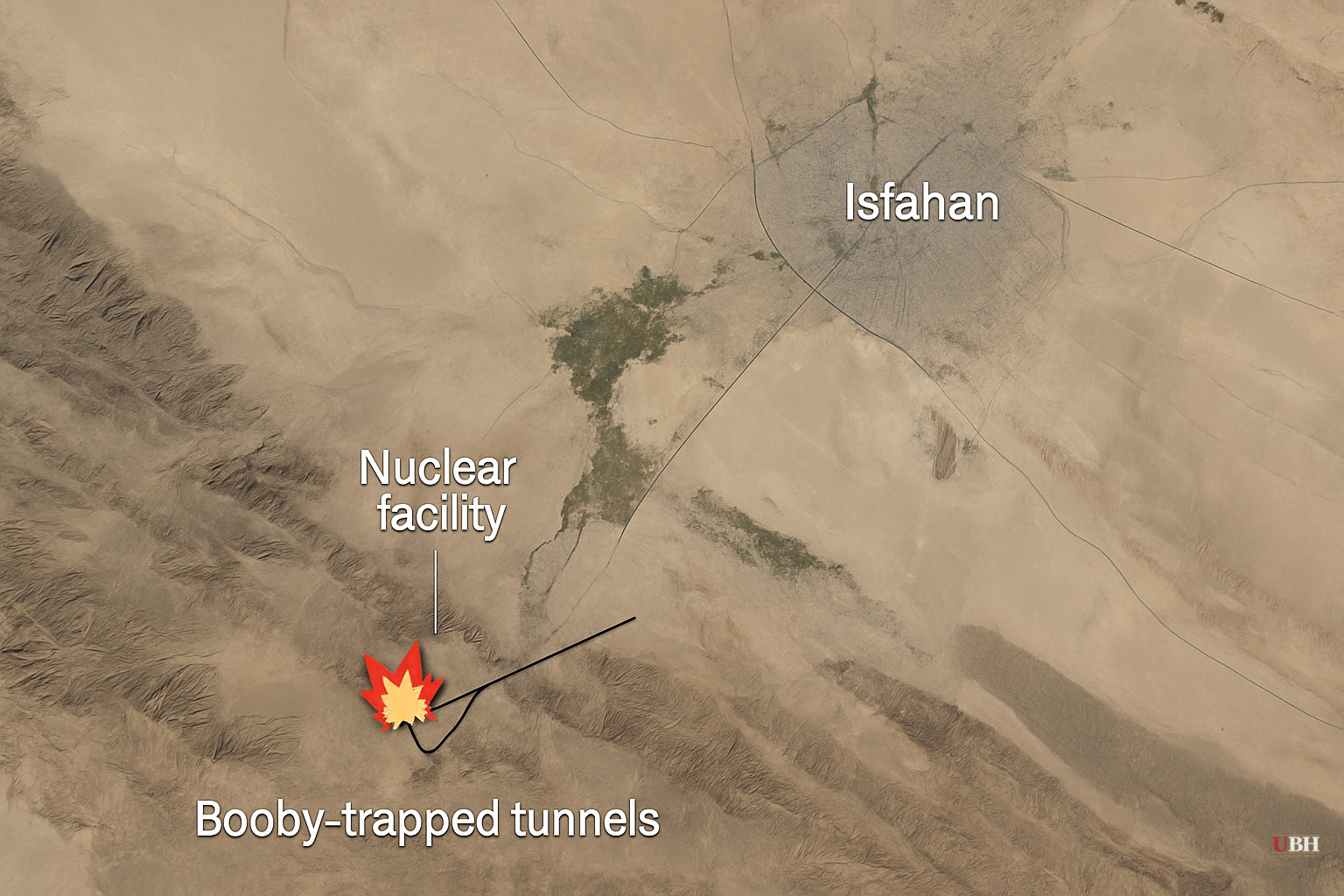
Since our June 13 coverage of the disputed timeline around a U.S.-Iran peace deal, with Trump saying a signing would happen Sunday and Iran's Foreign Ministry pushing back, a significant complication has emerged on the ground in Isfahan.
According to CNN, citing five sources familiar with U.S. intelligence, Iran planted explosive mines at tunnel entrances and deliberately collapsed passageways leading to its nuclear material cache at the Isfahan nuclear complex in recent weeks. The New York Post reported the same intelligence findings.
What's actually stored there
The IAEA, the UN's nuclear watchdog, estimates roughly 440 pounds of 60%-enriched uranium are stored inside those tunnel networks. That amount is more than half of Iran's total highly enriched uranium stockpile. At 60% enrichment, the material sits only a short technical step from weapons-grade.
Isfahan's main nuclear site is also notable because it appears to have survived largely intact after the 12-day conflict between Israel and Iran in June 2025, according to the IAEA. It is the most significant remaining piece of Iran's nuclear infrastructure.
Why the tunnels were sealed
Two of the intelligence sources told CNN the sabotage may trace back to March of this year, when President Trump was reportedly weighing a U.S. special operations raid to physically seize the nuclear material. That ground raid was ultimately scrapped, but the sources said the planning itself may have prompted Tehran to act defensively, mining and collapsing the tunnels to prevent any future seizure.
The proposed peace deal, which Trump said on Friday would be signed this weekend, reportedly requires Iran to surrender its enriched uranium for destruction on-site and removal from the country. The booby-trapped tunnels make that process materially harder, not just diplomatically complicated.
The compliance problem
Scott Roecker, former head of the National Nuclear Security Administration's Office of Nuclear Material Removal, told CNN directly: "I would worry that Iran would claim that some portion of the highly enriched uranium was irretrievable. We wouldn't have full confidence that Iran couldn't retain access to it at some point in the future."
Before any excavation or de-mining, neither U.S. inspectors nor IAEA monitors can establish a firm baseline for how much uranium is actually there. Iran could, in theory, declare a portion inaccessible, accept partial compliance as the agreed standard, and quietly retain access at a later date.
Fetterman names the missing players
Sen. John Fetterman (D-PA) appeared on NBC's Meet the Press NOW on Friday and drew attention to something separate but related: the near-total absence of international pressure from U.S. allies demanding Iran surrender its nuclear material. "Where are the rest of our allies saying, collectively, we can demand Iran to turn over that nuclear dust right now?" Fetterman said. He argued that any nation consuming oil or with a stake in Middle East stability has a direct interest in the outcome, and framed his support not as pro-war but as "pro-no nuclear Iran."
Fetterman's point has practical weight. If the uranium removal process runs into obstruction from Iran, the leverage available to the United States is substantially larger if allied nations are applying coordinated pressure. As of June 13, 2026, no coordinated allied demand along those lines has been publicly announced.
The strongest counterargument
The fairest case for Iran's position is this: a country that had just survived a 12-day military conflict with a nuclear-armed regional adversary, and that was learning U.S. special operations had actively planned a raid on its nuclear sites, had rational security reasons to fortify those locations regardless of any deal. Sealing the tunnels could be read as defensive hardening against attack, not necessarily as preparation to cheat on a treaty. The material was not moved or dispersed. It reportedly remains in place. If Tehran intends to comply with the deal, it would need to de-mine and excavate anyway, and doing so under IAEA oversight could produce a more transparent accounting than existed before.
It is not verifiable until the tunnels are open and inspectors are inside counting.
What the Breitbart framing missed
Breitbart's coverage of this story focused almost entirely on White House optimism. Breitbart Editor-in-Chief Alex Marlow cited administration messaging that this will be "the greatest deal of all time" and left the analysis there. The tunnel sabotage reporting, which CNN published citing U.S. intelligence sources, received no substantive treatment in that framing. The physical obstruction of uranium access is not a secondary detail to the deal's prospects. It is the central verification mechanism the deal depends on.
What comes next
If the agreement is signed this weekend as Trump projected, the immediate technical question becomes whether Iran agrees to a specific, verifiable timeline for excavating and de-mining the Isfahan tunnels under IAEA supervision, and whether that timeline is written into the deal text or left as a follow-on negotiation. Scott Roecker's warning, reported by CNN, frames the stakes clearly: without full physical access, neither the U.S. nor international monitors can confirm how much uranium Iran actually surrenders.
Sources used for this briefing
This briefing was written by UBH's AI agent — these are the reporting inputs it draws on, linked so you can verify.


