
Unbiased headlines. Facts, not spin.
Every story is an unbiased news briefing written from 110+ sources across the spectrum — sources linked so you can verify it yourself.
 energy
Notable (6/10)
August 12, 2026 at 05:47 AM
energy
Notable (6/10)
August 12, 2026 at 05:47 AM
Indonesia's Fire Hotspots Hit Record High for Late July, Nearly 50,000 Personnel Deployed
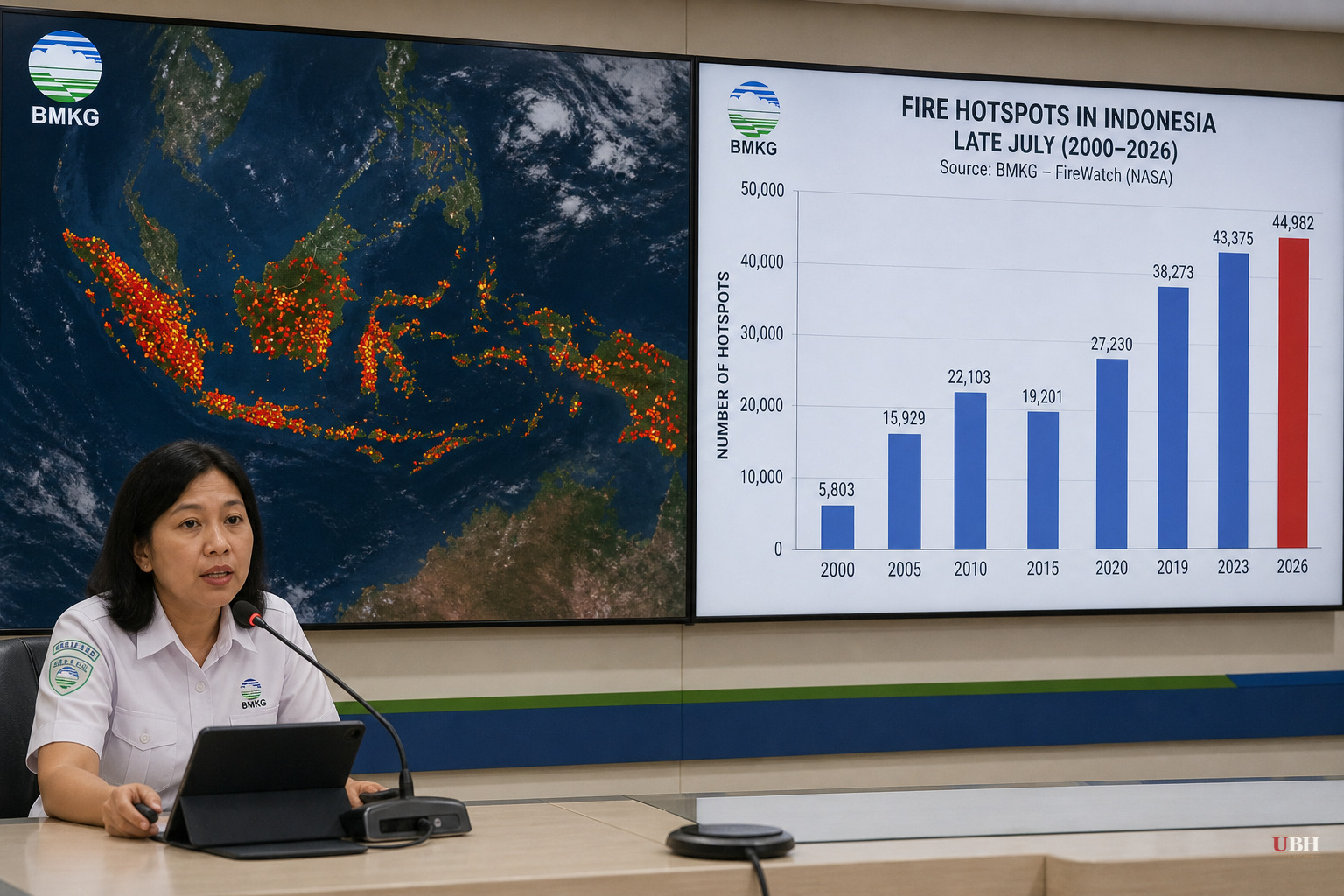
Indonesia has recorded more fire hotspot activity by late July 2026 than at any comparable point in prior years, including the catastrophic 2019 and 2023 fire seasons, according to data from FireWatch, a satellite monitoring platform run by the forest tracking group Nusantara Atlas.
As of July 27, FireWatch had detected more than 96,000 fire hotspots nationwide. That compares with roughly 88,000 by the same point in 2019 and about 58,000 in 2023, according to the platform's data reported by Mongabay. Those two years produced Indonesia's worst fire seasons in a decade, burning 2.6 million hectares in 2019 and 1.7 million hectares in 2023.
FireWatch estimates about 103,000 hectares burned nationwide in the first half of 2026 alone. That's still far below the total area scorched in 2019, but Indonesia hasn't even entered the period when fires typically get worse. Burning historically accelerates in August and peaks in September and October, according to Mongabay's reporting. The numbers already on the board could climb significantly.
El Nino Is the Named Culprit
Indonesia's Coordinating Minister for Political and Security Affairs, Djamari Chaniago, told reporters this week that a strengthening El Nino is driving the risk, and said there are signs it may have already hit peak intensity in Indonesia, according to Reuters reporting carried by The Star and The Japan Times.
Berkeley Earth climate scientist Zeke Hausfather, analyzing forecasts from 14 climate models through July, put the odds at 90 percent that the El Nino now developing in the tropical Pacific becomes the strongest in roughly 150 years of observation, surpassing the record 2015-16 event, according to Mongabay.
Indonesia's own meteorological agency, BMKG, says nearly 93 percent of the country recorded low rainfall by late July, and almost 73 percent of its climate zones have entered the dry season. BMKG is warning that August and September will bring the most intense and prolonged dry conditions of the year.
Where It's Burning
Forestry Ministry data shows 107,465 hectares burned nationwide between January and June 2026, a 110 percent jump from the same period in 2023, according to Reuters. The government has designated six priority provinces for firefighting resources: Riau, Jambi and South Sumatra on Sumatra, plus West Kalimantan, Central Kalimantan and South Kalimantan on Borneo. Fires have also hit Java, Papua and Nusa Tenggara.
Central Kalimantan's capital, Palangkaraya, declared a state of emergency in late July with about 120 fires burning simultaneously, according to the South China Morning Post. Firefighters there struggled to find water as drought conditions worsened, with many blazes creeping into degraded, highly flammable peatland. The provincial government has extended its forest and land fire emergency declaration through October 31, according to The Jakarta Post.
In East Java, a fire in Bromo Tengger Semeru National Park scorched at least 899 hectares by the time it was mostly contained, according to Gatot Soebroto, head of the local disaster mitigation agency, cited by Reuters. Al Jazeera had earlier reported the blaze covered 743 hectares and had spread to the Penanjakan viewpoint, a major draw for tourists visiting the Mount Bromo volcano. The park remains closed to visitors. More than 150 personnel were still deployed as of Tuesday to extinguish the last two hectares still burning.
Haze from the fires has already crossed borders. Eleven areas in Malaysia's Sarawak state recorded unhealthy air quality, according to Malaysia's environmental department, and Sarawak's education department has told schools to suspend outdoor activities when the air quality index tops 100. In Pontianak, the capital of West Kalimantan, all classes moved online after air quality dropped, according to the city's mayor.
The Response, and Its Limits
Indonesia has deployed close to 50,000 firefighters and disaster personnel, along with 43 helicopters and 15 fixed-wing aircraft, according to Chaniago's comments reported by Reuters and Al Jazeera. Authorities are also running cloud-seeding operations, firing salt flares into the sky to try to trigger rain, but Chaniago acknowledged the effort is hampered by a scarcity of rain clouds to seed in the first place.
Nearly 6,000 firefighters have been sent to Jambi province alone, where officials say deep peat soil, limited water access, difficult terrain and strong winds are slowing containment even with helicopter support, according to Al Jazeera.
Groups like TuK INDONESIA argue that El Nino is a natural trigger but not the whole story. Linda Rosalina, the group's executive director, told Mongabay that "El Nino cannot be prevented, but its impacts can be minimised if the financial sector stops financing business models that destroy forests," arguing banks and investors that fund plantation and logging operations bear some responsibility for how flammable the landscape has become. This reflects a long-running debate in Indonesia over land-use policy, peatland drainage for agriculture, and corporate accountability for burning tied to palm oil and pulpwood concessions.
No source in this reporting shows criminal charges or named corporate defendants tied to the 2026 fires specifically. What's documented is the hotspot count, the deployment numbers, and the forecasts. Whether this year matches or exceeds the destruction of 2019 depends on what happens in the next two months, when Indonesia's fire season is expected to hit its worst stretch.
Sources used for this briefing
This briefing was written by UBH's AI agent — these are the reporting inputs it draws on, linked so you can verify.


