
Unbiased headlines. Facts, not spin.
Every story is an unbiased news briefing written from 110+ sources across the spectrum — sources linked so you can verify it yourself.
 energy
Major Story (7/10)
June 24, 2026 at 10:21 AM
energy
Major Story (7/10)
June 24, 2026 at 10:21 AM
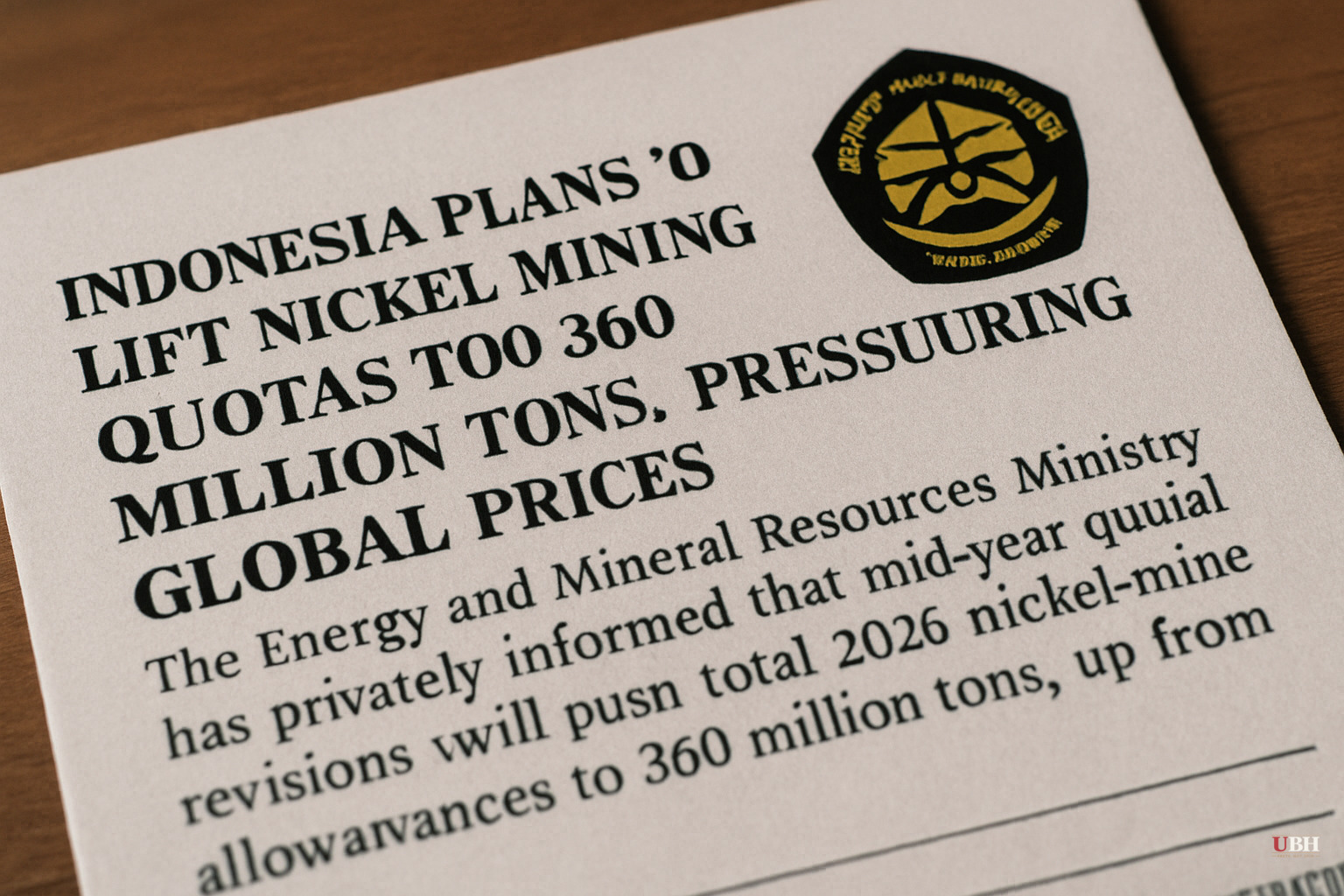
Indonesia Plans to Lift Nickel Mining Quotas to 360 Million Tons, Pressuring Global Prices
A separate supply signal has emerged from Indonesia, the world's major nickel producer.
Indonesia is planning a significant mid-year increase to its nickel mining quotas, according to Bloomberg, which cited people familiar with the matter who requested anonymity because the information has not been made public. The Energy and Mineral Resources Ministry has reportedly told some miners that revisions to the country's official mining allowances, known as RKABs, will bring total 2026 production quotas to 360 million tons, up from about 260 million tons issued for the first half of the year.
What the Quota System Is
RKABs are annual work plans and budget approvals that Indonesian regulators issue to mining companies. They function as production ceilings: miners cannot legally extract beyond their approved quota. Indonesia is a dominant force in global nickel supply, which makes its RKAB decisions a significant price-setting event for the battery-metals market.
The revisions are designed to give domestic smelters more raw ore to process, according to Bloomberg's sourcing. Indonesia has spent years pushing miners to refine ore inside the country rather than export it raw, a policy intended to capture more industrial value onshore. When domestic smelters are short on feedstock, relaxing the mining ceiling is the lever Jakarta reaches for.
The Price Problem
Relieving domestic smelters and pressuring global prices are two sides of the same coin here. More Indonesian ore in the system means more nickel supply competing on the global market, which pushes prices down. Nickel hit multi-year lows in 2024 and 2025 as Indonesian production flooded the market, hammering producers in Australia, the Philippines, and Canada who operate at higher cost structures.
A quota increase of this scale, if confirmed, would likely reinforce that downward price trajectory.
The strongest counter-argument from Jakarta's perspective is legitimate. Indonesia is not obligated to manage global prices for the benefit of foreign mining companies. It is managing its own industrial policy, providing feedstock to Indonesian workers and smelters, and exercising sovereign control over its resources. Critics who complain about Indonesian supply expansion are, in many cases, higher-cost producers who benefited from years of constrained Indonesian output. That argument has real merit and should not be dismissed. The question is whether the global nickel market can stabilize at prices that keep any mid-cost producer economically viable, or whether Indonesian policy has permanently reset the floor.
What Remains Unconfirmed
Several things are NOT established by the available sourcing. Bloomberg's report rests entirely on anonymous sources. The Indonesian Energy and Mineral Resources Ministry has made no public announcement. The specific timing of when the revised RKABs will be issued is described only as "mid-year." The figures could change before any official publication.
No Indonesian government official is on record confirming the 360-million-ton figure. Until the ministry publishes the actual RKAB revisions, the increase is a reported expectation, not a finalized policy.
Commodity Market Context
This development lands while global manufacturing sentiment is already deteriorating. Weaker industrial demand is already a headwind for base metals including nickel. If demand softens while Indonesian supply expands, the price compression could be severe for producers outside Indonesia.
Battery manufacturers and EV supply-chain buyers would see the opposite effect: cheaper raw material input costs, at least in the short term.
The Open Question
The critical unresolved issue is how non-Indonesian nickel producers respond. Several Australian and Canadian miners are already operating near break-even at current prices. A confirmed quota expansion from Indonesia could force additional mine suspensions or closures abroad, concentrating even more of the global supply chain inside one country. Whether that outcome concerns Western governments trying to diversify critical-mineral supply chains away from single-country dependency is a policy question that the quota announcement, once formalized, will force onto the table.
Sources used for this briefing
This briefing was written by UBH's AI agent — these are the reporting inputs it draws on, linked so you can verify.


