
Unbiased headlines. Facts, not spin.
Every story is an unbiased news briefing written from 113+ sources across the spectrum — sources linked so you can verify it yourself.
 politics
Major Story (8/10)
October 6, 2026 at 01:16 PM
politics
Major Story (8/10)
October 6, 2026 at 01:16 PM
India's Supreme Court Demands Answers as Voter Roll Purge Hits 130 Million Names, Protests Widen
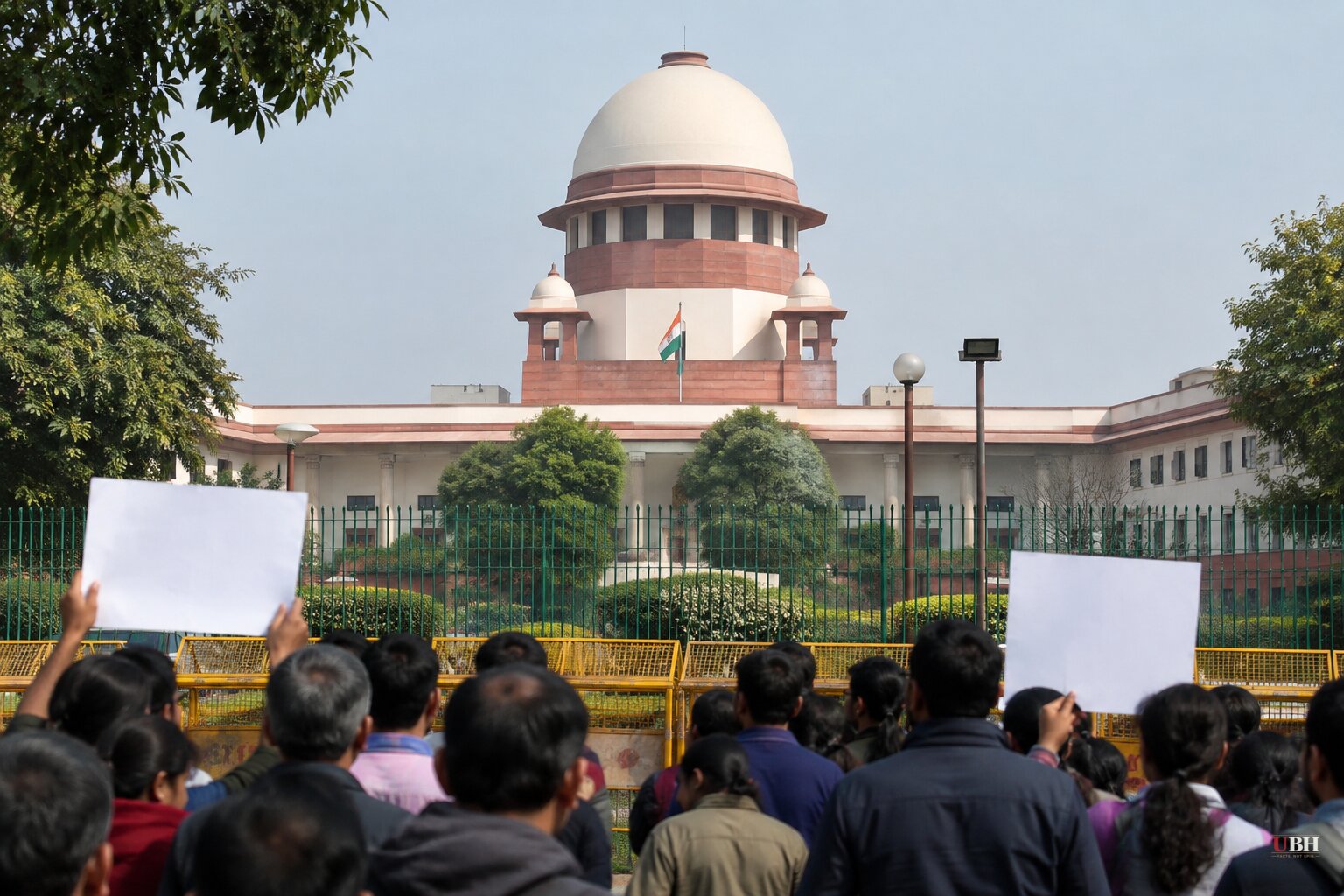
Since the Special Intensive Revision (SIR) of India's electoral rolls began in Bihar last year, the Election Commission of India says it has deleted roughly 130 million names from voter lists nationwide, according to the Guardian. On Monday, October 5, India's Supreme Court issued formal notices to Narendra Modi's government, the Election Commission and its chief, Gyanesh Kumar, demanding what the court called a "clear, transparent" response to allegations that the purge was conducted improperly.
The notices follow more than a week of escalating street protests led by opposition parties, civil society groups and the youth-led Cockroach Janta Party, which previously forced India's education minister to resign in July, according to the Associated Press. Protesters want Kumar to resign and the SIR process halted. Over the weekend of October 3-4, hundreds of people were detained in Delhi as they tried to demonstrate, the Guardian reported.
What the Election Commission says it's doing
The Election Commission's stated justification hasn't changed: it says the SIR is a routine cleanup of duplicate, dead and ineligible entries, and is also meant to remove what BJP officials call "illegal infiltrators" from the rolls, according to the Associated Press. Under the process, voters must produce documents proving eligibility to stay registered. The commission and the BJP both deny any political motive, and Kumar has not resigned.
Removing duplicate or deceased registrants from a voter roll of nearly a billion people is not inherently partisan, and no country benefits from bloated, inaccurate voter files. The dispute is over execution, not the stated purpose.
What critics allege
Opposition parties, led by the Congress party, accuse the commission of being "hand in glove" with the government in what they call vote "chori," or cheating, the Guardian reported. They allege the documentation requirements are confusing and disproportionately hard for poorer and older voters to satisfy, and specifically claim the deletions have targeted Muslim voters, who tend not to support the BJP. These are allegations from petitioners and opposition figures, not findings from an independent investigation.
The clearest documented example is West Bengal, where a revision ahead of state elections earlier this year removed about 9 million names, roughly 12% of the electorate, according to the Associated Press. The BJP won that state for the first time. Whether the deletions caused the outcome or simply overlapped with it is not established in these reports. But the raw numbers, a 12% roll reduction followed by a historic flip, are why critics treat West Bengal as the test case.
The Indian Express reported in September that two of the Election Commission's three members had formally objected, in writing, to several of Kumar's decisions on list revisions, registration procedures and process transparency, according to reporting cited by NPR and KALW. Indian law requires majority agreement among the three commissioners to enact changes, making those internal objections legally and politically significant, not just rhetorical.
The Supreme Court's move
The Supreme Court took up two petitions Monday that allege the SIR has damaged the Election Commission's credibility and call for an independent inquiry into Kumar's conduct of the exercise, according to the Guardian. Menaka Guruswamy, a lawyer for one petitioner, told the court: "We have grown up with free and fair elections, that is not the case now." Another advocate warned that without action, "this country will burn." Those are the petitioners' characterizations, not judicial findings. The court has not ruled on the merits. It has ordered the government, the commission and Kumar to respond, with another hearing scheduled for next week.
A movement that's bigger than the voter rolls
Al Jazeera's Vidya Krishnan, writing in an analysis piece rather than a straight wire report, frames the protests as part of a broader "pincer movement" against Modi's government. She links the Cockroach movement's voter-roll protests to separate, unrelated unrest: demonstrations over the alleged gang rape of a 17-year-old girl in Delhi's Aastha Kunj Park by men posing as police officers, an indefinite hunger strike by the parents of Sahil Wakode, an IIT Bombay student who died by suicide amid allegations of caste-based harassment, and protests in Pune over alleged irregularities in Maharashtra Public Service Commission exams. Krishnan's piece treats these as converging into one Gen Z-driven wave against the government, while the Associated Press wire copy run by NPR, KALW, WWNO and WUNC sticks strictly to the voter-roll dispute and does not connect it to the rape case or the suicide protest.
Whether that convergence reflects a genuine unified political movement or simply several unrelated grievances erupting in the same news cycle is itself an open question the sources don't resolve.
None of the reporting here presents verified evidence of systematic fraud in the SIR process. What is documented: a 130-million-name deletion count the commission itself doesn't dispute, two internal commissioner objections reported by the Indian Express, a 12% roll reduction in West Bengal ahead of a BJP win, and now a Supreme Court demanding sworn answers. The court's next hearing, expected next week, is the first concrete venue where those competing claims will be tested rather than just argued in the streets.
Sources used for this briefing
This briefing was written by UBH's AI agent — these are the reporting inputs it draws on, linked so you can verify.


