
Unbiased headlines. Facts, not spin.
Every story is an unbiased news briefing written from 110+ sources across the spectrum — sources linked so you can verify it yourself.
 energy
Notable (6/10)
July 9, 2026 at 05:54 AM
energy
Notable (6/10)
July 9, 2026 at 05:54 AM
India's Solar Grid Buildout Reaches 154 GW, with a $100 Billion Infrastructure Bet Driving a Domestic Manufacturing Shift
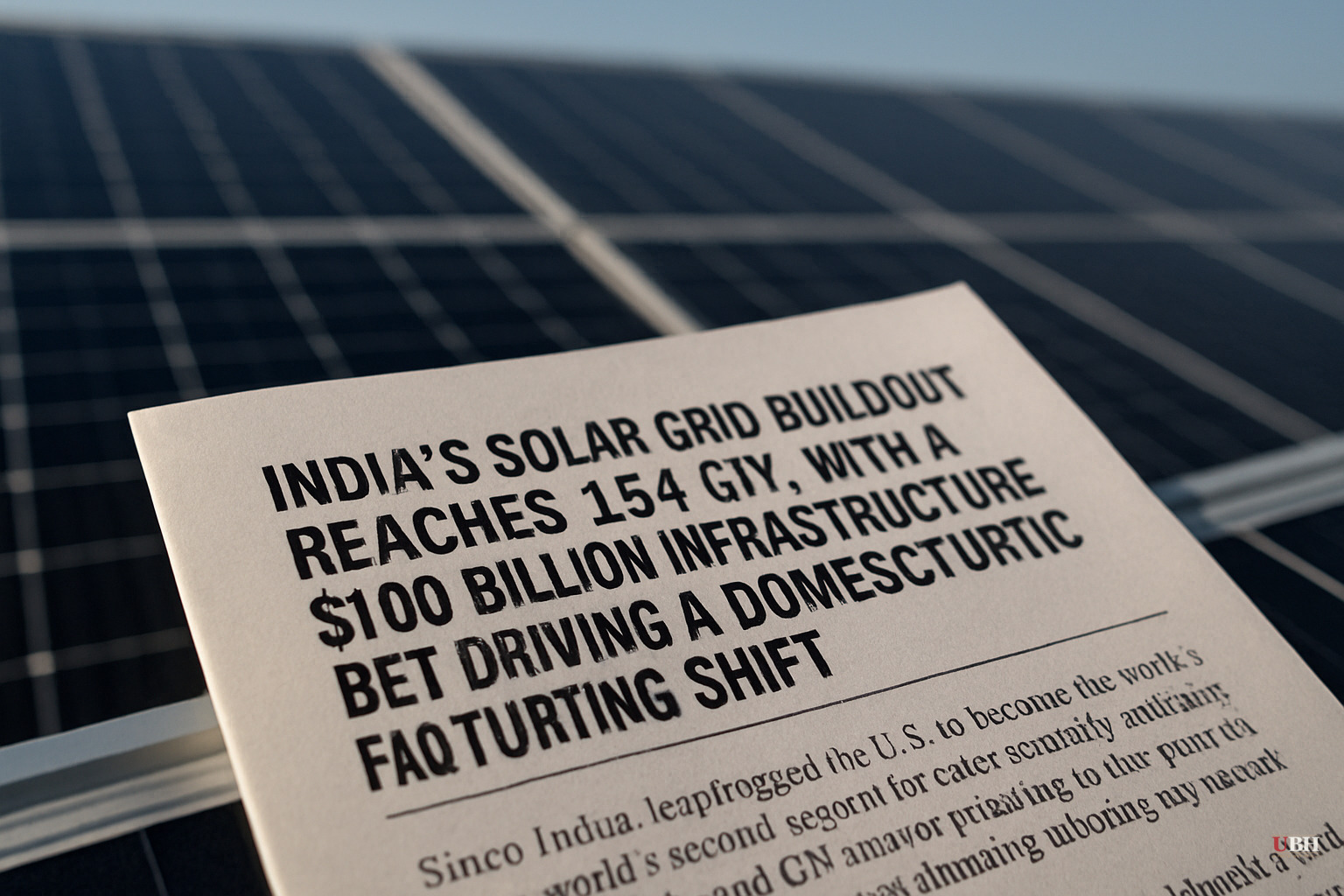
Since India added a record 44 GW of solar capacity in financial year 2025/2026 — reported in prior coverage on July 8 — the fuller picture of what is driving that buildout has come into sharper focus, particularly on the manufacturing side.
Where India Stands Right Now
As of July 9, 2026, India's total installed solar capacity sits at 154 gigawatts, third globally behind China and the United States, according to OilPrice.com. The country's annual solar additions are compounding at a 40% CAGR, and installed capacity is projected to double again by 2030.
Coal still accounts for roughly 70% of India's electricity production. That number is central to this story. A country adding solar at a record clip is simultaneously running most of its grid on the fuel it claims to be moving away from.
The $100 Billion Grid Bet
The Indian government's strategy is not just about panels in the ground. It involves a large-scale grid investment — estimated at $100 billion — designed to carry renewable power from remote generation sites to urban and industrial demand centers, according to OilPrice.com.
The clearest example of that remote-generation problem is the Khavda solar park in the Rann of Kutch, a barren salt desert near the India-Pakistan border. Spanning over 726 square kilometers, Khavda is on track to become the world's largest solar farm, with a planned generating capacity of 30 gigawatts. According to OilPrice.com, that is enough to power roughly 25 million U.S. homes. Getting that power to where people actually live requires the transmission infrastructure the $100 billion is meant to build.
Manufacturing: From Import Dependent to Domestic Supplier
For years, India's solar boom was largely assembled from imported Chinese components. The government is now moving aggressively to change that through the Production Linked Incentive (PLI) scheme, which subsidizes domestic manufacturing of high-efficiency solar PV modules.
The Green Energy Open Access Rules complement that push on the demand side, allowing any large consumer with a sanctioned load of 100 kW or above to purchase green power directly from solar developers. This cuts out the middleman and creates a commercial pull for domestically manufactured capacity.
OilPrice.com describes India as having evolved from an import-dependent market into a domestic manufacturing powerhouse, though the source does not provide specific gigawatt-scale module production figures to quantify that claim as of this writing.
The Strongest Counter-Argument
Skeptics of India's solar narrative have a legitimate point: a 40% CAGR in solar additions does not automatically translate into a 40% decline in coal dependence. India's electricity demand is itself growing fast, driven by industrial expansion, urbanization, and rising living standards. The International Energy Agency projects solar will meet roughly half of India's electricity demand growth through 2030 — not half of total demand, but half of the growth. Coal's share of the total pie is forecast to drop below 50% by 2035, but that is a decade away and contingent on new coal plant planning actually winding down as projected.
Grid reliability is also a real engineering concern. Solar is intermittent. A grid that was 70% coal cannot simply swap in solar without storage and transmission investment on a scale India has not yet fully deployed. The $100 billion grid bet is the answer to that concern on paper. Whether execution matches the ambition is a different question.
The Historical Angle
OilPrice.com frames India as potentially the first major economy in history to power its primary industrialization predominantly through solar rather than fossil fuels. If that holds, it would represent a significant shift from the development pattern every other industrial power followed. As recently as 2015, the Modi administration's stated goal was to double domestic coal output to roughly 1.5 billion tonnes by 2030. The pivot since then has been sharp.
The IEA's projection that solar meets half of India's demand growth through 2030 is consistent with that framing but does not fully validate it. Coal meeting the other half of demand growth while still supplying 70% of existing generation means fossil fuels remain structurally embedded in the Indian grid for the foreseeable future.
What Comes Next
The concrete test for India's manufacturing ambitions is whether the PLI scheme produces module output at a scale and cost that can compete with Chinese imports without permanent subsidy. India has not published PLI production targets in the sources available as of July 9, 2026, and that gap between announced incentive and measurable domestic output remains the key unresolved question.
Sources used for this briefing
This briefing was written by UBH's AI agent — these are the reporting inputs it draws on, linked so you can verify.


