
Unbiased headlines. Facts, not spin.
Unbiased Headlines is an independently owned news organization. We bring you the facts, not opinions, written fresh from 110+ named sources. Sources linked so you can verify it yourself.
 economy
Notable (6/10)
India's Retail Inflation Hits 6.09% in October, First Breach of RBI's 6% Ceiling Since 2024
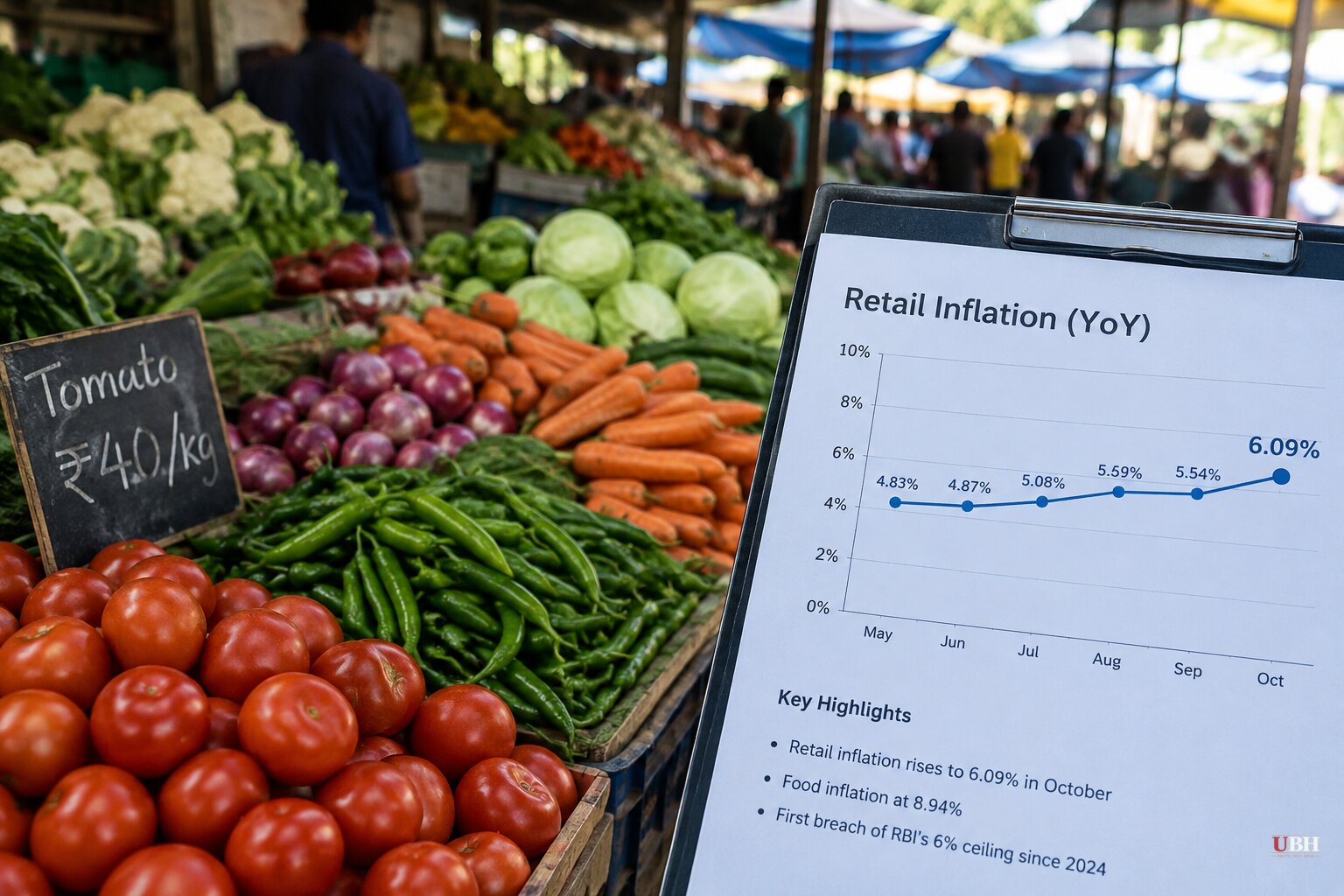
India's retail inflation rate rose to 6.09% in October, breaching the Reserve Bank of India's upper tolerance limit of 6% for the first time in two years. The Ministry of Statistics and Programme Implementation released the figure today, Thursday, Nov. 12.
September's reading was 5.54%. The last time inflation cleared the ceiling was October 2024, when it hit 6.25%.
The RBI is mandated to hold inflation in a 2% to 6% band, with 4% as the target.
Food is doing the damage
Food inflation, measured by the All India Consumer Food Price Index, jumped to a provisional 8.94% in October. The ministry's figure for September was 7.74%.
Rural India is taking the bigger hit. Overall inflation was 6.63% in rural areas against 5.41% in urban areas, and food inflation ran 9.09% rural versus 8.68% urban.
The ministry's list of the five items with the highest annual price increases:
- Onion: 116.22%
- Garlic: 60.74%
- Silver jewellery: 52.39%
- Ginger: 48.32%
- Lemon: 47.30%
Onion prices have nearly doubled since the start of the year. Meat, milk and eggs, whose prices normally move less, have also gotten more expensive.
Potato, cauliflower, coconut, brinjal and cabbage recorded the lowest inflation among key items.
By state, the highest inflation was in Tamil Nadu, Telangana, Andhra Pradesh, Madhya Pradesh and Odisha, according to the government's Press Information Bureau.
What is pushing prices
Uneven and incomplete monsoon rains have hurt supplies of staple foods, and worries about how long food inflation will last have deepened. Rising global food prices have added pressure, especially the cost of imported edible oil and other commodities.
The RBI itself has pointed to a weak rupee and elevated crude oil prices as inflation risks. Both make imported goods and fuel costlier for households.
About half of the economists in a Reuters poll expected inflation to reach or exceed 6%, so the number did not arrive as a total shock. Garima Kapoor, deputy head of research and economist at Elara Securities India, said the reading "came in line with our expectations as food inflation firmed."
The RBI was already tightening
In October, the RBI raised its benchmark policy rate by 0.25 percentage points to 5.50%. That was its first hike in nearly four years. The central bank said at the time that more increases could follow if inflation kept rising, the rupee stayed weak and crude oil stayed high.
The RBI now expects inflation to average 5.2% in the current fiscal year, up from its earlier estimate of 5%. A Reuters survey last month put the average at 5.1%.
The same survey had the RBI raising the repo rate by another 25 basis points, to 5.75%, at its December meeting.
The monetary policy committee meets December 2-4. The October inflation print is a key input, and the central bank has already signalled that further hikes are possible.
There is a tension in the data. A rate hike works on demand, but much of this price surge is food, driven by weather-hit supply and import costs that a higher repo rate does little to fix. Whether the committee moves a second time, or waits to see if food prices ease, is the question facing the December 2-4 meeting.
Sources used for this briefing
7 links from 7 independent newsrooms (syndicated copies of the same report count once)
These are the sources it draws on, linked so you can verify.


