
Unbiased headlines. Facts, not spin.
Unbiased Headlines is an independently owned news organization. We bring you the facts, not opinions, written fresh from 110+ named sources. Sources linked so you can verify it yourself.
 economy
Major Story (7/10)
Black Sea Attacks Have Killed More Seafarers This Year Than the Iran War Around Hormuz
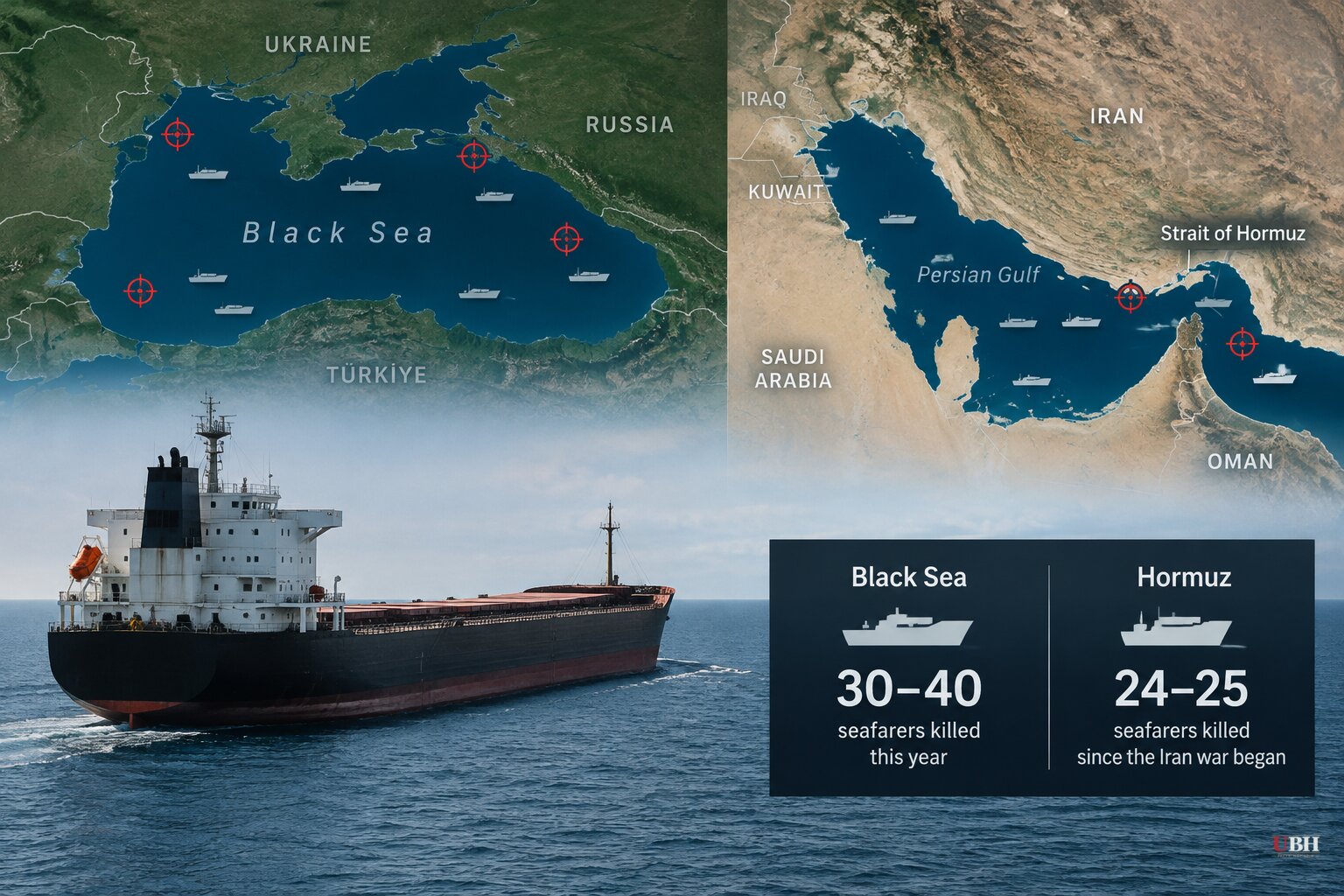
The most dangerous water for merchant sailors this year is not the Strait of Hormuz. It is the Black Sea.
The maritime security firm Ambrey and the International Maritime Organization put seafarer deaths in the Black Sea at 40 or more. The Turkish Shipowners' Association, MarineTraffic and local authorities count more than 30 dead and over 20 missing. The IMO counts around 24 to 25 seafarer deaths in Hormuz and the wider Middle East since the U.S.-Iran conflict began at the end of February.
The tallies do not line up neatly. Counts of Black Sea attacks run from more than 300 to more than 570 vessels struck, and the Financial Times has noted that reporting from both regions is patchy. The direction is the same in every count.
A sharp escalation since summer
Ambrey says about 387 ships were hit between July and September, more than five times the previous quarter. Attacks averaged more than four a day in the third quarter. The IMO logged about 120 incidents in Hormuz and the wider Middle East.
Both sides are firing. Russia has gone after commercial ships carrying Ukrainian food exports. Ukraine has used drones on Russian shipping on the sea's other side, and on ships using Russian ports in the Black Sea and Sea of Azov.
Ambrey attributes roughly 90% of attacks over the past 45 days to Russia. According to shipping and security sources cited by CNN, Russia has combined sea and air drones and has begun using newer jet-powered drones that are faster and harder to intercept.
The October toll
The recent surge began in early October, when the Turkish-owned Alfa Watan, bound from Egypt to the Romanian port of Sulina, was hit by air and naval drones. Nine Syrian crew members and one Egyptian died, and the ship sank.
Six days later, 11 crew on the HS Dignity, mostly Syrian, died when the ship was struck off the Bulgarian coast at night. Syrian seafarers' activist Mohammad Hajjouz said the crew saw an unmanned surface vessel approach after the first strike, then hit the ship.
On Oct. 15, drones repeatedly struck the chemical tanker Wine Trader off Romania, leaving seven crew missing. On Oct. 23, the cargo ship Khoryv sank off Romania. One crew member died and three are missing.
The most recent case came last week. Three drones hit the container ship Contship Jet as it approached a Romanian port, and it later sank. A French surveillance plane filmed a surface drone closing on the vessel. It was about 25 kilometers (15 miles) from the Bulgarian coast. Separately, India condemned an attack on the MV Royad Mammadov, in which two foreign sailors died. Three Indian crew members were safe.
NATO's edge
Some European leaders have linked the attacks near Romania and Bulgaria to Russia. Moscow has denied involvement. Both countries are NATO members, and both have among the least developed militaries and civil-defense forces in Europe.
Ambrey says attacks have shifted to open waters and the exclusive economic zones of NATO states. European officials have also tied a rise in airspace violations, cyberattacks and sabotage on NATO's eastern flank to Moscow.
The European Commission announced Monday, Nov. 9, that it would fast-track a Black Sea maritime-security hub. It did not name Russia as responsible for the attacks.
Ukrainian Foreign Minister Andrii Sybiha says the uptick is "turning the Black Sea into a zone of danger for civilian shipping." Oleg Grygoriuk, chair of the Marine Transport Workers' Trade Union of Ukraine, put it more bluntly: "For me, the Black Sea and calling at Ukrainian ports is near suicidal."
Grain and trade
Russia's aim, per CNN's reporting, is to choke trade through Ukrainian ports, which export almost all of the country's grain. Ukraine exported 1.09 million tons of wheat in September, according to government figures. A year earlier it exported 2.05 million tons.
Ukraine tried to shift exports to smaller ports on the Danube, which borders Romania. Russian drones followed. Countries across Africa and parts of the Middle East depend on those harvests.
The Black Sea links Europe and Asia and is bordered by six countries: Bulgaria, Georgia, Romania, Russia, Turkey and Ukraine. Shippers have largely pulled back from the waters off Ukraine and Russia, and activity has dropped sharply.
The people bearing the risk are mostly crew who have little say over where their ships sail. Many of the dead were Syrian, Egyptian and other foreign nationals aboard Turkish-owned and other third-country vessels.
What comes next
No source shows de-escalation. The open question is what Romania, Bulgaria and the wider alliance do when a sinking happens inside their waters, and whether Brussels' maritime hub, still only announced, changes anything before the next strike.
Insurers, shipowners and crews are already pricing in the danger. The grain figures show the cost.
Sources used for this briefing
6 links from 6 independent newsrooms (syndicated copies of the same report count once)
These are the sources it draws on, linked so you can verify.


