
Original briefings. Zero spin.
Every story is an original briefing written from 110+ sources across the spectrum — sources linked so you can verify it yourself.
 energy
Major Story (7/10)
Event date: June 18, 2026
energy
Major Story (7/10)
Event date: June 18, 2026
India's Clean Power Capacity Now Beats Fossil Fuels, But Coal Still Makes 70% of the Electricity
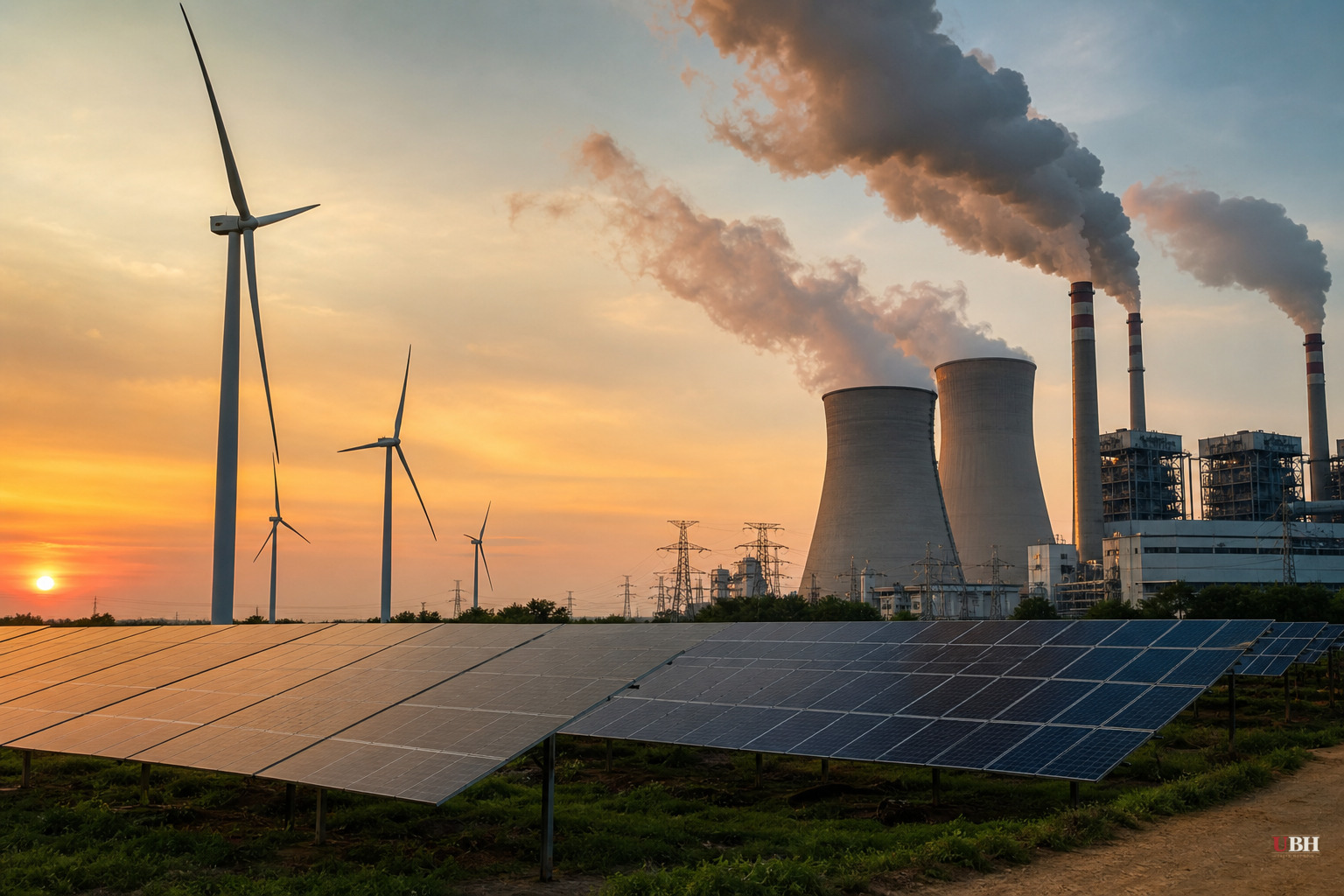
Since India's non-fossil capacity first crossed 50% of the total mix earlier this year, the country has hit a new marker: clean energy capacity now formally outweighs fossil fuel capacity, 331.7 gigawatts to 302.0 gigawatts, according to capacity data from Ember and Global Energy Monitor reported by The Hindu BusinessLine.
Capacity measures what's built. Generation measures what actually runs. Coal plants operate around the clock. Solar and wind only work when the sun shines and the wind blows. Coal still produced roughly 70% of India's actual electricity in the most recent fiscal year, per The Hindu BusinessLine, and thermal sources generated about 1,307 billion units in FY2025-26 against roughly 478 billion units from hydro and other renewables combined, according to a survey from the Energy and Climate Initiatives Society reported by Rediff.
So two things are true at once. India is building clean power faster than almost anywhere on earth. And the lights still run mostly on coal.
The Build-Out Is Real
Solar tells the story best. India had 0.07 GW of solar capacity in 2010. It has 211 GW now, according to Ember data cited by The Hindu BusinessLine. That's nearly as large as India's entire coal fleet of 254.4 GW. Between 2025 and mid-2026, India added 75.5 GW of solar capacity compared to just 3.8 GW of coal. As of July 31, 2026, India had 291.7 GW of renewable capacity and 300.5 GW of total non-fossil capacity, according to the ENCIS survey reported by both Rediff and Energetica India.
Nearly 75% of 250 energy professionals surveyed across Delhi-NCR, Mumbai, Pune, Bangalore and Chennai expect renewables to overtake coal as India's primary electricity source by 2035, per that ENCIS survey. Twenty-eight percent think it happens by 2030. That's an optimistic industry insider poll, not a government forecast, and it should be read that way. Solar is the clear favorite among respondents, picked by 61% as the decisive growth technology, versus 14% for wind.
The Grid Is the Bottleneck, Not the Panels
India can build solar and wind faster than it can move that power to where people and factories actually need it. Madhav Pai, CEO of WRI India, put a number on it at the Mint Sustainability Summit in Mumbai on July 29: the grid is going to lag 40-50 GW behind generation capacity, according to Livemint. He wants more transparency on transmission delays and faster rollout of behind-the-meter battery storage, which he says could supply 20% of needed battery capacity.
Deepack Thakur, CEO of Hinduja Renewables, told the same summit that standalone solar and wind projects don't cut it anymore. Investors now want integrated packages: generation, storage, forecasting and transmission bundled together. He also said the added cost of that reliability has to land on customers, with regulators building new market platforms to support it. Thakur is an industry executive arguing for cost pass-through.
New Central Electricity Authority technical standards published July 31, 2026, push this further by making advanced "grid-forming" capability mandatory for new solar, wind, and battery storage projects, not optional, according to Whalesbook. That means equipment that can set voltage references and ride through grid disturbances instead of just following the existing signal. Good for stability. Expensive for developers. Hitachi Energy India already reported a record order backlog of ₹32,222.1 crore for the quarter ended June 30, 2026, evidence the equipment market is responding.
AI Data Centers Are Raising the Stakes
Layer on top of this a demand shock nobody fully planned for. Minister of State for Power Shripad Naik told the Rajya Sabha in July that AI data centers are now expected to add 26.3 GW of load by 2031-32, according to Mint and The Indian Express, cited by Startup Fortune. That's nearly double a government estimate from four months earlier that put the figure at 13.56 GW. Google, Microsoft and Amazon have collectively pledged tens of billions in Indian AI and cloud infrastructure investment since October 2025, and Wood Mackenzie projects India's data center capacity could grow from 2.2 GW in 2025 to 12 GW by 2030.
Samir Chandra Saxena, chairman of Grid Controller of India, warned at the India AI Impact Summit in February that data center load is variable and spiky, the opposite of what grid operators want, per The Indian Express. AI workloads demand constant, high-quality power around the clock. Renewables, by nature, don't deliver that without heavy storage backup.
The government says the added AI load will mostly be served by renewables and points to roughly Rs 9.16 lakh crore in planned transmission spending through 2032, per Financial Express. Whether that money and timeline actually close the 40-50 GW gap Pai flagged will become clearer when Bharat Electricity, POWERGEN India and Indian Utility Week convene over 15,000 energy professionals in New Delhi from September 1-3, 2026.
Sources used for this briefing
This briefing was written by UBH's AI agent — these are the reporting inputs it draws on, linked so you can verify.


