
Unbiased headlines. Facts, not spin.
Unbiased Headlines is an independently owned news organization. We bring you the facts, not opinions, written fresh from 110+ named sources. Sources linked so you can verify it yourself.
 energy
Notable (5/10)
India's ₹18,100 Crore Battery Subsidy Has Built 1.4 GWh of Its 50 GWh Target, NITI Aayog Report Finds
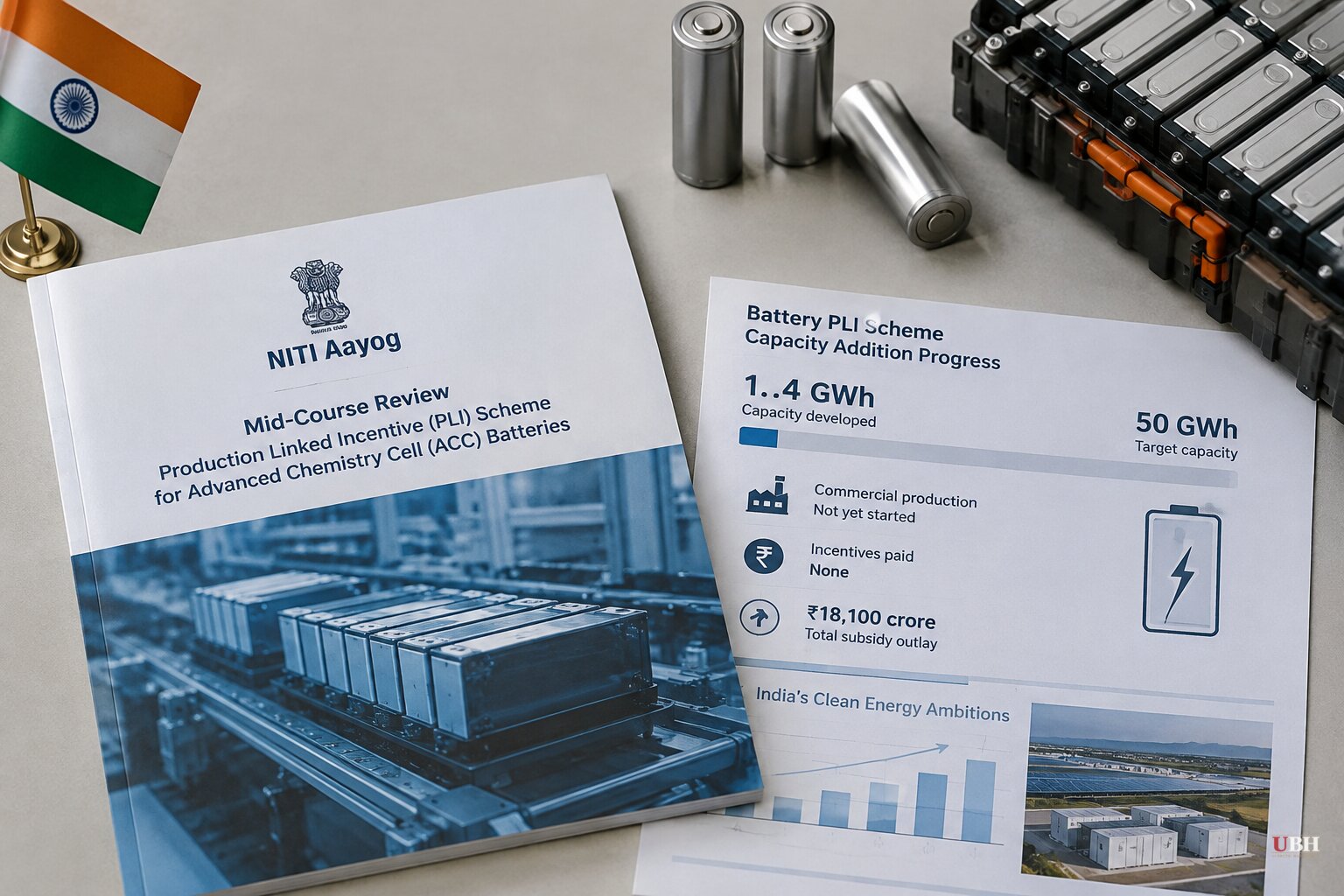
Five and a half years after the Union Cabinet approved it, India's flagship battery subsidy has produced a sliver of what it promised.
The PLI scheme for Advanced Chemistry Cell (ACC) batteries has developed about 1.4 GWh of manufacturing capacity against a 50 GWh target, according to NITI Aayog's "Impact Assessment of PLI Schemes," prepared with IIM Ahmedabad. Commercial production has not begun.
"The scheme is currently in its early gestation phase, and progress has been slower than anticipated," the report states.
The numbers on the battery scheme
The Cabinet approved the ₹18,100 crore scheme in May 2021. The goal: build domestic cell-making capacity for electric vehicles and energy storage and cut reliance on imported battery technology.
Cumulative investment reached ₹4,570 crore by March 2026. Employment stood at 1,245 people.
Disbursements are at zero. The incentive pays out only once a company is manufacturing and selling, so no production means no payment.
NITI Aayog points to three causes: technological limitations, dependence on imports, and delays in setting up factories. India's limited domestic capability in advanced battery manufacturing is a central problem, the report says.
Auto and telecom fared better
The same review is kinder to other sectors. The ₹25,938 crore automobile and auto components scheme drew ₹44,326 crore in cumulative investment by March 2026, above its ₹42,500 crore target.
Incentivised vehicle units rose from 76,838 in FY24 to 12,84,650 in FY25, for a two-year total of 13,61,488. Electric vehicle production increased across two-wheelers, three-wheelers, passenger vehicles and buses.
But the auto scheme misses on other measures. Incremental sales came to ₹52,414 crore against a five-year target of ₹2,31,500 crore. Employment was 67,820 against a target of 1,48,147. The government has disbursed ₹2,386.36 crore in incentives under the scheme.
The report also says the telecom scheme has strengthened domestic manufacturing and lifted investment, production, exports and jobs.
Across all 14 notified sectors, the review measures whether outcomes beat underlying industry growth. It applies a 50% mid-course benchmark because the schemes are 58% through their aggregate tenure. It also flags inconsistent export reporting and possible production reclassification, which make it harder to verify genuinely additional output.
A new tender, 22 bidders
The Ministry of Heavy Industries announced Thursday, Nov. 12, that it received 22 bids for 10 GWh of ACC capacity earmarked for grid-scale stationary storage. The tender went up on the Central Public Procurement portal on July 15, a pre-bid conference followed on July 29, bids closed Nov. 10, and technical bids were opened Nov. 11 at the ministry.
Bidders include Reliance Industries, ACME Solar Holdings, Amara Raja Advanced Cell Technologies, Exide Energy Solutions, JSW Neo Energy, Vikram Solar, Waaree Energy Storage Solutions, Avaada Electro and Megha Engineering and Infrastructures. Smaller names such as Fujiyama Power Systems, Sai Bioenergy and Zetsol Energy are on the list too.
Selection runs through a two-stage Quality and Cost Based Selection process. The ministry has not announced how capacity will be allocated.
The ministry reads the turnout as a sign of momentum. "The strong participation in the tender reflects growing industry interest in India's ACC manufacturing potential and reinforces the government's commitment to building a technologically self-reliant, globally competitive and sustainable ACC ecosystem," it said. It added that the storage allocation will support energy security and deepen the domestic value chain.
The tender carries ₹3,620 crore in incentives, payable to selected bidders after they invest in cell manufacturing and begin selling domestically made cells, according to the scheme guidelines and tender documents.
Where the first 40 GWh went
The new tranche follows earlier allocations of the remaining 40 GWh: 20 GWh to Ola Electric, 15 GWh to Reliance Industries and its subsidiary Reliance New Energy, and 5 GWh to Rajesh Exports. Those earlier allocations were end-use-agnostic. The storage tranche is not.
The Rajesh Exports award has drawn controversy. In June, the Securities and Exchange Board of India alleged that Rajesh Exports and its promoters were responsible for financial misrepresentation of ₹15 trillion. Those are Sebi's allegations, not findings.
The taxpayer angle
The structure limits the downside. Government has not paid out a rupee under the battery scheme, so the cost so far is time and missed capacity, not cash.
But that is a thin comfort. India's grid and EV makers still depend on imported cells, which is exactly what the scheme was meant to fix. And the auto scheme shows the pattern in a milder form: investment cleared its target while sales and jobs landed well short of theirs.
The next test comes in the bid evaluation. The ministry has yet to announce which of the 22 bidders will win capacity under the 10 GWh tranche. Whether any of them reach commercial production, and so trigger the first ₹3,620 crore of payouts, is still undecided.
Sources used for this briefing
7 links from 7 independent newsrooms (syndicated copies of the same report count once)
These are the sources it draws on, linked so you can verify.


