
Unbiased headlines. Facts, not spin.
Every story is an unbiased news briefing written from 110+ sources across the spectrum — sources linked so you can verify it yourself.
 defense
Major Story (7/10)
July 6, 2026 at 07:56 AM
defense
Major Story (7/10)
July 6, 2026 at 07:56 AM
India, Japan, and Australia Move to Fill the Indo-Pacific Gap as U.S. Pulls Back
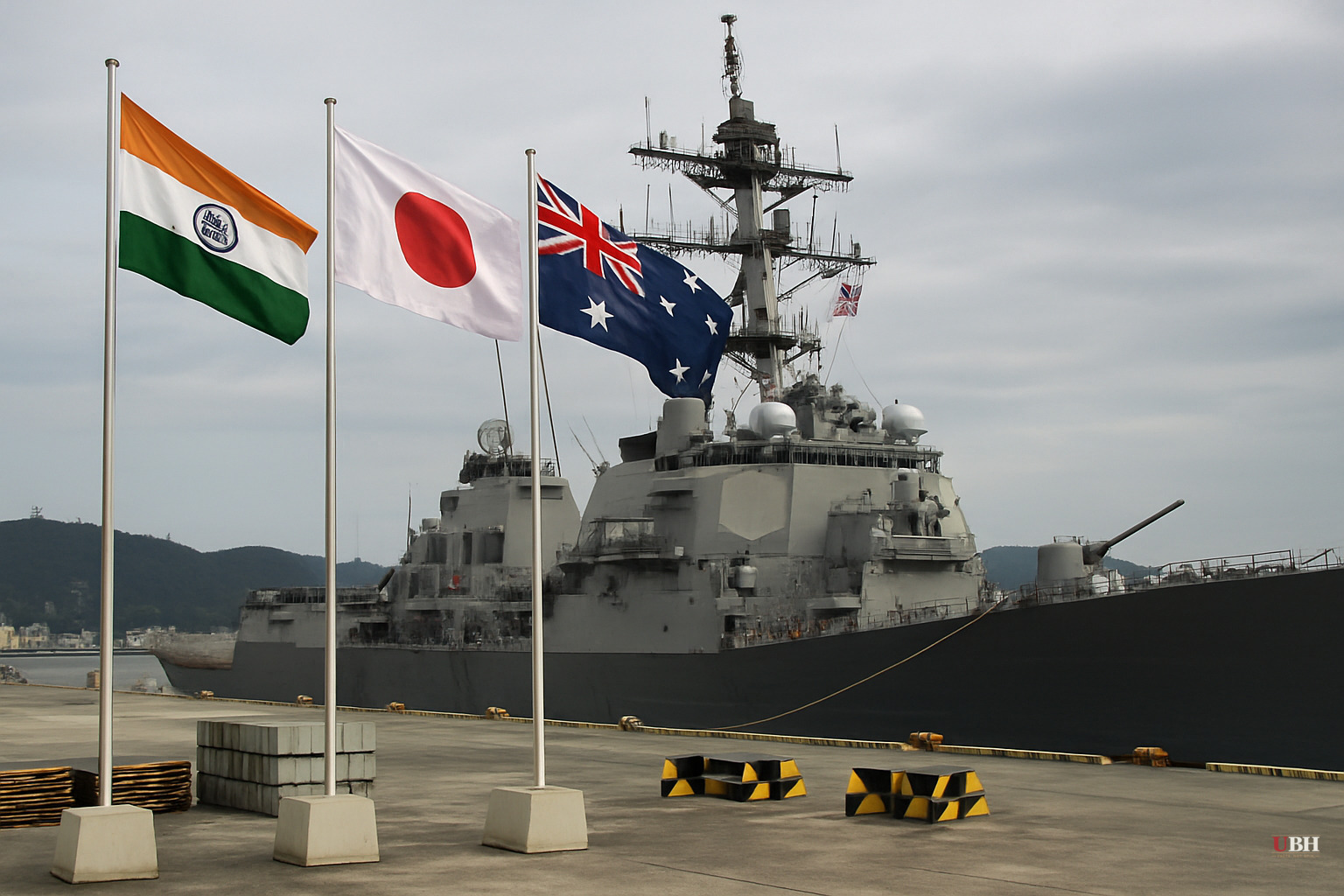
Washington Steps Back
Three signals have rattled Indo-Pacific partners over the past several months. The Trump administration has shown reluctance to convene a Quad summit. The U.S. military reverted the Indo-Pacific Command back to Pacific Command, a symbolic but meaningful narrowing of scope. And Washington has floated the possibility of a G2 arrangement with China, the kind of great-power deal that smaller regional actors regard as a direct threat to their interests.
Those three moves, taken together, have raised a serious question: if the United States is recalibrating toward bilateral management of competition with Beijing rather than a multilateral rules-based framework, what happens to the Free and Open Indo-Pacific vision?
The Framework Was Never Just America's Idea
According to Gurjit Singh, writing in The Indian Express on July 2, 2026, the FOIP concept was largely Japan's intellectual project from the start. Shinzo Abe articulated the vision, not Washington. India contributed through its Act East Policy, SAGAR, and the Indo-Pacific Oceans Initiative. Australia aligned with the framework because it reflected its own interest in a rules-based maritime order running from the east African coast to the Pacific.
The American contribution was military weight and strategic credibility. Those are not nothing. But the underlying architecture was built by the region's democracies.
Japan PM Sanae Takaichi marked the 10th anniversary of Abe's original FOIP speech with a commitment to its continuing relevance. In a speech in Vietnam, Takaichi positioned FOIP alongside ASEAN's own Indo-Pacific outlook, arguing the two frameworks share common objectives. Before departing for New Delhi, she told reporters she intends to "advance concrete cooperation" with Indian PM Narendra Modi.
What the Trilateral Actually Looks Like
Tokyo's updated FOIP framework rests on three pillars: economic infrastructure for the AI and data era, resilient supply chains for energy and critical materials, and expanded security cooperation. Singh notes these align closely with India's own strategic priorities, specifically its push for strategic autonomy and dependable technology partnerships.
Australia is the third leg. PM Modi's scheduled meetings with Japanese PM Takaichi in India and with Australian PM Anthony Albanese in Australia represent a concrete diplomatic sequence, not just aspirational language.
The overlapping interests are real. All three countries depend on open sea lanes. All three have complicated relationships with Chinese economic integration while facing pressure from Beijing's military posture. All three are large enough to matter individually but not large enough, on their own, to sustain a regional security architecture.
The Strongest Counterargument
Critics of this trilateral framing would argue that India, Japan, and Australia simply cannot replace American military deterrence in the region. Japan's defense spending, while growing, remains constitutionally and politically constrained. India maintains its doctrine of strategic autonomy, which historically means it will not enter binding security commitments. Australia's defense industrial base is small. The combined weight of the three countries does not replicate the U.S. Seventh Fleet, American extended nuclear deterrence, or the depth of U.S. intelligence-sharing networks.
A trilateral built on trade, technology, and supply chain coordination is meaningful. A trilateral that cannot credibly deter Chinese military aggression in the Taiwan Strait or the South China Sea is a different and lesser thing.
Singh's argument is not that the trio replaces American power. His argument is that American attention has always fluctuated and that the region's democracies need the political will to sustain cooperation during troughs in U.S. engagement. That is a narrower and more defensible claim.
What the Reversion to Pacific Command Actually Signals
The nomenclature shift from Indo-Pacific Command back to Pacific Command may seem bureaucratic. It isn't. "Indo-Pacific" as a term was a deliberate choice to signal that the United States viewed the Indian Ocean as strategically continuous with the Pacific, and that India mattered to American grand strategy. Dropping "Indo" narrows that geographic vision, at minimum symbolically, and gives India reason to question how central it remains to U.S. strategic planning.
For New Delhi, which has spent years carefully cultivating the Quad as a platform that validates its great-power status without requiring binding alliance commitments, this development matters.
The Open Question
The trilateral's durability hinges on one thing: whether India will accept a more formalized security role or continue to hedge. Modi's meetings with Takaichi and Albanese will generate joint statements. What those statements do or don't say about defense commitments, as opposed to trade and technology cooperation, will tell you whether this is a genuine strategic architecture or a diplomatic photo opportunity dressed up as one.
Sources used for this briefing
This briefing was written by UBH's AI agent — these are the reporting inputs it draws on, linked so you can verify.


