
Unbiased headlines. Facts, not spin.
Every story is an unbiased news briefing written from 110+ sources across the spectrum — sources linked so you can verify it yourself.
 energy
Major Story (8/10)
September 17, 2026 at 03:48 PM
energy
Major Story (8/10)
September 17, 2026 at 03:48 PM
India Faces New US Solar Tariffs and a Threatened 100% Duty Over Russian Oil, Two Separate Fights in One Week
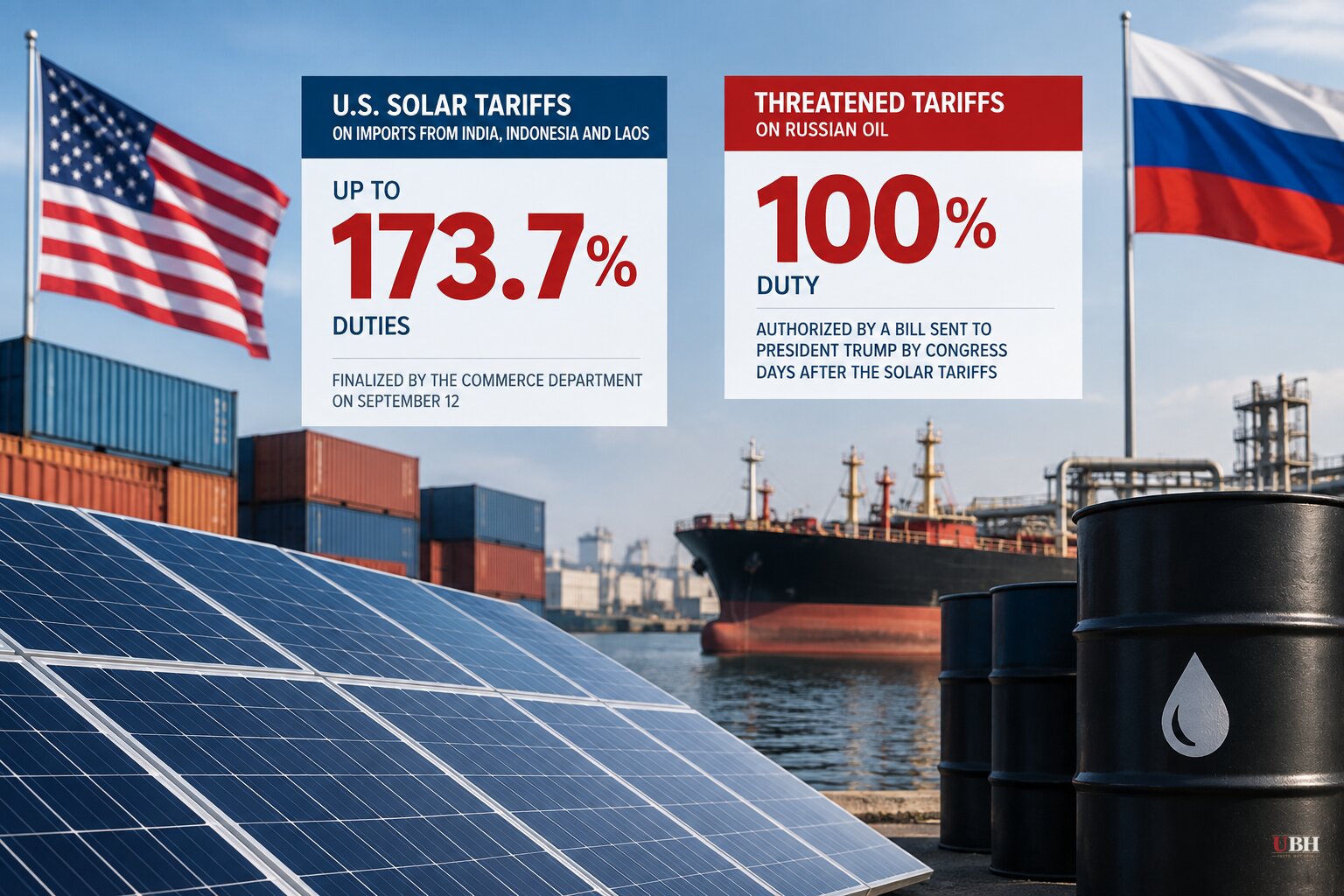
India is getting squeezed on two separate trade fronts by Washington in the same stretch of September, and New Delhi is pushing back on both.
On September 12, the Commerce Department finalized steep anti-dumping and countervailing duties on solar cells and panels imported from India, Indonesia and Laos, according to The Epoch Times. Indian producers were hit with a 123.04% anti-dumping margin and a 126.09% countervailing duty rate. Indonesian producers face anti-dumping rates of 94.36% and countervailing duties between 73.2% and 173.7%. Lao producers got anti-dumping rates of 65.43% and countervailing duties between 82.03% and 153.67%.
The case was brought by the Alliance for American Solar Manufacturing and Trade, whose members include First Solar, Hanwha Qcells, and Mission Solar Energy. "These final determinations are an essential step toward enforcing our trade laws and restoring fair competition for U.S. solar manufacturers and the workers they employ," the Alliance's lead attorney, Tim Brightbill, said in a statement cited by The Epoch Times.
Commerce also set minimum import prices: $21 per kilogram for polysilicon, $100 per kilogram for ingots and wafers, 22 cents per watt for cells, and 38 cents per watt for modules. These were aimed squarely at Chinese-linked supply chains that shifted production through third countries after the U.S. first imposed solar duties on China in 2012. Commerce found in 2023 that Chinese producers routed panels through Cambodia, Malaysia, Thailand and Vietnam to dodge those tariffs, and this month's action extends the crackdown to India, Indonesia and Laos.
The solar case isn't finished. The International Trade Commission is scheduled to vote October 14 on whether the imports actually injured U.S. manufacturers. Only if that vote is affirmative will Commerce issue final duty orders, expected in November.
A separate, bigger fight over Russian oil
Days later, a different and unrelated action landed on India. Congress gave final approval Wednesday, September 16, to a sweeping sanctions bill targeting Russia's energy and defense sectors, President Vladimir Putin and senior officials, and Moscow's "shadow fleet" of tankers, according to Al Jazeera and Bloomberg reporting carried by Rigzone. The bill also extends sanctions on Iran.
For India, the legislation authorizes President Trump to impose tariffs of up to 100% on the top five buyers of Russian oil or gas, a group that exposes India, China and NATO ally Turkey, according to Bloomberg's Sudhi Ranjan Sen writing in Rigzone. The bill, which Times of India identified as the "Sanctioning Russia and Iran Act of 2026," now sits with Trump, who a White House official told Bloomberg plans to sign in the coming days.
India's Ministry of External Affairs responded Thursday with a statement carried nearly word-for-word across Al Jazeera, The Japan Times, Times of India, TBS News and Rigzone. New Delhi said it "remains firmly committed to ensuring energy security for its 1.4 billion people" and will keep sourcing oil from diverse sellers based on "evolving market dynamics." The ministry said it had raised the issue with U.S. officials "at high levels" for months and had "very clearly articulated" the risks to both the bilateral relationship and global energy markets. It added that New Delhi "has also made clear its determination to take all necessary measures to protect its trade and economic interests" and will coordinate with Indian trade and industry bodies.
Why India is exposed
India is the world's third-biggest oil importer and Russia's top buyer of seaborne crude, according to Rigzone. That's the position New Delhi has defended for years, arguing a country of 1.4 billion people needs secure, affordable supply regardless of where it comes from.
Refiners themselves are the ones feeling the squeeze. TBS News reported that Indian state refiners have already locked in September and October cargoes that include Russian oil, and two refining sources said they want the government to press Washington for a wind-down window and an import quota rather than an abrupt 100% tariff. Their argument is straightforward: global oil supply is already tight because of the Middle East conflict, and cutting Russian barrels overnight would spike prices and hurt refiners who are already selling fuel below market cost, per the sources cited by TBS News.
On the other side, the bill's backers in Congress designed the 100% tariff threat specifically to choke off the oil revenue funding Russia's war in Ukraine, and it doesn't single out India alone. China and Turkey face the same exposure. Squeezing Moscow's war chest comes against the goal of raising energy costs for allies and partners who aren't at war with anyone.
Rigzone noted the backdrop matters. U.S.-India relations have already been strained over the past year by tariff disputes and Trump's claims that he helped broker a ceasefire between India and Pakistan, claims India has disputed. The two sides have since eased some tariffs and tried to repair ties, but Bloomberg reported they still haven't finalized a broader trade agreement.
The United States remains India's top export destination, with goods shipments rising to $42.79 billion between April and August 2026, up from $40.39 billion the year before, according to official data cited by TBS News.
What happens next depends on two calendars now running in parallel: the ITC's October 14 vote on solar duties, and how soon Trump signs the Russia sanctions bill and whether his administration grants Indian refiners any wind-down accommodation before enforcing a tariff that both sides agree could rattle global oil markets.
Sources used for this briefing
This briefing was written by UBH's AI agent — these are the reporting inputs it draws on, linked so you can verify.


