
Unbiased headlines. Facts, not spin.
Every story is an unbiased news briefing written from 110+ sources across the spectrum — sources linked so you can verify it yourself.
 energy
Major Story (7/10)
July 9, 2026 at 12:16 AM
energy
Major Story (7/10)
July 9, 2026 at 12:16 AM
India Added 44 GW of Solar in One Year and Now Ranks Second Globally for New Capacity
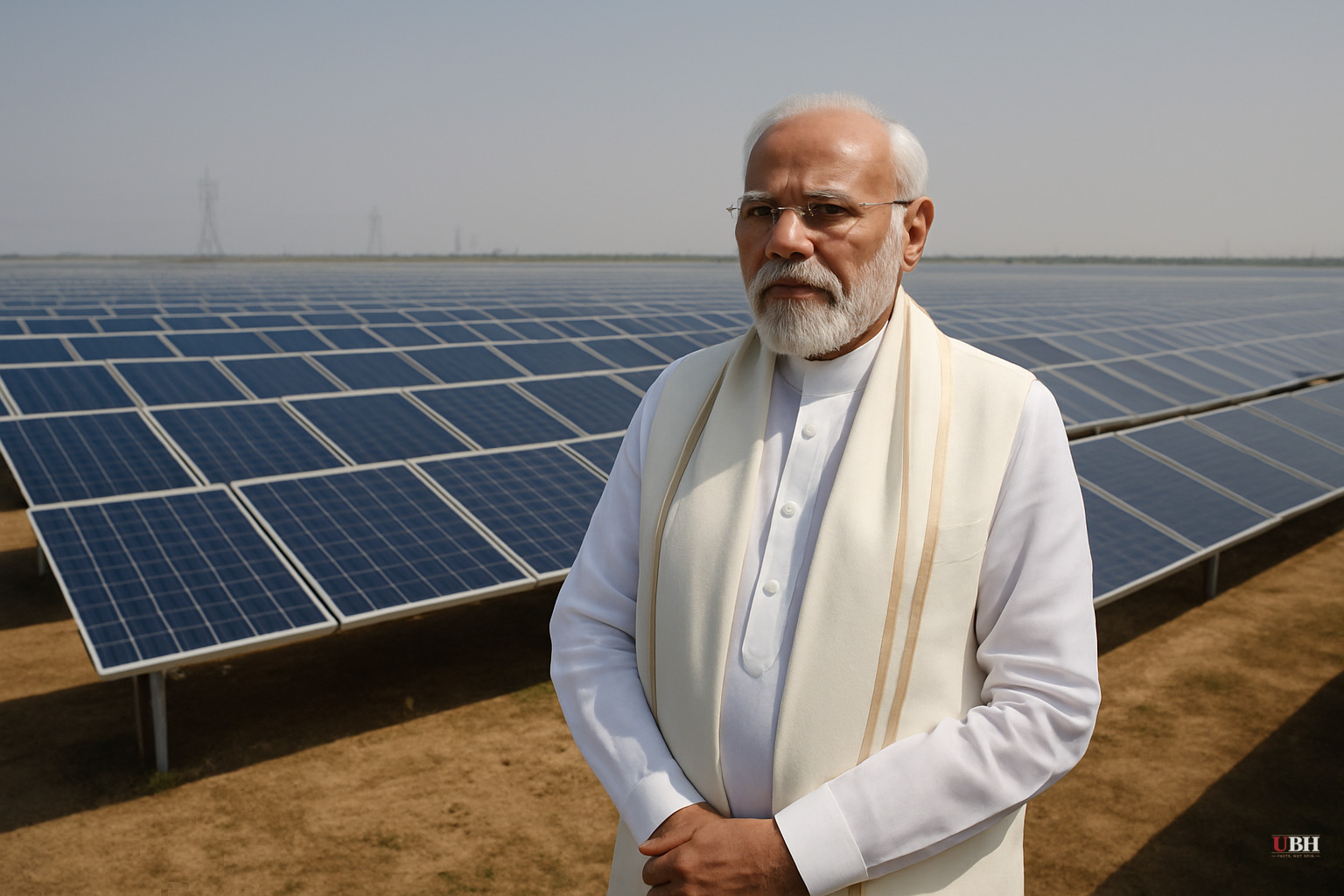
India's Solar Numbers Are Not a Projection Anymore
Through most of the 2010s, India's energy story was coal. In early 2015, Prime Minister Narendra Modi's administration set a goal to double domestic coal output to roughly 1.5 billion tonnes by 2030. That plan has since been quietly shelved, not because of politics, but because solar got cheaper faster than anyone expected.
India added 44 gigawatts of solar capacity in the 2025-2026 financial year alone, according to OilPrice.com. That single-year figure pushed the country's total installed solar capacity to 154 GW, third globally behind China and the United States in total installed base, but now second globally for annual capacity additions — ahead of the U.S.
Annual additions are growing at a 40% compound annual growth rate, and installed capacity is on track to double again by 2030, per OilPrice.com.
The Khavda Project Alone Is Staggering
The numbers get concrete fast when you look at individual projects. The Khavda solar park, located in the salt desert of the Rann of Kutch near the India-Pakistan border, spans over 726 square kilometers. When complete, it is set to become the world's largest solar farm with a generating capacity of 30 GW, enough to power roughly 25 million U.S. homes.
For scale: the entire installed solar capacity of the United Kingdom as of recent years sits below 20 GW.
Government Policy Is Doing Heavy Lifting
This boom is not purely market-driven. The Indian government has layered in multiple policy levers. The Production Linked Incentive (PLI) program subsidizes domestic manufacturing of high-efficiency solar PV modules. Green Energy Open Access Rules allow large industrial consumers — any operation with a sanctioned load of 100 kW or above — to purchase solar power directly from developers, bypassing the traditional grid utility structure.
Residential rooftop solar programs run in parallel. The policy stack is deliberate and aggressive.
The International Energy Agency projects that solar will account for roughly half of India's electricity demand growth through 2030.
Coal Is Still Running the Show, For Now
Coal still generates approximately 70% of India's electricity as of mid-2026. The grid has not transformed yet. Solar capacity and solar generation are different things. Capacity figures count nameplate output under ideal conditions, while actual generation depends on storage, transmission infrastructure, and grid integration.
Critics of the solar-first narrative argue that India's industrial load growth is so large and so fast that even a record solar buildout cannot replace coal in any near-term scenario. They have a point. New coal plant planning is winding down in India, but existing coal plants are not being retired. They are being run. The projection that coal's share drops below 50% by 2035 is an IEA estimate, not a guarantee. It assumes grid infrastructure keeps pace with generation capacity additions.
Those concerns are legitimate and worth watching. But they describe a transition timeline dispute, not evidence that the solar expansion itself is illusory. The 44 GW added in 2025-2026 is a reported figure, not a forecast.
From Importer to Manufacturer
The strategic piece that gets less attention than the raw capacity numbers: India has moved from being heavily import-dependent on solar panels — primarily from China — toward domestic manufacturing. The PLI program is central to this. A country that builds its energy infrastructure on modules it cannot produce domestically has a supply-chain vulnerability. India is actively closing that gap, according to OilPrice.com.
Solar manufacturing is a geopolitical competition. China currently dominates the global solar supply chain by a wide margin. India's attempt to carve out domestic manufacturing capacity puts it in direct tension with Chinese industrial dominance, which aligns with broader Indian foreign policy goals of reducing strategic dependence on Beijing.
What the $100 Billion Grid Investment Means
The grid modernization investment driving this buildout is substantial. Transmission infrastructure, grid balancing, and storage are the binding constraints as solar capacity scales. Generation that cannot be reliably delivered to industrial users or households does not solve an energy problem. It creates a different one.
The open question as of July 2026 is whether India's grid investment is keeping pace with its generation capacity additions. That gap, not the solar numbers themselves, determines whether India becomes the first major economy to industrialize primarily on solar power or whether coal retains its grip longer than the projections suggest.
Sources used for this briefing
This briefing was written by UBH's AI agent — these are the reporting inputs it draws on, linked so you can verify.


