
Unbiased headlines. Facts, not spin.
Unbiased Headlines is an independently owned news organization. We bring you the facts, not opinions, written fresh from 110+ named sources. Sources linked so you can verify it yourself.
 finance
Notable (6/10)
finance
Notable (6/10)
IDBI Bank Shares Fall More Than 6% After India Approves $5.5 Billion Stake Sale to Fairfax at ₹81
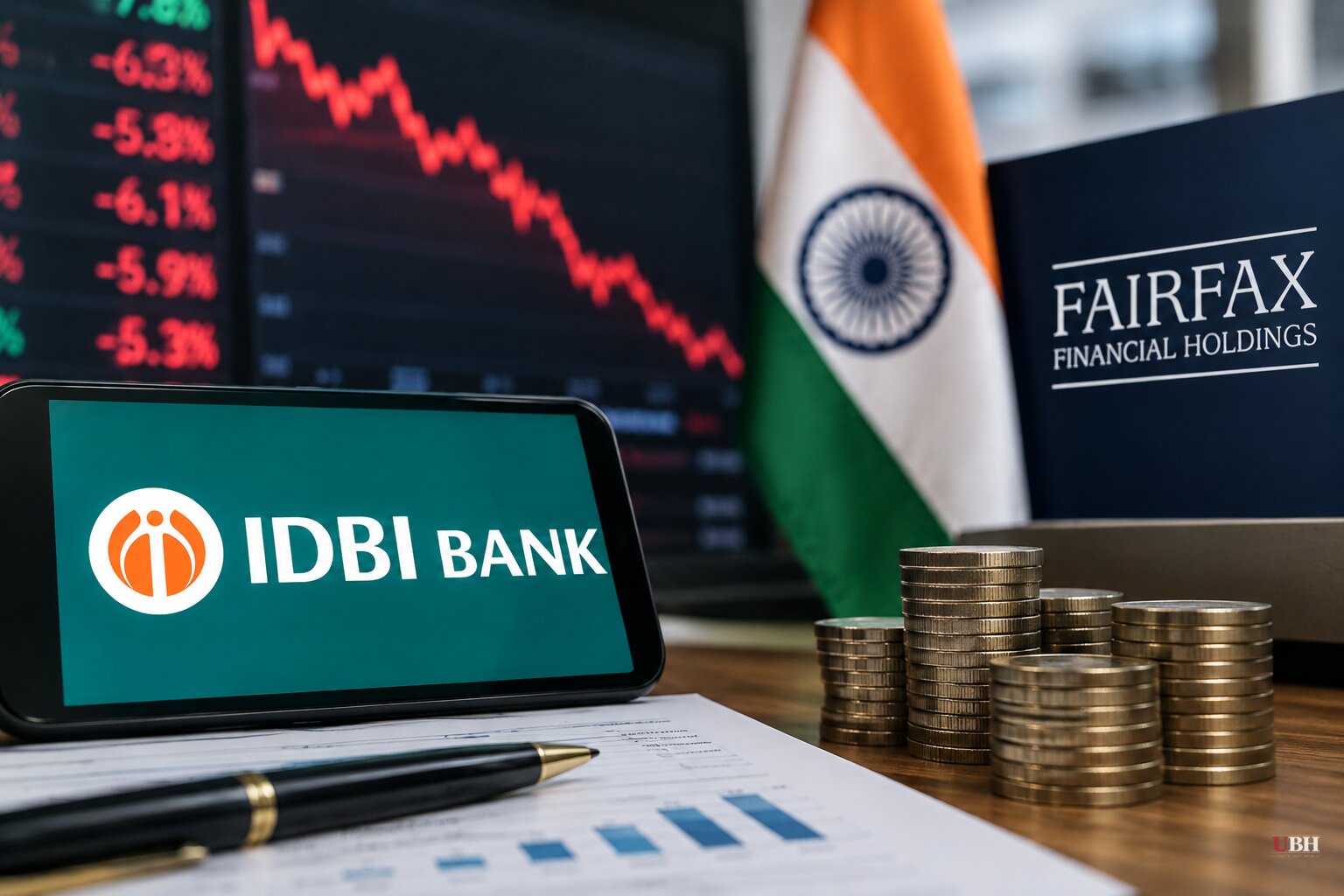
India's government has approved the sale of a controlling stake in state-owned IDBI Bank to Canada's Fairfax Financial Holdings. Investors did not cheer.
Shares of IDBI Bank fell more than 6% on Thursday, Oct. 15, after the Cabinet Committee on Economic Affairs, chaired by Prime Minister Narendra Modi, cleared the deal after market hours on Wednesday. By BSE data, the stock hit a low of ₹84.51, down 6.5%. Other trackers put the drop closer to 7%.
The deal
Fairfax will buy a combined 60.72% of the bank for ₹52,878 crore. That is about $5.5 billion.
The central government is selling 30.48%. Life Insurance Corporation of India (LIC) is selling 30.24%. When it closes, the government will hold 15% and LIC 19%, a combined 34%.
Union Minister Ashwini Vaishnaw called it India's largest foreign direct investment in the financial sector. The Finance Ministry said the same in its release.
The price is ₹81 a share. IDBI closed Wednesday at about ₹90.40, so the deal prices the stake roughly 10% below where the stock last traded.
Why the stock fell
The stock had jumped about 9% on Wednesday ahead of the announcement. Thursday's slide gave back much of that.
Independent market expert Ambareesh Baliga told Business Standard that markets had expected a sale price of ₹100 to ₹110 a share. That is closer to where IDBI traded before the West Asia war earlier this year, he said. "So to that effect, the Rs 81 per share price is a disappointment for the markets," Baliga said.
The stock is down about 19% in 2026, against a 12.6% fall in the Nifty 50. At roughly ₹84, IDBI's market capitalisation was about ₹90,567 crore. The shares still traded above Fairfax's price on Thursday, between about 4% and 5% higher in the sources' intraday figures.
The government's case
The Finance Ministry says the price beat its own yardstick. During bidding, the government set an average fair value of ₹75.99 per share. Fairfax offered ₹81. The Department of Investment and Public Asset Management confirmed that ₹75.99 was the benchmark for evaluating the revised bids.
This was also a second attempt. The disinvestment process began in October 2022. Initial financial bids in FY26 fell short of the government's reserve price of ₹94.42 per share and were rejected. The government then invited fresh sealed bids.
The ministry did not dress up the bank's history. "Due to its poor financial health, the [IDBI] Bank required repeated infusion of capital," it said, adding that after a brief recovery the government decided to sell to a "Strategic Buyer."
Finance Minister Nirmala Sitharaman framed it as growth. "Having supported the bank's recovery, we are now enabling its next phase of growth through the infusion of Foreign Direct Investment while retaining a minority stake," she wrote on X. She added that the investment reinforced that "India's growth story is strong, its economy is resilient, and the government's commitment to reform is unwavering."
What Fairfax is buying
The bank is in far better shape than it was. As of the June quarter of FY27, deposits stood at ₹3,25,757 crore and net advances at ₹2,58,968 crore. The provision coverage ratio was 99.31%.
That turnaround was paid for by taxpayers and by LIC, the state-run insurer. The government and LIC kept putting capital into the bank for years. The buyer now gets a cleaned-up balance sheet at a price below the market's recent view of its value.
LIC's role matters here. It is selling 30.24% at the same ₹81 as the government. LIC is also a listed company in which the government sold a 6.5% stake in August, raising $3.3 billion.
Part of a bigger sell-off
New Delhi has sold stakes in Cochin Shipyard, Indian Railways Finance Corp, NHPC and Coal India this year. The push comes amid deepening fiscal pressure on the government's books.
The IDBI sale is the largest of these by deal size and the only one that puts a foreign investor in control of a lender.
What happens next
The deal is not done. Fairfax must present its credentials to the Reserve Bank of India for a "fit and proper assessment." The Competition Commission of India also has to sign off. The share purchase agreement is expected to be signed and executed before the end of 2026, according to DIPAM.
The RBI's ruling on Fairfax is the next hard checkpoint. Until then, ₹81 is an agreed price, not a closed sale.
Sources used for this briefing
8 links from 7 independent newsrooms (syndicated copies of the same report count once)
These are the sources it draws on, linked so you can verify.


