
Unbiased headlines. Facts, not spin.
Unbiased Headlines is an independently owned news organization. We bring you the facts, not opinions, written fresh from 110+ named sources. Sources linked so you can verify it yourself.
 finance
Notable (6/10)
finance
Notable (6/10)
Hyperliquid's US Route Runs Through Kraken Parent Payward, Bitnomial and NinjaTrader, Pending CFTC Approval
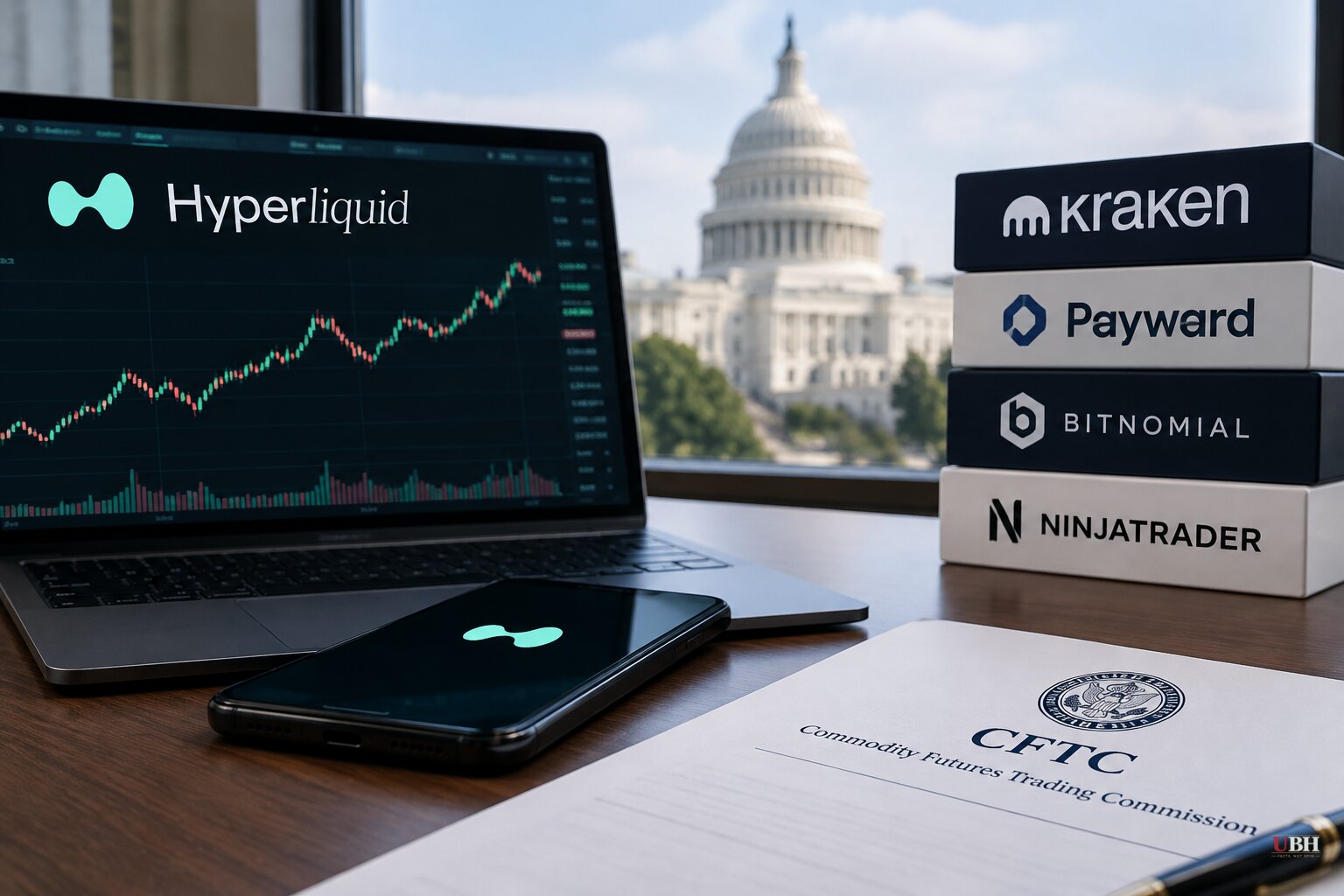
Hyperliquid's path into the US market now has named participants. The plan Jeff Yan described on Bloomberg's Odd Lots podcast, released Oct. 15, rests on a structure Kraken parent Payward announced on Sept. 16: Hyperliquid-built perpetual futures offered to US clients through firms already registered with the Commodity Futures Trading Commission.
Payward's proposal has three regulated pieces. Bitnomial Exchange, a CFTC-regulated designated contract market, would list the contracts. Bitnomial Clearinghouse, a registered derivatives clearing organization, would clear them. NinjaTrader Clearing, a registered futures commission merchant, would hold client accounts.
Payward said the listings remain subject to regulatory approval. No approval has been announced.
What Yan is asking for
Yan wants the blockchain itself treated as shared financial infrastructure, not as an exchange. Compliance duties would sit with the businesses that deploy and control markets on it.
"The regulation sits at the layer where there are controls, and indeed the deployers are the ones that exercise these controls," Yan said. Under his model, a regulated deployer would handle customer onboarding, surveillance and reporting.
Yan described this as his preferred approach, not an existing classification under US law. He also said the technology is not meant to replace banks or asset managers, comparing its potential role to how Amazon's AWS complemented existing businesses. "We're not trying to displace anything," he said.
Hyperliquid's own perpetual futures platform remains closed to US customers. Its terms of use bar US persons. Yan said some Americans get around that with VPNs and that he discourages it.
How deployers work
The markets would be built under HIP-3, the Hyperliquid Improvement Proposal that lets outside builders launch their own perpetual markets. According to Hyperliquid's documentation, each deployer must stake 500,000 HYPE tokens, the network's native token, for at least 183 days.
Yan said deployers compete for listing slots in a Dutch auction held roughly every 31 hours. The price starts high and falls until someone claims the slot. He argued that format resists the last-second bid-sniping common in conventional auctions.
The risk side has already produced a test case. Trade XYZ, an active deployer, runs the oracle system behind perpetuals on Nvidia and SK Hynix. Yan pointed to an earlier incident in which a bad SK Hynix price quote knocked the oracle off track. Trade XYZ refunded the resulting losses after publishing a detailed postmortem.
The protocol now caps how far an oracle price can move between updates at 1%. Yan also said most large traders on Hyperliquid are institutions, given the sophistication needed to market-make.
Yan said CFTC clarity would need to catch up with features such as the ability to verify in real time that user balances match the platform's holdings before legal US access becomes possible. He said he had no advance notice of President Trump's August statement that the CFTC was working to bring Hyperliquid into the US under federal regulation.
The regulator's capacity
The agency that would review the Payward listings has been shrinking. By the end of 2025, the CFTC had 21% fewer staff than its previous 10-year average, according to US Office of Personnel Management data. Staffing fell 22% between January 2024 and January 2025 alone.
Enforcement actions dropped further. The agency's annual reports show nearly 80% fewer actions in 2025 than the annual average for the previous decade.
Jeff Le Riche, who worked as a CFTC enforcement lawyer from 2005 to 2025, tied the cuts to politics. "The Trump administration had run partially on a platform that it would be friendlier to the crypto industry," he told NPR. He said people who brought cases against crypto firms "either left or were forced out," and that the staff loss "castrated the enforcement team."
The CFTC did not address that claim directly. Spokesman Zach Fulton said the agency "remains committed to promoting integrity and responsible innovation in U.S. derivatives markets" and that Chairman Michael Selig is grateful to the staff who continue the mission. The agency has not publicly accepted Le Riche's account of why enforcement numbers fell.
The Biden-era CFTC had brought fraud cases against crypto firms including Gemini, Mirror Trading, Voyager, Celsius and FTX, and against the prediction market Polymarket.
What is still open
Yan's pitch is that a regulated operator sitting between Hyperliquid and US customers answers the oversight question. The Payward structure is the first concrete test of that idea, with CFTC-registered firms handling the customer-facing obligations.
No investigation, charge or rule change is attached to Hyperliquid in any of this. The open items are procedural. Payward has not announced an approval date. The CFTC has not said how it would treat a market whose matching and settlement happen on a blockchain it does not regulate, run by deployers staking a token to participate.
Whether an agency with 21% fewer staff than its decade average can review that on a timeline Payward and Hyperliquid want is the question the next regulatory filing will begin to answer.
Sources used for this briefing
7 links from 7 independent newsrooms (syndicated copies of the same report count once)
These are the sources it draws on, linked so you can verify.


