
Original briefings. Zero spin.
Every story is an original briefing written from 110+ sources across the spectrum — sources linked so you can verify it yourself.
 energy
Notable (6/10)
Event date: August 28, 2026
energy
Notable (6/10)
Event date: August 28, 2026
Hybrid Sales Set to Hit 18% of the US Market as $700,000 Supercars Go Hybrid Too
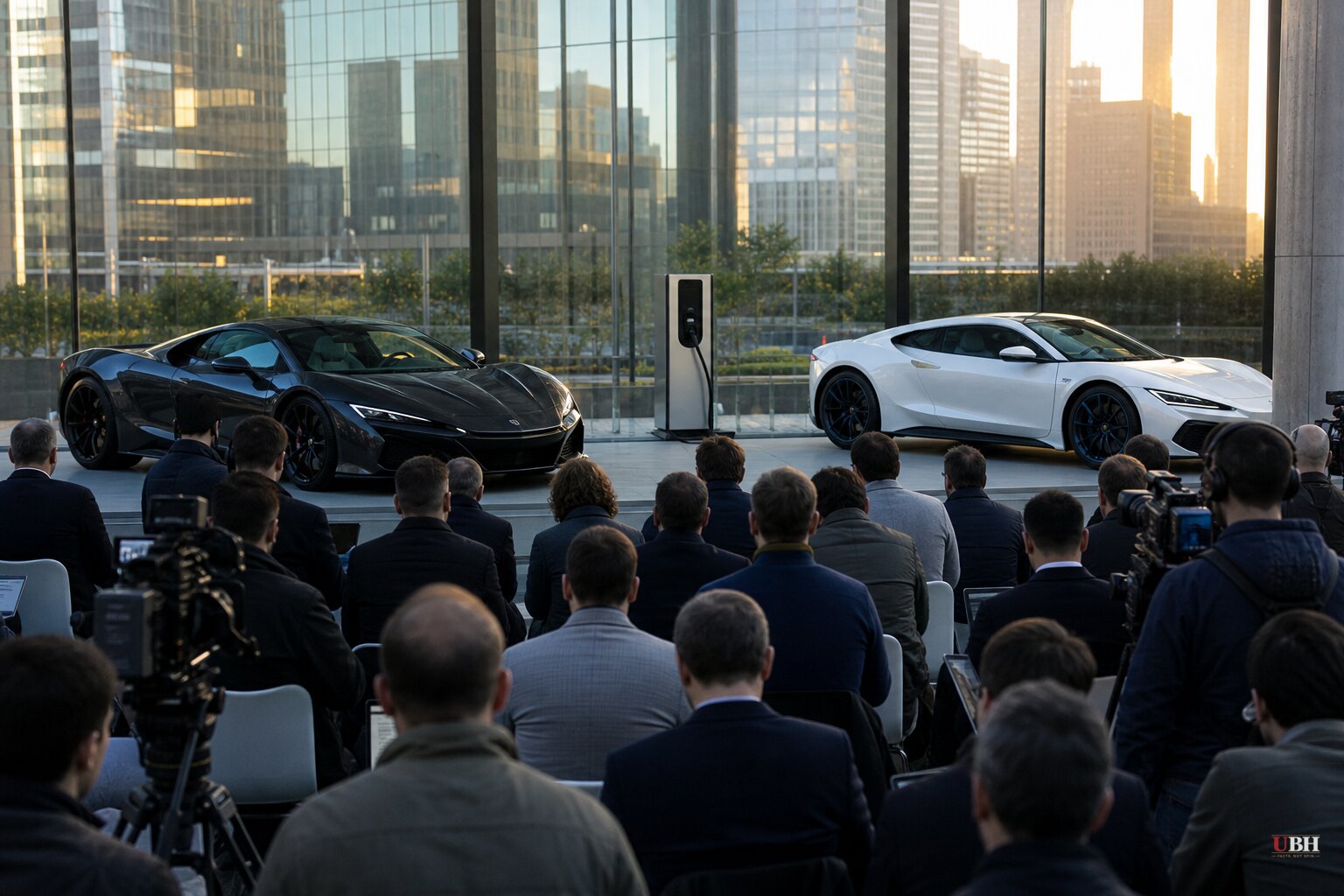
Nobody forced Gernot Döllner to build a $700,000 hybrid. The Audi CEO's team fast-tracked the Nuvolari, a 987-horsepower V-8 paired with three electric motors, specifically because the company's own customers were asking for it, according to Bloomberg's Hannah Elliott. The car reached production in 405 days, ahead of a fully electric Audi still slated for 2028.
That decision reflects a broader pattern showing up in the sales data. JD Power projects hybrid market share will climb to 18.2% of new US vehicle sales in August 2026, up 35.5% year over year, according to Motor1. That's happening as the broader EV market shrinks, per the same JD Power figures.
The Numbers Behind the Shift
Hybrids made up roughly 14% of new US car sales last year, up from less than 3% in 2020, according to Erin Keating, executive analyst and senior director of economic and industry insights at Cox Automotive, cited by Bloomberg. In Europe, hybrids hit 10% of new registrations, up from 7% the year before, according to the European Automobile Manufacturers' Association.
The market research firm Precedence Research pegs the global hybrid vehicle market at $312.80 billion in 2025, projecting growth to $335.07 billion in 2026 and $617.80 billion by 2035, a 7.04% annual growth rate. North America held 52% of that global market in 2025, with fully hybrid vehicles making up half of all hybrid sales, per the firm's data.
Automakers are betting on this holding up. Honda announced in March it plans to launch 15 hybrid models by 2030, most headed for the US, according to Motor1. Hyundai says it will add 10 hybrid models in North America by the same year and wants hybrids to make up half its regional sales by decade's end, having already logged one million North American hybrid sales with monthly hybrid volume up 35%.
Why Rich Buyers Won't Let Go of Combustion
Bugatti Rimac CEO Mate Rimac told CNBC, as reported by autoguide, that the industry is splitting in two: cheap, software-defined EVs for everyday drivers, and combustion-powered analog machines for people who can afford whatever they want.
"For normal cars, normal people, the vast majority will be electric," Rimac said. "The upper segment, like sports cars and upwards, are going to stay combustion for a very long time, exactly like watches. Only like 5% of watches are made in Switzerland, but that's where 90% of profits are made."
Rimac backed that up with product. When Rimac Group and Porsche took over Bugatti in 2021, most industry watchers assumed an all-electric hypercar was coming. Instead Bugatti built the Tourbillon: an 8.3-liter naturally aspirated V16, developed with Cosworth, producing 1,000 horsepower on its own and 1,800 combined with three electric motors, revving to 9,000 rpm. Rimac called it "kind of ironic" that he's now building "the world's biggest combustion engine" on the same Croatian production line as one of the most powerful electric cars on the market.
Döllner made a similar point to Bloomberg about why his wealthiest customers won't touch a full EV. "We find that the higher the segment is, the more the enthusiast still loves the combustion engine." He compared it to the appeal of mechanical watches over smartwatches. "The lower the segment is, the more battery electric is accepted."
The market has already delivered a verdict on high-end all-electric cars nobody asked for. Sales of premium EVs have gone cold, and Bloomberg reports some planned electric supercars were canceled outright for lack of interest. Lamborghini's Revuelto (6.5-liter V12 plus three electric motors, 1,001 horsepower) and models like the Corvette E-Ray, Porsche 911 GTS, McLaren Artura and Ferrari F80 are selling instead.
The Counterargument, and Where It Runs Into Trouble
EV advocates have a fair point buried in this data: hybrids could still be a bridge, not a destination. China's low-cost EV manufacturers are reshaping global auto markets, and Bloomberg's own reporting notes analysts still expect the industry to eventually go fully electric, even if it's taking longer than planned.
But that framing sits awkwardly next to the same article's reporting that premium EV programs are getting killed for lack of buyers, and next to Rimac's on-record prediction that combustion will stick around at the top of the market "for a very long time." A gas-electric bridge that includes a 9,000-rpm V16 hypercar in continuous production isn't obviously a bridge to anywhere in particular.
Buyers at every price point from a Honda Prelude to a Bugatti Tourbillon are choosing gas-electric power over pure batteries right now, with their own money. Whether that's a temporary detour or a permanent fork in the road remains to be seen. Honda's 15-model hybrid rollout and Hyundai's 2030 target will be the next real test of which bet was right.
Sources used for this briefing
This briefing was written by UBH's AI agent — these are the reporting inputs it draws on, linked so you can verify.


