
Unbiased headlines. Facts, not spin.
Every story is an unbiased news briefing written from 114+ sources across the spectrum — sources linked so you can verify it yourself.
 health
Major Story (7/10)
Event date: October 7, 2026
health
Major Story (7/10)
Event date: October 7, 2026
Hundreds Sue Novo Nordisk and Eli Lilly Over GLP-1 Vision Loss as Studies Fail to Settle Cause
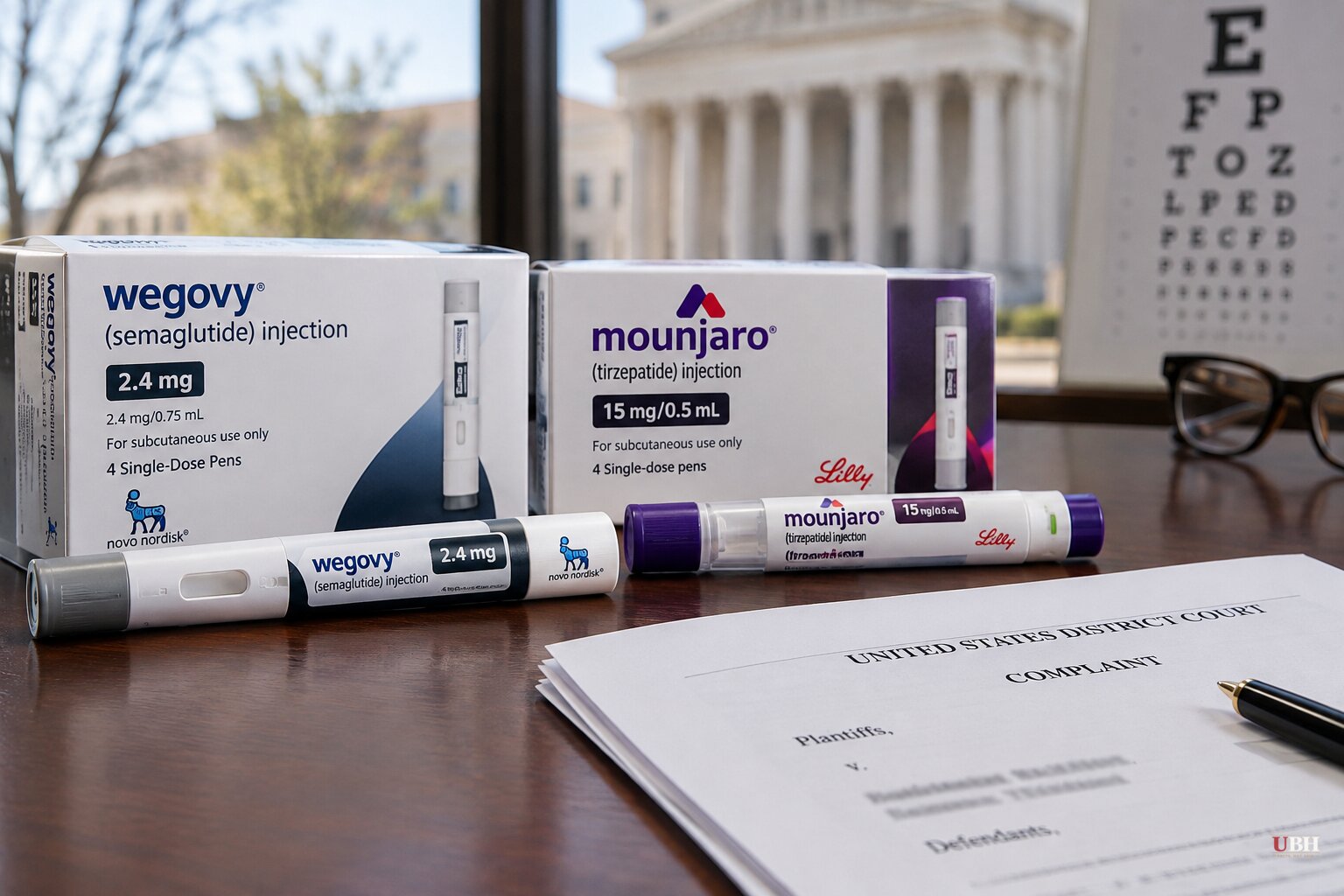
Since a safety signal surfaced at a Boston health center in 2024, the question of whether GLP-1 drugs cause a rare form of sudden vision loss has moved from medical journals into court. Hundreds of Americans have now sued the makers of Ozempic, Wegovy, Mounjaro and Zepbound, alleging they were never properly warned.
The condition is NAION, short for nonarteritic anterior ischemic optic neuropathy. Blood flow to the optic nerve is suddenly cut off. Vision loss is painless, usually permanent, and there is no treatment.
The American Academy of Ophthalmology and the National Eye Institute call it the most common cause of acute optic nerve injury in adults over 50.
The plaintiffs
Todd Engel spent four decades operating forklifts and loaders around Maryland warehouses and highways. His doctor put him on Ozempic for diabetes in early 2023. One New Year's Eve he woke with what felt like a patch over his right eye. "It was all dark. It was black," he told NPR.
His doctor diagnosed NAION. When his wife, Shelley, asked specifically about Ozempic, she recalls the doctor saying, "We have heard nothing about that."
Seven months later, JAMA Ophthalmology published research showing higher NAION rates among diabetic patients taking semaglutide, the active ingredient in Ozempic. Neither Engel nor his doctor knew. He kept taking the weekly shots until his left eye went dark too.
Engel's suit alleges Novo Nordisk failed to warn patients and doctors. It is part of two main ongoing consolidated lawsuits alleging serious harm from GLP-1 drugs.
Sandra Godby of Kentucky makes a similar claim. She says she took Ozempic and Wegovy as prescribed, developed NAION in her left eye, and suffered permanent vision loss that caused "radical changes" to her lifestyle.
What the studies show
The research is real, but it stops short of proving cause.
A 2024 Harvard Medical School study in JAMA Ophthalmology found that type 2 diabetes patients prescribed semaglutide had roughly a fourfold higher relative risk of NAION. The absolute risk stayed very low.
A 2025 analysis of 37 million adults in the same journal found a modest increase in NAION risk for semaglutide users compared with people on SGLT2 inhibitors, another diabetes drug class.
The authors of both studies said they were observational and could not prove the drug caused the condition. Most published work has examined semaglutide, not tirzepatide, the ingredient in Mounjaro and Zepbound.
A 2026 consensus statement from the American Academy of Ophthalmology and the North American Neuro-Ophthalmology Society says some studies suggest a small possible increase in risk while others find no association. It describes the overall magnitude of the risk as low.
Earlier, the same two groups said of the 2024 study: "This is not the type of study that can show the treatment caused NAION." They acknowledged a potential link and do not recommend that patients stop taking their GLP-1s.
The companies' position
Novo Nordisk says the lawsuits are "without merit." It points to later research casting doubt on a causal link, including company-funded research that found no increased NAION risk with its drugs.
Eli Lilly says it continuously monitors safety information, including potential eye issues, and that current studies do not prove GLP-1 medications cause the condition.
Doctors also point to risk factors that exist apart from these drugs. Diabetes, overnight low blood pressure and a very small optic nerve cup are among them. Diabetes is the condition many GLP-1 patients are being treated for, which complicates the comparison.
Dr. Douglas Lazzaro, an ophthalmologist at NYU Langone Health, told Fox News Digital that for many people the overall health benefits can outweigh what he called a relatively uncommon eye complication. He also said NAION "can cause some very profound vision loss."
The regulatory gap
The FDA is reviewing the potential safety signal. NAION is not specifically required on the drugs' labels. The agency said in a statement: "The FDA routinely monitors the safety of drug products postmarketing. The FDA identifies safety signals from a variety of sources, evaluates the available data and takes regulatory actions when appropriate."
The agency's adverse event database is one of the few channels for flagging problems. Reporting is mostly voluntary and the FDA does not verify the reports. That makes it a starting point for investigation, not a count of cases.
The scale of use raises the stakes. Gallup found 11 percent of U.S. adults were taking a GLP-1 for weight loss in 2026, up from 3 percent in 2024.
Even a very small absolute risk, spread across that many patients, adds up to real people. A drug that is helping tens of millions of others is also at stake.
A separate supply-chain fight
A different GLP-1 safety argument is playing out over compounded copies. Dr. Michael Burgess, a former Republican congressman from Texas and now an adviser to RX Border Defense, told a Breitbart News policy event that the FDA's "green list" of approved overseas ingredient facilities is obsolete. The list launched in September 2025 after nationwide shortages.
Burgess says shortages have ended but the list remains, with China the most heavily represented country. He called it a system of imports "with no checks, no balances." He stressed that brand-name drugs made under FDA oversight are not the concern.
The FDA has not been quoted in response to his specific claims.
What comes next
The courts will have to decide whether plaintiffs can show these drugs caused their injuries, not just that the two things happened together. The FDA has not said when its review of the NAION signal will conclude or whether it will require a label change.
Until one of those happens, patients like Engel are left arguing over a warning that regulators have not required.
Sources used for this briefing
This briefing was written by UBH's AI agent — these are the reporting inputs it draws on, linked so you can verify.


