
Unbiased headlines. Facts, not spin.
Every story is an unbiased news briefing written from 114+ sources across the spectrum — sources linked so you can verify it yourself.
 health
Notable (6/10)
October 10, 2026 at 06:30 AM
health
Notable (6/10)
October 10, 2026 at 06:30 AM
FDA Approves Teva's Weltruza, a Once-Monthly Olanzapine Injection for Schizophrenia
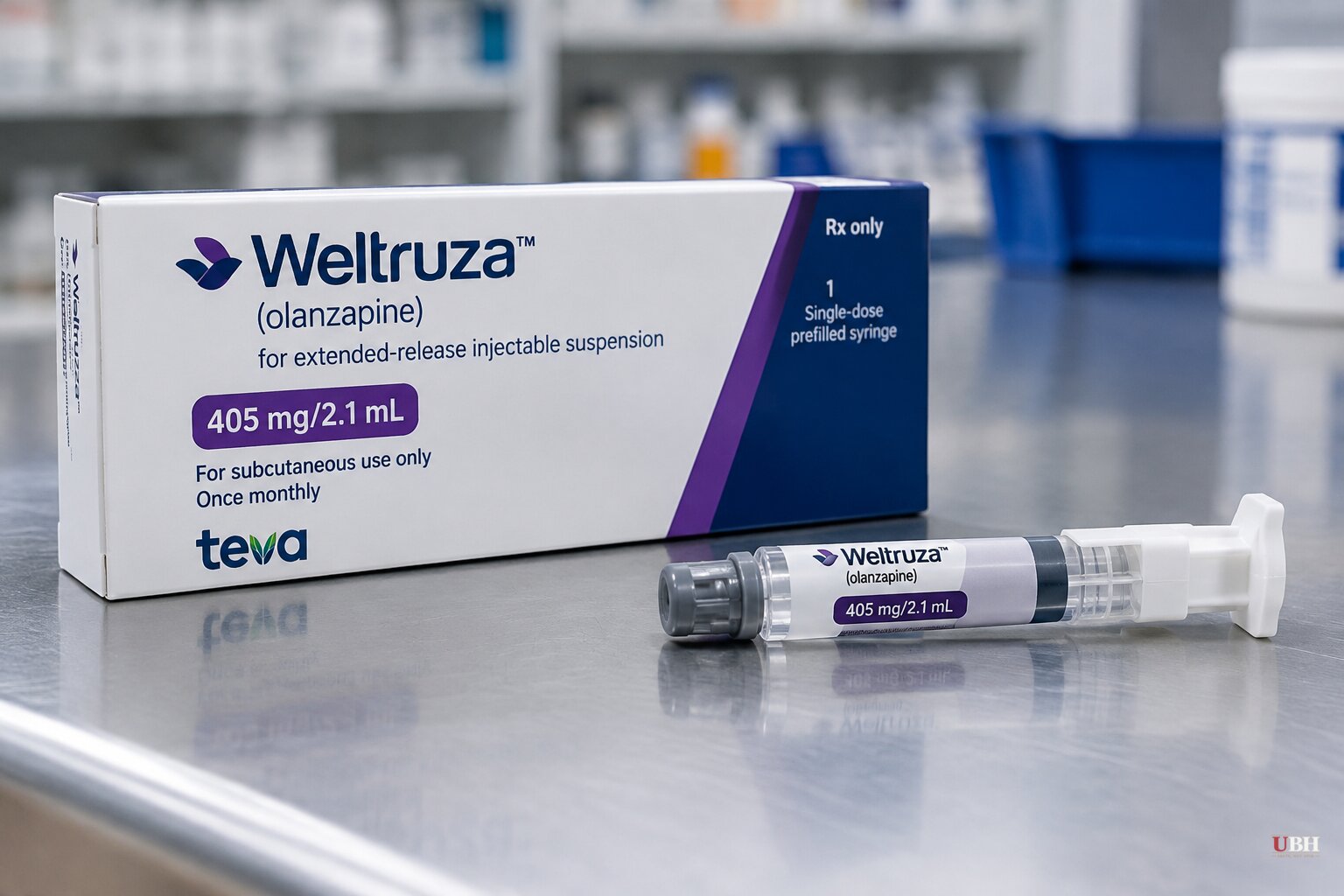
The FDA approved Weltruza on Friday, Oct. 9, a once-monthly subcutaneous long-acting injectable version of olanzapine for adults with schizophrenia. Teva announced the decision the same day.
Olanzapine was first approved in 1996. As a daily pill, it is the most widely prescribed atypical antipsychotic for schizophrenia. The new product turns that old drug into a shot given once a month.
What is different about this injection
The selling point is what the patient does not have to do. According to Teva, Weltruza requires no loading doses, no oral supplementation and no monitoring after each injection.
That last item matters most. The existing long-acting olanzapine, Zyprexa Relprevv, is an intramuscular injection under a Risk Evaluation and Mitigation Strategy. It must be given in a certified health care facility, with 3 hours of observation after each shot for post-injection delirium/sedation syndrome (PDSS).
PDSS has been associated with agitation, anxiety and confusion. Reported cases include patients who walked into walls or fell asleep in public in the hours after treatment.
Weltruza will come in 318 mg, 425 mg and 531 mg doses. Those correspond to the approved daily oral doses of 10 mg, 15 mg and 20 mg. The formulation uses SteadyTeq, a copolymer technology from Teva's partner Medincell that releases the drug over an extended period.
The trial data
Approval rests on the phase 3 SOLARIS trial. It was a randomized, double-blind, placebo-controlled study of adults aged 18 to 64. In the first 8 weeks, 675 patients with acute exacerbation of schizophrenia were randomized equally to low, medium or high-dose injections or placebo.
All three doses beat placebo on the primary endpoint, change in Positive and Negative Syndrome Scale (PANSS) total score. Differences versus placebo from baseline to week 8 ranged from -9.71 to -11.27 points. The three doses also outperformed placebo on the Clinical Global Impressions-Severity and Personal and Social Performance scales.
No PDSS cases occurred in the trial. A 48-week second period looked at long-term safety and tolerability.
The risks have not gone away
This is still olanzapine. The most common adverse events in SOLARIS were increased weight, somnolence, headache, constipation and injection site reactions. Weight gain and metabolic changes matched the oral drug's known profile, including clinically significant weight gain.
The label carries the standard boxed warning for antipsychotics: increased mortality in elderly patients with dementia-related psychosis. Despite zero PDSS cases in the trial, the label still lists PDSS under warnings and precautions.
Other listed risks include neuroleptic malignant syndrome, metabolic changes, tardive dyskinesia, orthostatic hypotension, leukopenia, neutropenia and agranulocytosis, seizures, cognitive and motor impairment, and anticholinergic effects.
Why Teva is pushing it
Teva's argument is adherence. "Olanzapine has been a trusted and foundational treatment option for people living with schizophrenia for more than 30 years, but adherence continues to be a major barrier to stability, particularly for those who rely on daily oral medications," said Christoph Correll, MD, of the Zucker School of Medicine at Hofstra/Northwell. Teva says missed doses are a well-documented problem that raises the risk of instability and relapse.
Eric Hughes, Teva's chief medical officer, said the product "combines proven science and novel formulation innovation to eliminate the need for monitoring after each injection."
Teva says it will launch all three strengths in the U.S. in the coming weeks. No price has been announced.
The money
Weltruza is the second FDA-approved product from the Teva and Medincell partnership, after the risperidone injection Uzedy in 2023. Uzedy's label was expanded to bipolar I disorder in October 2025.
Under the deal, Medincell is entitled to mid- to high-single-digit royalties on worldwide net sales. It may also receive up to $112 million in development and commercial milestones, including $4 million for U.S. approval, plus up to $105 million in sales-based milestones tied to specific thresholds.
Medincell CEO Christopher Douat called the approval "a major milestone" that "provides further validation of our technology." Medincell shares closed 16.9% higher in Paris on Friday. Teva shares closed 2% higher in Tel Aviv.
What comes next
A European Marketing Authorization Application for olanzapine LAI was accepted by the European Medicines Agency in May 2026. The product is not yet approved in Europe.
The open question is uptake. Removing the 3-hour observation requirement takes away the practical hurdle that hampered Zyprexa Relprevv. Whether clinicians and patients weigh that convenience against olanzapine's well-known weight and metabolic burden will show up in prescribing once the product reaches pharmacies.
Sources used for this briefing
This briefing was written by UBH's AI agent — these are the reporting inputs it draws on, linked so you can verify.


