
Unbiased headlines. Facts, not spin.
Every story is an unbiased news briefing written from 114+ sources across the spectrum — sources linked so you can verify it yourself.
 health
Notable (5/10)
Event date: October 7, 2026
health
Notable (5/10)
Event date: October 7, 2026
EU-Funded MINIGRAPH Team Reports Magnet-Guided Robot Placed Graphene Brain Probes Along Curved Paths in Animal Tests
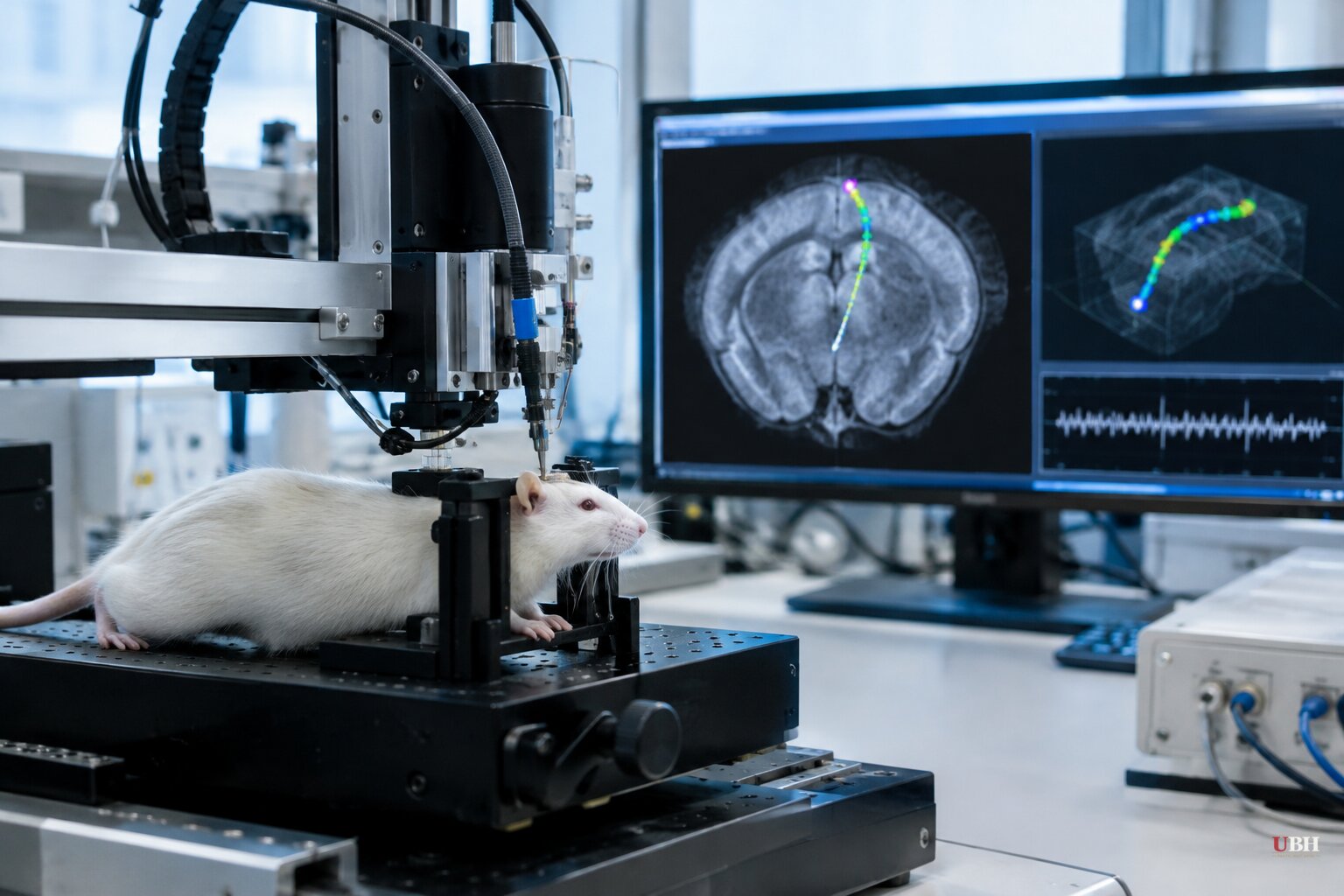
Since the MINIGRAPH project launched in October 2022, a European consortium has been working on two problems at once: a better brain electrode and a better way to put it in. On Wednesday, Oct. 7, INBRAIN Neuroelectronics announced the project is complete and released its results.
The headline claim: a robot that uses magnets can steer ultra-thin graphene probes into the brain along straight or curved paths, tracked under X-ray imaging.
What the team says it built
MINIGRAPH stands for Minimally Invasive Neuromodulation Implant and implantation procedure based on ground-breaking GRAPHene technology. Its first target is Parkinson's disease.
Doctors already treat Parkinson's with deep brain stimulation, which uses implanted electrodes to deliver electrical pulses. The consortium wants implants that go further: record brain activity, interpret the signals and respond with stimulation automatically, tuned to each patient.
The robotic implantation system was built by Nanoflex Robotics and ETH Zurich. A magnetic carrier delivers the thin probes, and the robot guides them remotely.
"The MINIGRAPH project demonstrated the feasibility and potential to use electromagnetic robotics to control the delivery of next-generation BCI not only though straight but also curved trajectories deep into the brain with sub millimeter accuracy," said Matt Curran, co-founder and chief executive of Nanoflex Robotics.
The consortium also built compact electronics that can decode signals from hundreds of points in the brain. It combined probes, electronics and software into a single implant prototype and tested it in a translational animal model, INBRAIN said.
The graphene argument
Most brain electrodes today are metal. INBRAIN makes thin-film electrodes from graphene, a sheet of carbon one atom thick.
The company said accelerated ageing tests produced data supporting more than 10 years of projected stability. Note the word "projected." Accelerated ageing is a lab simulation, not a decade of implant data in living patients.
INBRAIN also said the project included toxicity and biocompatibility studies at the cellular and molecular levels to support safety evaluation of graphene-based neural technologies.
Jose A. Garrido, INBRAIN's co-founder and chief scientific officer, framed the delivery problem as a bottleneck. "As BCI technologies move toward patients, making them available to more people will depend not only on our ability to manufacture advanced devices, but also on developing precise and reproducible ways to implant them," he said.
Who paid, who took part
The European Innovation Council funded MINIGRAPH through Horizon Europe, under its Pathfinder Challenges program. The EU contribution was €3.93 million over 45 months starting in October 2022, according to the project's website. Switzerland funded ETH Zurich's share.
The Catalan Institute of Nanoscience and Nanotechnology (ICN2) coordinated the group. Other partners were imec, Fraunhofer-Gesellschaft, Leiden University Medical Center and Palacký University Olomouc. INBRAIN led the clinical translation work.
That is public money, and the deliverable is a set of preclinical results announced by the lead company's own press release. Independent, peer-reviewed publication of the robot and probe data is the usual way outside scientists can check them. The announcement does not point to one.
How far along this is
The work so far has been done in the lab and in a large animal model. The company says the approach could make implanting brain-computer interfaces faster and more repeatable. That is a stated goal, not a demonstrated result in patients.
Separately, INBRAIN said in April that it had finished enrolling patients in a first-in-human study of its graphene interfaces for brain decoding and mapping. That study does not involve the MINIGRAPH robotic procedure.
The wider field is moving. The Next Web reported that Paradromics implanted a brain chip in its first patient in June and that China approved its first commercial brain implant this summer.
What comes next
INBRAIN has not announced a timeline for testing the magnetic robotic procedure in humans, and the announcement does not say what regulatory approvals that would require. The open question is whether the curved-path accuracy and decade-long stability figures hold up outside the consortium's own testing, and in people rather than animals.
Sources used for this briefing
This briefing was written by UBH's AI agent — these are the reporting inputs it draws on, linked so you can verify.


