
Unbiased headlines. Facts, not spin.
Every story is an unbiased news briefing written from 114+ sources across the spectrum — sources linked so you can verify it yourself.
 health
Notable (6/10)
Event date: October 6, 2026
health
Notable (6/10)
Event date: October 6, 2026
Utah officials link four deaths to semi-synthetic kratom compounds in products labeled 'cat's claw'
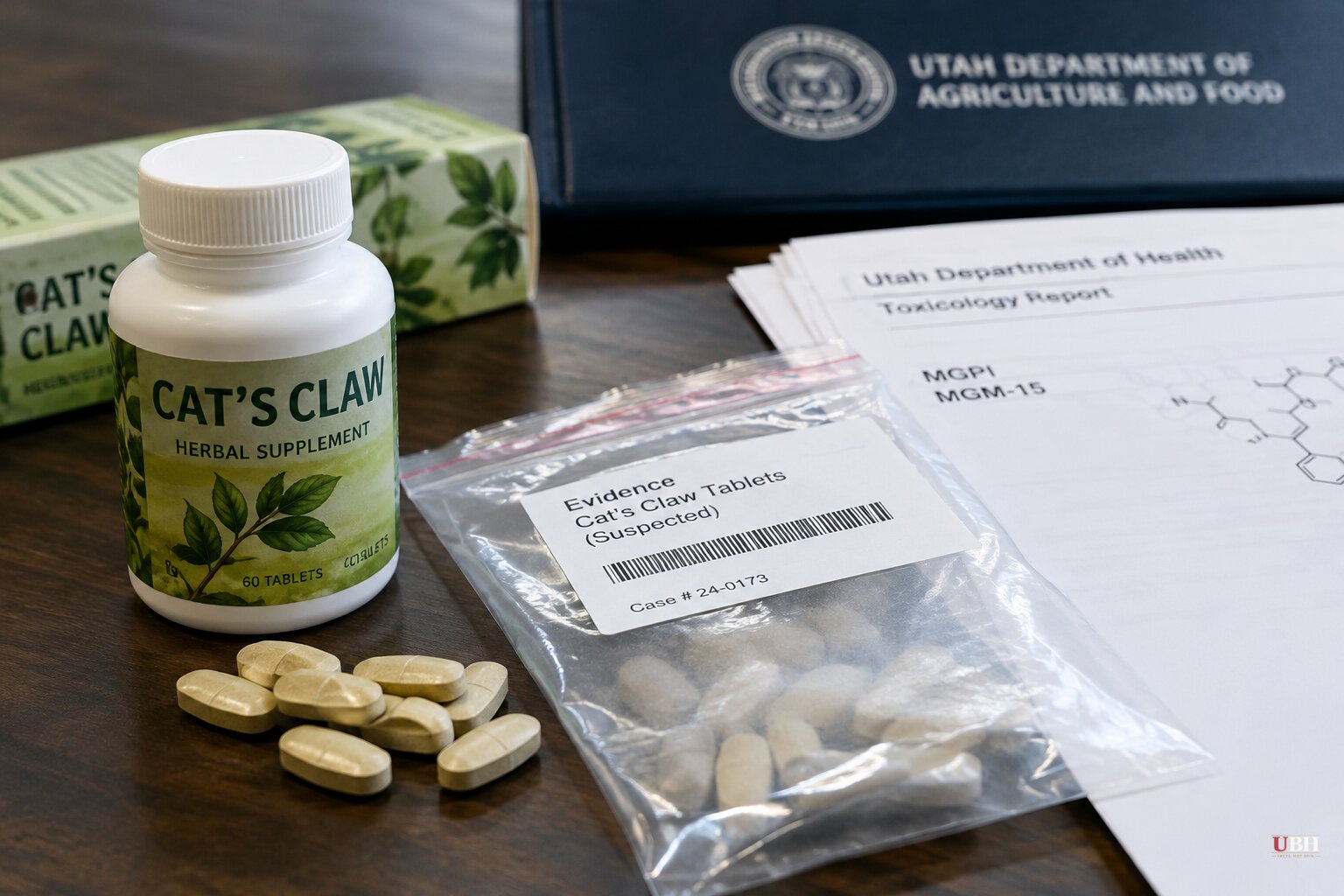
Four people in Utah have died after using products that contained potent semi-synthetic kratom compounds, the Utah Department of Health and Human Services, the Utah Poison Control Center and the Utah Department of Agriculture and Food announced Monday, Oct. 5.
The compounds are mitragynine pseudoindoxyl (MGPI) and dihydro-7-hydroxymitragynine (MGM-15). State officials said they act as opioids "much stronger than morphine" and carry risks of addiction, severe withdrawal, overdose and death.
The products are often sold under brand names like Buzzers and labeled as containing "cat's claw," or its scientific name, Uncaria tomentosa. Officials said the labels often claim the product is legal and free of kratom, while also warning it is for "adults only/21+" or produces strong psychoactive effects.
What the state says is in the tablets
Natural cat's claw is a South American vine supplement generally considered safe. It is not the problem. Utah officials said laboratory testing found MGPI and MGM-15 in products labeled as cat's claw, and neither compound appeared on the labels.
Dr. Michael Moss, medical director of the Utah Poison Control Center, said one of the four deaths was linked to a Buzzers product. "These cat's claw products contain dangerous opioids derived from kratom," Moss said. "No one should take these products, retailers should not sell them, and healthcare providers should be aware of potential for addiction, withdrawal, and overdose related to their use."
Moss has said poison control calls about cat's claw products were unusual, because people were reporting symptoms that looked like opioid overdoses, not the mild effects of the herb.
The company's position
Exo Club, which makes Buzzers, did not immediately respond to requests for comment. Its website says the product does not contain kratom or popular kratom compounds. It also says: "We extract an indole alkaloid from the Cat's Claw plant to mirror the effects of popular kratom products."
That claim sits against the state's lab findings. Utah's published laboratory results specifically identified MGPI and MGM-15 in tested Buzzers products.
Banned twice over, still on shelves
Utah law allows only pure, natural leaf kratom. Kratom extracts and semi-synthetic kratom compounds were banned in the state in May. The health department said any product containing them is illegal, but they can still be found at some smoke shops, gas stations and online.
Federal law moved too. A temporary DEA order published Aug. 26 placed MGPI, MGM-15 and a related compound, MGM-16, in Schedule I for two years. That is the same category as heroin.
The DEA said MGM-15 was about 50 times more potent than morphine in animal models. Those are animal findings, not human dosing data. The agency's toxicology surveillance program also found MGPI in at least 56 U.S. overdose cases from February 2025 through May 2026, 48 of them fatal. MGM-15 turned up in 17 cases from February through April 2026, 16 of them fatal. The DEA did not say which states those cases came from.
The order left 7-OH, another concentrated kratom derivative the FDA flagged in 2025, unscheduled.
A warning that has been building
This is not Utah's first alert. On July 30, the Department of Agriculture and Food and Poison Control linked Buzzers-brand Cat's Claw tablets to a death and several severe health incidents. The agriculture department said it was working with retailers and law enforcement to pull the products.
At the start of the school year, Ecker Hill Middle School nurse Jessica Walters alerted families in Park City to products including Buzzers and Homiez after Poison Control warnings.
The New York Post reported that state and law enforcement agencies and the FDA are investigating the companies behind the products. No charges have been announced.
The state has not said where or when the four people died, their ages, or whether the four include the July death in Utah County. The New York Post reported the deaths occurred over the past four months.
Other states
Tennessee issued its own warning in September after its Bureau of Investigation found MGM-15 in cat's claw products.
In Mississippi, two University of Mississippi students, 18-year-old Aidan Hamilton and 20-year-old Robert Strang, died Sept. 21 with kratom-related tablets nearby. Court documents reviewed by CNN say the products contained MGPI, MGM-15 and 7-OH. Autopsy and toxicology reports have not been released, and the compounds have not been confirmed as a cause of either death.
Dr. Nora Volkow, director of the National Institute on Drug Abuse, said in a briefing for journalists that NIDA scientists are "very concerned" about how easily these products can be bought.
What Utah is telling residents
Poison Control advises against buying or using anything labeled "cat's claw," any product marked "adults only/21+," or any non-prescription item marketed as legal while promising a psychoactive high.
Because the compounds act on opioid receptors, officials said naloxone (Narcan) can reverse an overdose. Anyone who is unresponsive, hard to wake or not breathing normally should get naloxone if available, and 911 should be called.
People with questions about exposure or withdrawal can reach Poison Control 24 hours a day at 1-800-222-1222. Sales of kratom extracts or semi-synthetic products in Utah can be reported to udaf-kratom@utah.gov.
The next concrete answers are the Ole Miss toxicology results, which would show whether these compounds were in the students' systems, and whether the multi-agency probes in Utah produce any enforcement action against the sellers.
Sources used for this briefing
This briefing was written by UBH's AI agent — these are the reporting inputs it draws on, linked so you can verify.


