
Unbiased headlines. Facts, not spin.
Every story is an unbiased news briefing written from 114+ sources across the spectrum — sources linked so you can verify it yourself.
 health
Major Story (7/10)
Event date: October 3, 2026
health
Major Story (7/10)
Event date: October 3, 2026
HHS Sets 1 mg/g Threshold for 7-OH as DEA Issues New Kratom Notices of Intent
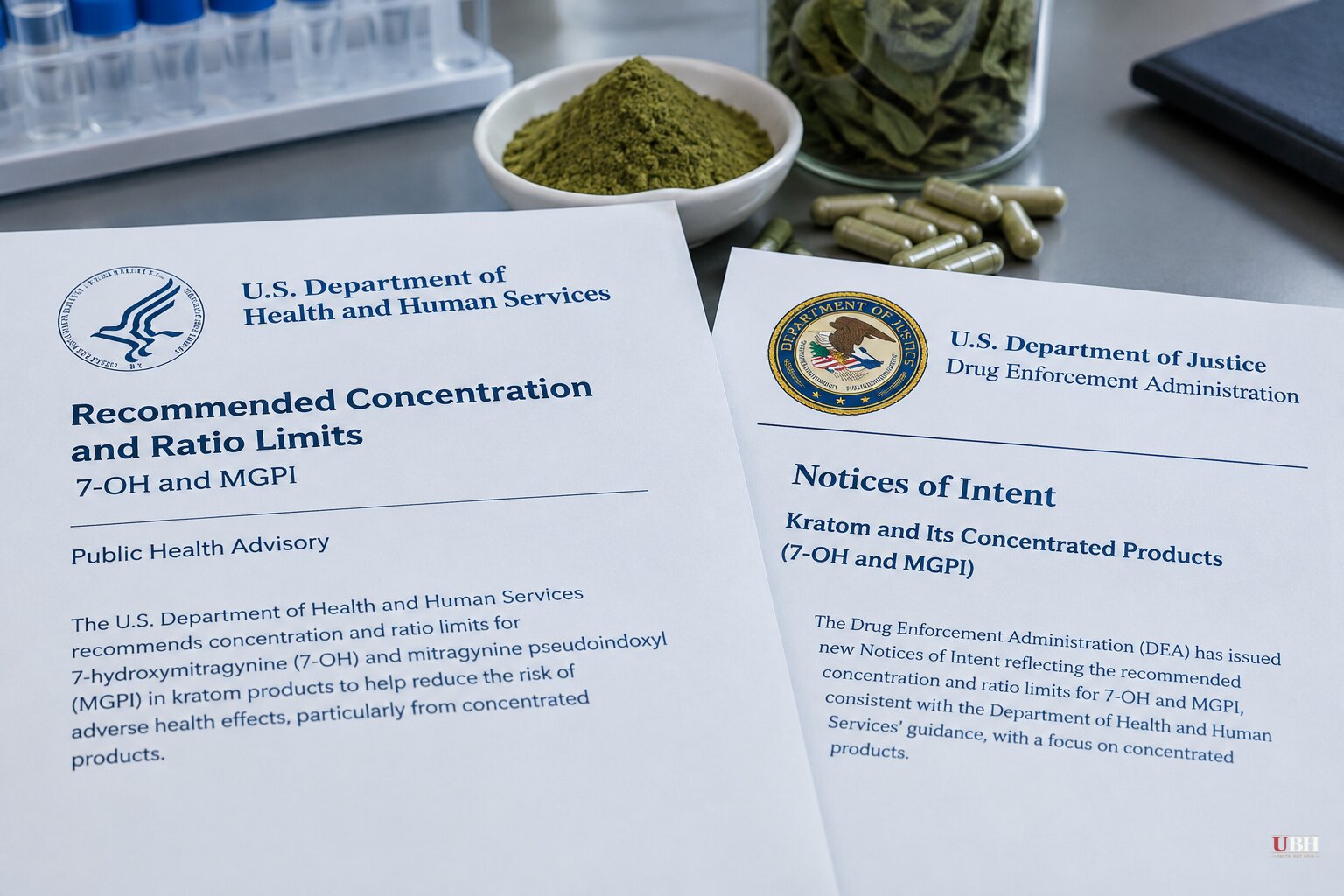
Since the DEA announced in July that it would temporarily place 7-hydroxymitragynine (7-OH) in Schedule I, the fight has moved from whether to act to where the line gets drawn. On Oct. 9, HHS answered that with numbers.
HHS Assistant Secretary for Health Adm. Brian Christine recommended that the DEA use concentration or ratio thresholds to decide which products containing 7-OH and mitragynine pseudoindoxyl (MGPI) fall under Schedule I. The Justice Department said the DEA issued new Notices of Intent reflecting that recommendation.
The thresholds
Under the HHS recommendation, either compound, or the two combined, would be controlled when they exceed 1 milligram per gram in solid powders, capsules or other solids. In liquids the limit is 1 milligram per milliliter.
The second test is a ratio. A product is covered if the mass of mitragynine divided by the mass of 7-OH, MGPI, or both combined is less than 100. HHS says that ratio tracks the alkaloid makeup of natural kratom, where 7-OH exists only in trace amounts.
The stated aim is to hit concentrated or chemically altered products while separating them from natural botanical kratom. HHS Secretary Robert F. Kennedy Jr. said the department is "drawing a clear line between natural kratom and dangerous, enhanced opioid products."
Attorney General Todd Blanche said: "Dangerous and addictive opioids do not belong behind convenience store counters."
Effective date and the industry lawsuit
Pain News Network reports the amended order will be published in the Federal Register next week and take effect Nov. 13, with no further public comment period. That date comes from the outlet's own reporting. Neither HHS nor DOJ gave it in the statements quoted here.
The outlet also reports the changes follow a lawsuit the American Kratom Association filed against the DEA in July. The group represents natural leaf vendors. It backed scheduling 7-OH but wanted MGPI carved out. The DEA had banned MGPI only about two months earlier.
Mac Haddow, an association lobbyist and spokesman, said the DEA "established a carveout for mitragynine pseudoindoxyl, and they changed the standard for 7-OH to a much more restrictive standard, which we fully support because it captures more of the potential synthetic products that they could tinker with." Under the thresholds, MGPI is controlled only above the stated limits rather than outright.
Haddow made a similar case on Oct. 1, arguing that synthetic opioids should not be labeled kratom.
The push to ban the whole plant
Not everyone is satisfied with a line between extracts and leaf. The Foundation for Drug Policy Solutions, working with Smart Approaches to Marijuana, is running an ad campaign titled "Football, Not Funerals" that calls on President Trump and Congress to ban kratom entirely. Its president, Dr. Kevin Sabet, said: "Kratom is dangerous in all its forms, and it's time to shut down the addiction economy."
The group argues that the body converts mitragynine into 7-OH, so leaving the leaf on shelves leaves the drug there too. Its campaign site cites 5,208 overdose deaths involving kratom from 2020 to 2024. That figure is the group's own. The site also cites a rise in poison-center exposure reports from 258 in 2015 to 3,434 in 2025.
According to Pain News Network, three U.S. senators this week called for all kratom products, leaf included, to be scheduled or banned. Earlier this year, Sens. Pete Ricketts and Richard Blumenthal led a bipartisan letter, signed by nine colleagues, asking the FDA to consider scheduling both 7-OH and the whole leaf.
At the federal level, leaf kratom remains legal. Some states and localities ban it.
The Ole Miss case
Pressure intensified after University of Mississippi students Aidan Hamilton and Robert Strang were found dead on Sept. 21. Investigators found kratom derivative products in both cases.
Federal prosecutors have said both deaths appear consistent with drug overdoses. It is still not clear whether the substances contributed to either death. Gov. Tate Reeves said two state agencies were working to expedite toxicology reports.
Prosecutors have charged store clerk Yahya Mohamed Mosleh, 51, and his son Islam Yahya Mosleh, 18, each with one count of possession with intent to distribute a controlled substance. The charges concern the sale of an illegal kratom product at an Oxford vape and tobacco store. Bank records show Hamilton made multiple purchases there in September, according to a federal court filing.
In an affidavit, DEA Special Agent Michael Dassance said an informant bought kratom-based pills from the elder Mosleh on Sept. 24. He said Mosleh warned the informant to "be careful taking the pills because people were dying from them." The agent also said one of the compounds the DEA banned in August was listed as an ingredient in products seized from the store and from Hamilton's room.
The defendants appeared before a magistrate judge, who found sufficient evidence to proceed. Their attorneys, Scott Davis and A.E. Harlow Jr., had no comment. Lafayette County Metro Narcotics said additional charges are possible.
What comes next
The amended order is expected in the Federal Register next week. If Pain News Network's Nov. 13 date holds, products above the 1 mg/g and 100-to-1 limits will be illegal Schedule I substances from that date.
The pending toxicology results in Mississippi will show what role, if any, kratom compounds played in the two deaths. Whether Congress or the White House moves against the leaf itself, as the senators and the Foundation for Drug Policy Solutions are urging, remains undecided.
Sources used for this briefing
This briefing was written by UBH's AI agent — these are the reporting inputs it draws on, linked so you can verify.


