
Unbiased headlines. Facts, not spin.
Unbiased Headlines is an independently owned news organization. We bring you the facts, not opinions, written fresh from 110+ named sources. Sources linked so you can verify it yourself.
 economy
Notable (5/10)
Event date: November 7, 2026 ·
Hundreds Rally in Latvia Against Russian Grain Transit as Prime Minister Promises Bill Barring New Contracts
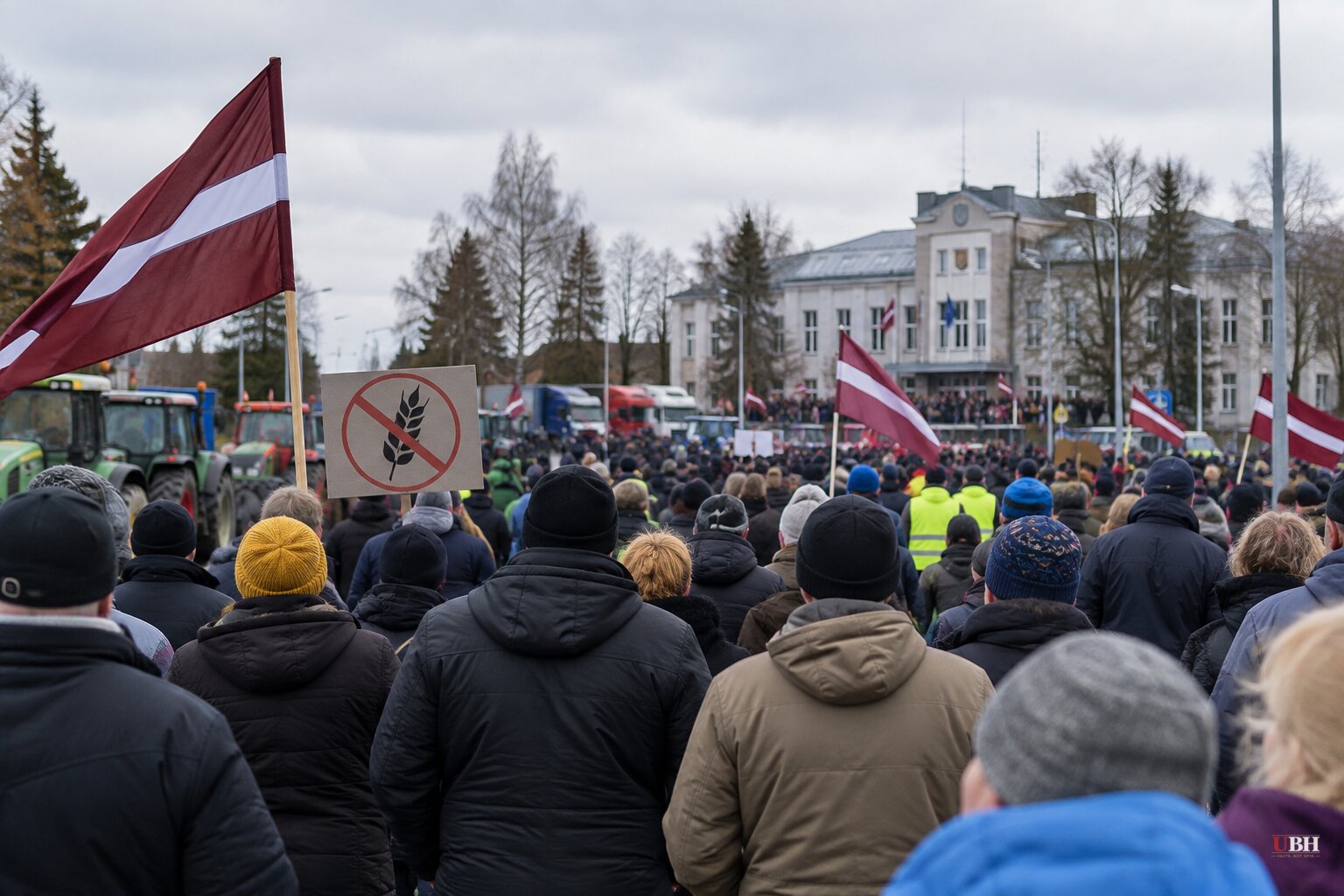
Latvia's government is under pressure from its own farmers to stop Russian grain from crossing the country by rail. On Saturday, Nov. 7, protesters in the city of Jēkabpils put that demand in front of the prime minister himself.
The rally, held under the slogan "No to blood grain!", began at 11:00 a.m. on Madonas Street. The goal is a complete ban on transit through Latvia's railway network of grain from Russia and from Russian-occupied parts of Ukraine.
Turnout and the crowd
Ukrainian outlet ua.news, citing Ukrinform, put attendance at more than 300 people and about 200 vehicles, including tractors, grain lorries and cars decorated with Latvian and Ukrainian flags. Ukrainska Pravda, citing Latvian portal Delfi, described several dozen heavy vehicles. Kulbergs spoke to what was described as hundreds of protesters.
That is well below what was projected before the event. Latvian public broadcaster LSM had reported organizers expecting up to 2,000 people and between 150 and 400 tractors. Organizer Gundars Kalve had said the machinery column could stretch 15 kilometers on a planned 22-kilometer route through Jēkabpils and along the bypass toward Riga.
This was the second demonstration on the issue. The first was in September. Local authorities approved Saturday's event, and several dozen organizations backed it, including the charity Ziedot.lv, the Farmers' Parliament and the Museum of the Occupation of Latvia.
What the protesters say
Kalve, a farmer and civic activist, argues the transit helps pay for the war. Rūta Dimanta, head of Ziedot.lv, was blunt: "We help Russia fill its budget, which goes to military needs, and Russia uses this money to create new weapons, killing children, the elderly, and soldiers in Ukraine. And this essentially makes us accomplices."
Some participants also said Latvian farmers are losing money because of the grain flows, according to Delfi's account of the rally.
The volume is significant. Latvia's State Revenue Service (VID) data shows Russian grain transit through the country rose 3.1-fold in the first 10 months of 2026 compared with the same period in 2025.
The prime minister's position
Kulbergs attended and agreed with the protesters on the principle. He said the transit must stop and that Latvia must not "fuel the Russian military machine." He said a bill will go to the Saeima that would stop transit by banning new contracts, and that ministries will coordinate on it next week.
He also admitted a quick fix has not been found. A ban at the Latvian level alone, he said, would not be effective. He argued transit restrictions fall under EU authority, that Latvia must follow the generally applicable rules, and that going alone could bring penalties that hit Latvian farmers too. He said all three Baltic states are pushing for an EU-level ban.
Earlier, Kulbergs defended the lack of a ban by saying the grain belongs to companies in allied countries, including the United States and Japan, according to LSM's reporting.
Kalve rejects that. Speaking on TV3 before the rally, he said of the claim that transit cannot be stopped: "It is possible. It is a lie."
The two positions are not identical. The bill Kulbergs described would block new contracts, not end existing ones. Kalve and his supporters want a complete halt. The prime minister has not said how existing transit agreements would be handled or when the bill will reach the Saeima floor.
The deadline
Saturday's event was planned as a peaceful gathering, and Kalve said before it that organizers did not intend to obstruct rail traffic this time. He described it as a show of "readiness to go further."
He also set a clock. The government has two weeks to end transit entirely, he said. If it does not, protesters will move to "the next stage of escalation" on Nov. 22. Kalve has signaled that could involve blocking freight trains.
The next concrete markers are the inter-ministry coordination Kulbergs promised for the coming week, the text and timing of the Saeima bill, and Kalve's Nov. 22 deadline.
Sources used for this briefing
7 links from 7 independent newsrooms (syndicated copies of the same report count once)
These are the sources it draws on, linked so you can verify.


