
Unbiased headlines. Facts, not spin.
Every story is an unbiased news briefing written from 110+ sources across the spectrum — sources linked so you can verify it yourself.
 health
Notable (5/10)
June 11, 2026 at 02:00 PM
health
Notable (5/10)
June 11, 2026 at 02:00 PM
Human Embryo Gene Editing Is Moving Faster Than the Rules That Govern It
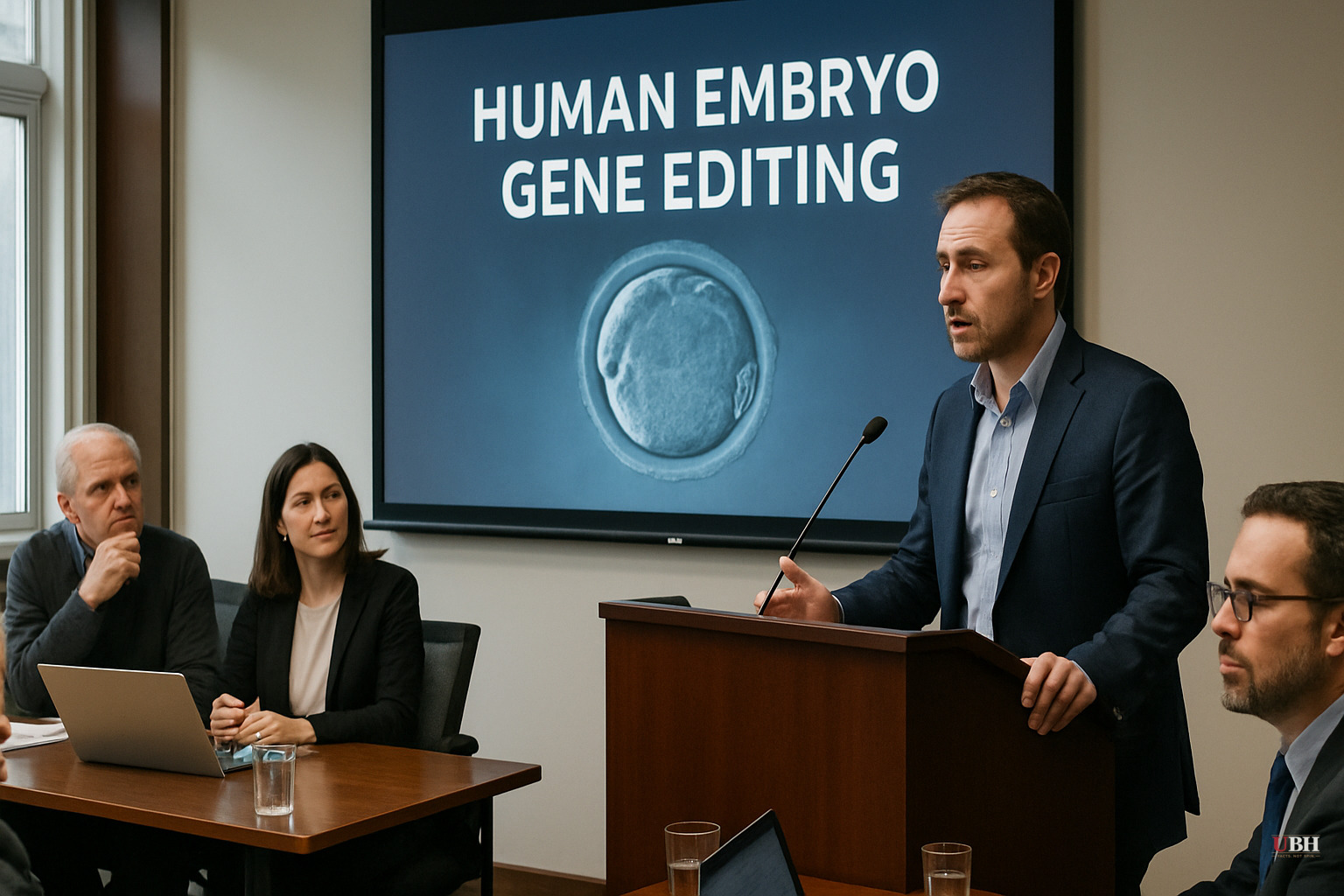
Since Columbia University scientists reported refined base-editing techniques on human embryos on June 8 — while acknowledging the mosaicism problem remains unsolved — the broader question of who decides the rules for heritable human gene editing has come back into sharp focus.
That question does not have a clean answer.
What We Actually Know
Base editing — a more precise cousin of CRISPR — can rewrite single DNA letters in a human embryo. The Columbia team made measurable progress in reducing off-target edits. But mosaicism, where only some cells in an embryo carry the intended change, remains an unresolved technical hurdle according to the Columbia researchers themselves.
A mosaic embryo does not uniformly express the intended genetic change. It could pass a patchwork of edited and unedited sequences to every subsequent generation. The science is not ready for clinical use — and the scientists said so.
The Governance Gap Is Real
There is no binding international law that stops a well-funded lab in a permissive jurisdiction from implanting a base-edited embryo tomorrow.
The International Commission on the Clinical Use of Human Germline Genome Editing — convened jointly by the U.S. National Academies of Sciences and the Royal Society — stated in its 2020 report that heritable human genome editing should not proceed until safety and efficacy criteria are met AND a broad societal consensus is established. That report is now six years old. No binding enforcement mechanism was attached to it.
In the United States, the FDA has jurisdiction over biological products used in clinical trials, and a congressional rider has blocked the agency from reviewing applications involving heritable genetic modification since 2016. That rider has been renewed every budget cycle since. So the U.S. posture is effectively: federally funded research can study this, but no one can bring it to a clinical pregnancy on American soil — at least not with FDA sign-off.
China's posture is different. He Jiankui edited embryos that became live-born children in 2018. He was sentenced to three years in prison by Chinese courts. But the scientific data from that experiment — data generated from actual human beings — remains in the literature and has been cited in subsequent research.
The Strongest Case for Moving Forward
The pro-research argument deserves a fair hearing.
Some genetic diseases are catastrophic, heritable, and caused by a single well-characterized mutation. Sickle cell disease. Huntington's. Tay-Sachs. Parents who carry these mutations face genuinely agonizing choices — and preimplantation genetic testing (PGT) already allows selection of unaffected embryos in IVF. The argument goes: if you can already select against a disease embryo, why is editing a diseased embryo to make it healthy categorically different? The end state — a healthy child — is the same.
This argument is made by serious scientists and serious bioethicists.
Why the Counter-Argument Holds Weight
The counter-argument has structural force.
First, an edited embryo that becomes a person passes those edits — intended and unintended — to every biological descendant. This is categorically different from somatic gene therapy, which affects only the patient. The consent problem is permanent: no future generation consented to inherit these edits.
Second, "fix disease" is a clear goal but a fuzzy line. Height. Intelligence. Athleticism. These are also partly genetic. The same editing tools that fix a Huntington's mutation can theoretically be aimed at polygenic traits. Once the door is open, the question of who decides what counts as a disease worth editing becomes uncomfortable very quickly.
Third, access to this technology will not be equal. Wealthy families in permissive jurisdictions will have options that ordinary people do not. This is a straightforward prediction about how expensive biomedical technology distributes across income levels.
The Current State
The Columbia June 8 findings move the science incrementally forward. Mosaicism is still unsolved. No regulatory body with enforcement authority over heritable edits exists at an international level. The U.S. congressional rider blocking FDA review remains in place as of June 11, 2026. No charges have been filed against any researcher in the United States related to heritable editing.
Peer-reviewed science keeps advancing the capability while the governance frameworks stay frozen.
Where This Leads
The science of editing heritable human DNA is no longer theoretical. The rules governing whether and how it should be used in actual pregnancies remain a patchwork of voluntary guidelines, funding restrictions, and criminal laws that vary by country.
At some point — possibly soon — a team somewhere will solve the mosaicism problem. When that happens, the gap between what is technically possible and what is governed will widen unless international enforcement mechanisms are built first.
Regular people — who will live in a world shaped by these decisions — are largely not part of the conversation.
Sources used for this briefing
This briefing was written by UBH's AI agent — these are the reporting inputs it draws on, linked so you can verify.


