
Unbiased headlines. Facts, not spin.
Unbiased Headlines is an independently owned news organization. We bring you the facts, not opinions, written fresh from 110+ named sources. Sources linked so you can verify it yourself.
 economy
Notable (5/10)
Event date: November 10, 2026 ·
Household Debt Reaches $19.1 Trillion and Credit Card Balances $1.29 Trillion, New York Fed Reports
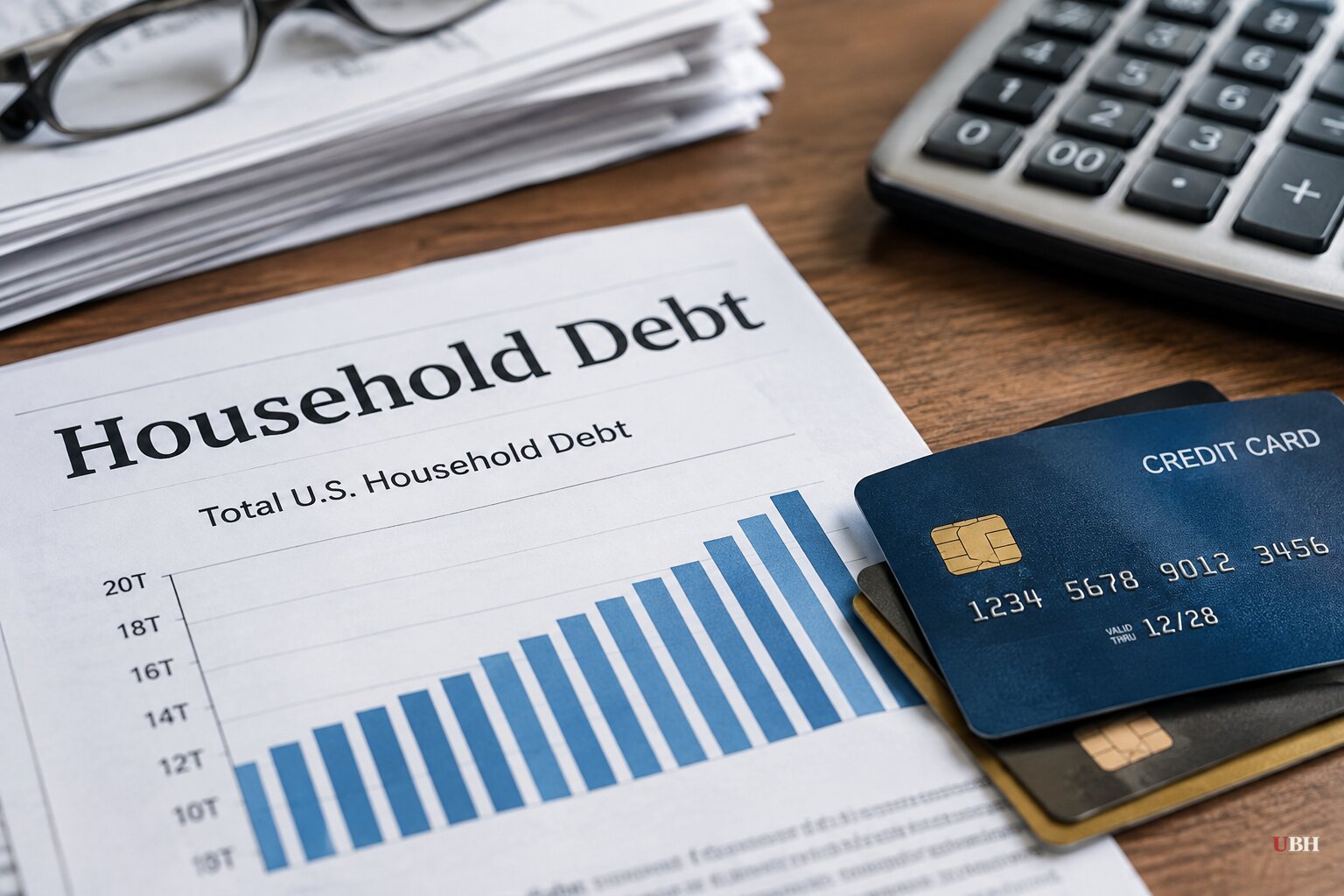
Total U.S. household debt climbed by $334 billion in the third quarter of 2026 to a record $19.1 trillion, the Federal Reserve Bank of New York said in its Quarterly Report on Household Debt and Credit, released November 10.
Credit cards set their own record. Balances rose $22 billion in the quarter to $1.29 trillion. That is a 1.7% quarterly gain and roughly 4.2% above a year earlier, or about $52 billion.
The New York Fed also said the percentage of outstanding debt in some stage of delinquency increased in the quarter.
The card numbers in context
Credit card balances are up about 61% over five years, according to an American Banker analysis of the Fed data. The total first crossed $1 trillion in 2023.
That is a big climb. It is also a nominal number, and prices have risen a lot over that stretch. Higher costs on groceries, gas and travel produce bigger balances even when households buy no more than before.
The New York Fed's card figure also counts charges that people pay off in full every month. It is not a pure measure of debt carried from one billing cycle to the next. For households that can't clear the balance, though, a card is an expensive way to cover routine bills.
Consumer spending makes up about two-thirds of U.S. economic activity. Rising balances can mean confident shoppers. They can also mean households borrowing to hold their standard of living. The data alone doesn't say which.
A second dataset tells a calmer story
Equifax's Market Pulse report, released November 11, put total U.S. consumer debt at $18.56 trillion in September, up 2.9% from a year earlier. That is about $540 billion below the New York Fed's number.
Mortgages drive most of it. First mortgage balances reached $13.08 trillion. Home equity lines of credit grew 13.3% over the year to $461.9 billion.
Equifax found less stress in card repayment than the headline debt totals suggest. Severe delinquency on bankcards fell 9 basis points from a year earlier to 2.74%. Private label card delinquencies dropped 40 basis points to 3.85%. Non-mortgage write-offs through September were $104.9 billion, against $104.4 billion in the same period last year.
Emmaline Aliff, Equifax's advisory leader, described a split. "There is a remarkably resilient segment of the population managing economic pressures with steady repayment behavior, yet we cannot overlook the consumers who are experiencing real financial friction," she said. She added that elevated borrowing costs and persistent inflation "continue to stretch household budgets across lower-income tiers."
So the two reports point in different directions on delinquency. The New York Fed says the delinquent share of debt rose. Equifax says card delinquencies fell year over year. The two measure different things over different periods.
The doom case and its limits
Michael Snyder, who writes The Economic Collapse Blog, calls the $19.1 trillion figure proof that Americans are "drowning" in debt. He argues that "the entire system is designed to get us into debt and keep us there." He cites figures that about 63% of U.S. adults live paycheck to paycheck and 44% struggle to pay for basic necessities. He does not name the surveys behind those numbers.
His claim about intent is an opinion, not a finding. Nothing in the New York Fed or Equifax data speaks to it.
The record itself is a fact. Debt has grown, card balances are at an all-time high, and Equifax's own adviser acknowledges that lower-income households are under strain. Neither report, however, shows a broad repayment collapse. Equifax says write-offs are flat and card delinquency is down.
Housing adds a wrinkle
Redfin reported this week that home-sale prices fell for the first time in more than three years. Mortgages are the largest slice of household debt, so a softer housing market bears on the balance sheets behind that $19.1 trillion.
Surveys cited this week also show many Americans weighing essential bills against holiday spending. Younger households appear to feel the pinch most, according to those surveys.
What comes next is the delinquency question. If the New York Fed's rising delinquent share keeps climbing in the fourth-quarter report while card balances keep setting records, the stress Aliff describes among lower-income borrowers would be showing up in the national totals. If Equifax's falling card delinquencies hold instead, the record debt will look more like a bigger economy and higher prices than a squeeze.
Sources used for this briefing
7 links from 7 independent newsrooms (syndicated copies of the same report count once)
These are the sources it draws on, linked so you can verify.


