
Unbiased headlines. Facts, not spin.
Unbiased Headlines is an independently owned news organization. We bring you the facts, not opinions, written fresh from 110+ named sources. Sources linked so you can verify it yourself.
 economy
Major Story (7/10)
Duffy Says FAA Is Back at Full Operations as Preliminary Probe Points to Contractor Router Swap, With 4,100 Flights Canceled Saturday
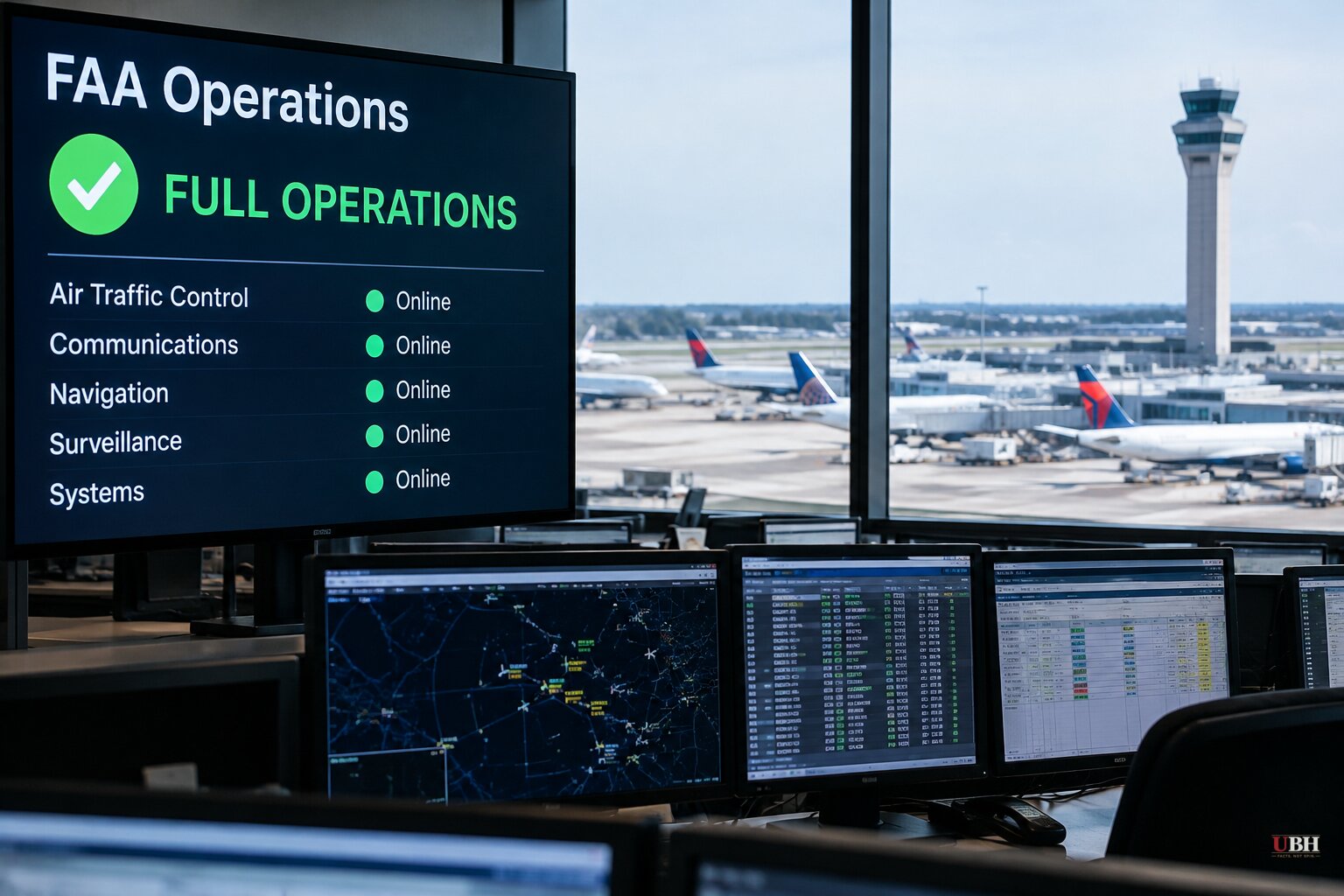
Since Friday's nationwide ground stop, the disruption has kept rolling. FlightAware counted more than 4,100 flights canceled and about 3,200 delayed on Saturday, Nov. 14, even as Transportation Secretary Sean Duffy told reporters at a news conference, "We are back at full operations."
The new development is a preliminary account of what went wrong.
A router swap at a remote site
Duffy said the FAA's preliminary investigation found that a contractor from L3Harris was working at a remote FAA location, switching old copper wire to fiber while replacing a router. The router being switched then started flooding other routers and overloaded the system.
Duffy said the system saw 1,000 log-on attempts every four to five seconds. He said L3Harris, the technology and defense company, owned the system.
The FAA is still working to determine whether the problem was human error or a faulty router that was installed. Duffy offered a blunt view of the vendor class generally, saying many contractors "take our money and provide really poor service."
FAA Administrator Bryan Bedford framed the work as routine. Updating the wires was a maintenance task the agency had been pursuing for years, he said, and about 70% of the system has already moved from copper to fiber.
Bedford said the router flooded the system for 45 minutes, and the FAA could not determine the cause of the instability during that time. The instability then spread to 17 facilities. "Out of an abundance of caution," Bedford said, the FAA issued the ground stop.
Duffy said about 3,500 planes were airborne when the order came, and all of them landed safely.
The scale of the fallout
FlightAware tallied about 9,159 cancellations and 7,190 delays on Friday. CNN put the combined Friday figure for delayed or canceled U.S. flights above 15,000, with roughly 3,000 expected on Saturday. The actual Saturday count has run higher than that early projection.
CBS News reported this was the first nationwide ground stop since January 2023, when a key FAA computer system malfunctioned. Before that, the last one came after the Sept. 11, 2001 attacks.
Duffy said in a social media post Saturday that travelers "will continue to see some delays and cancellations as carriers reschedule flights and reposition aircraft/crews where they are needed most." He said recovery will be slow but should not affect Thanksgiving travel in a couple of weeks.
European carriers felt it too. CNN reported flights to the U.S. from airports including Paris Charles de Gaulle and Frankfurt were canceled or delayed.
Cyberattack not ruled out, officials say
Homeland Security Secretary Markwayne Mullin said there was never any indication of a cyberattack, but told reporters Friday, "we are still looking, and we’re not going to rule it out." He also said the stoppage was not linked to this week's Microsoft outage and that lives were never in danger.
Mullin pointed to FAA updates to the aging systems as the reason behind the halt. That squares with Duffy's contractor account: the failure surfaced during modernization work, not on an untouched legacy system.
The money fight
Duffy has used the outage to push his funding request. On Friday night he said he wants $50 billion for air traffic control modernization, up from the $30 billion he had been seeking for months. He wants it as emergency funding before year's end, when control of Congress passes from Republicans to Democrats.
"How many times does this have to happen for Congress to give the money to fix it?" Duffy said. "It's going to continue to fail."
Congress approved $12.5 billion last year, which Duffy has called a "down payment." Some Democratic lawmakers have questioned how efficiently the FAA has spent the money so far, according to the New York Times.
The preliminary findings sharpen that question. A router replacement tied to a multiyear fiber conversion is the kind of work the existing funds were meant to cover, and the FAA has yet to say whether the fault was the contractor's work or the equipment itself. Taxpayers are funding the upgrade whether or not the vendor is at fault.
What stranded travelers can claim
Airlines have issued waivers. American allows a one-time change without a fee for tickets bought by Nov. 12 for travel Nov. 13 or 14 through affected airports, with the replacement flight booked by Nov. 14 for travel Nov. 13 to 17.
Delta covers travel Nov. 13 to 15, with the new flight departing by Nov. 22. United covers Nov. 13 to 15 flights and requires rebooked departures by Nov. 20. Southwest covers travel Nov. 13 to 16 and allows rebooking or standby within five days of the original travel date. These are the airlines' advisories as of Saturday morning and may change.
Under Department of Transportation rules, passengers whose flights are canceled or significantly changed are entitled to a refund if they decline alternatives. Scott Maurer, a Santa Clara University law professor, told KQED that airlines generally do not owe hotel or car rental costs when the cause is outside their control.
What comes next
The open questions are specific. The FAA has not said whether a human mistake or a bad router started the cascade. It has not explained why one router failure at a remote location spread to 17 facilities. And Congress, with weeks left under its current makeup, has not scheduled a vote on Duffy's $50 billion request.
Sources used for this briefing
7 links from 7 independent newsrooms (syndicated copies of the same report count once)
These are the sources it draws on, linked so you can verify.


