
Unbiased headlines. Facts, not spin.
Unbiased Headlines is an independently owned news organization. We bring you the facts, not opinions, written fresh from 110+ named sources. Sources linked so you can verify it yourself.
 economy
Major Story (7/10)
Former Trade Officials and Cato Urge Court to Strike Down Trump's 50% Section 338 Tariffs on Canada
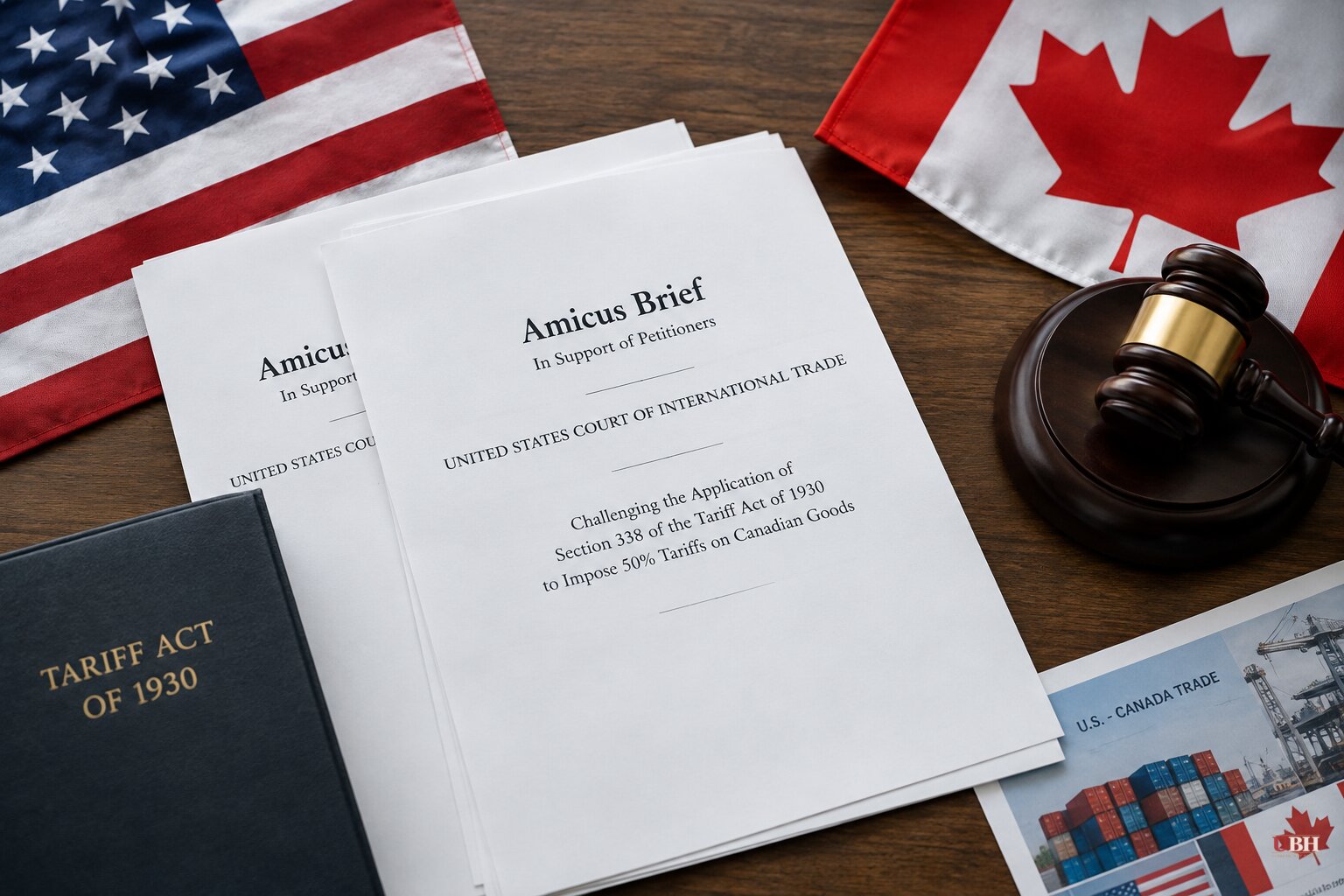
A statute nobody had used in nearly 100 years is now the legal foundation for 50% tariffs on Canadian goods. Those tariffs remain in force as of today, Nov. 14, and a federal trade court is being asked to throw them out.
The case is Gellert Global Group Corp. v. Trump, filed Oct. 20 at the U.S. Court of International Trade. It is the first court challenge to Section 338, the Smoot-Hawley-era provision that lets a president impose duties of up to 50% on countries found to discriminate against U.S. commerce.
How the tariffs came about
On July 20, Trump issued three proclamations imposing 50% duties on Canadian goods to "offset Canadian discrimination against the commerce of the United States." They targeted alcoholic beverages, dairy and motor vehicles. The first tranche covered roughly $20 billion in imports.
The duties took effect Aug. 22, after Canadian Prime Minister Mark Carney called off a month of talks in mid-August. Canada answered with retaliatory tariffs of 15, 25 and 50 percent that took effect Sept. 8.
Trump then widened the action in September, modifying the list of covered products and banning imports of some goods outright, including specialty cheeses, boats and furniture. A later proclamation, effective Oct. 30, removed plywood, certain industrial machinery and some packaging and paper products from the tariff list. It added carpets, other textile floor coverings and self-contained window and wall air conditioners. Trump said senior executive branch officials advised him the changes would still offset the alleged discrimination while serving the public interest.
The importer's suit
Gellert, a New Jersey-based food importer, is represented by the Liberty Justice Center. The company says it imported about $71 million of Canadian cheese in 2025, historically duty-free under the USMCA. It alleges it will pay roughly $40 million a year in Section 338 duties, along with squeezed margins, pressure on working capital, delayed hiring and investment, and possible loss of customers and suppliers.
The complaint asks the court to remove the tariffs, block collection and order refunds. It also seeks class status for every importer of record that has paid or will pay Section 338 duties on entries made on or after Aug. 22. Those are Gellert's allegations. The court has not ruled on any of them.
Gellert calls the tariffs the "latest attempt" to use, "through a statute never designed for the purpose, the tariff power that the Constitution assigns to Congress." It points to the Supreme Court's early-2026 ruling in Learning Resources v. Trump, which invalidated the IEEPA tariffs. The CIT has also ruled the Section 122 replacement tariffs unlawful in Oregon v. United States, a decision now on appeal.
Two briefs, two arguments
This week, three former senior trade officials filed an amicus brief supporting Gellert: Carla Hills, U.S. trade representative from 1989 to 1993; Alan Wolff, a former deputy trade representative who drafted the initial version of what became Section 301; and Warren Maruyama, USTR general counsel from 2007 to 2009.
Their argument is that Section 338 has been superseded by Section 301 of the Trade Act of 1974 and Section 252 of the Trade Expansion Act of 1962. Section 301 requires investigations, public hearings, consultations and time limits. Section 338 requires none of that.
"The only conceivable purpose served by invoking Section 338 is to avoid the stronger procedural requirements of Section 301," the former officials wrote. Their summary: "Section 338 of the Tariff Act of 1930 is not dormant; it is dead."
The Cato Institute filed a separate brief with three grounds. First, the statute requires tariffs to respond to discriminatory foreign restrictions and to offset them, and Cato says these tariffs do neither. Second, the major questions doctrine bars reading the statute to let a president impose extraordinary import taxes whenever another country restricts trade or declines to buy American goods. Third, a 50% rate ceiling cannot stand in for clear legislative limits, which Cato says raises a nondelegation problem.
What the administration says
The administration's position is that the statute does what it says. Trump's proclamations rest on findings that Canada discriminates against U.S. commerce: duties and quotas on American cars, a halt in purchases of U.S. alcohol, and tariff-rate quotas on certain dairy products.
Greer said on CNBC on Thursday that the administration will "keep taking trade actions as necessary." He blamed Democratic state attorneys general, who have challenged the tariffs in court, for denying the country stability. "I agree on wanting to have certainty on tariffs," he said.
Talks and politics
Greer also said U.S. and Canadian officials discussed a trade deal within the past few days but declined to set a timeline. "The substance of the deal is more important than a timeline," he said. Ambassador Pete Hoekstra predicted last week that a deal could come before the end of 2026.
The political backdrop is shifting. The Hub reported that Republicans lost both chambers in the Nov. 3 midterms, and the AP VoteCast survey found voters punished Republicans over economic policies including import taxes. House Democratic Leader Hakeem Jeffries has named ending the tariffs a priority. Overriding a presidential veto would take 67 senators and 290 House members.
The next hard date is Jan. 1, 2027. Trump has threatened to raise tariffs on Canadian vehicles, auto parts and steel to 50% that day. The CIT has not said when it will rule, and importers paying Section 338 duties are left to wait on whether the refunds Gellert is seeking will ever be ordered.
Sources used for this briefing
7 links from 6 independent newsrooms (syndicated copies of the same report count once)
These are the sources it draws on, linked so you can verify.


