
Unbiased headlines. Facts, not spin.
Every story is an unbiased news briefing written from 110+ sources across the spectrum — sources linked so you can verify it yourself.
 defense
Notable (5/10)
Event date: September 8, 2026
defense
Notable (5/10)
Event date: September 8, 2026
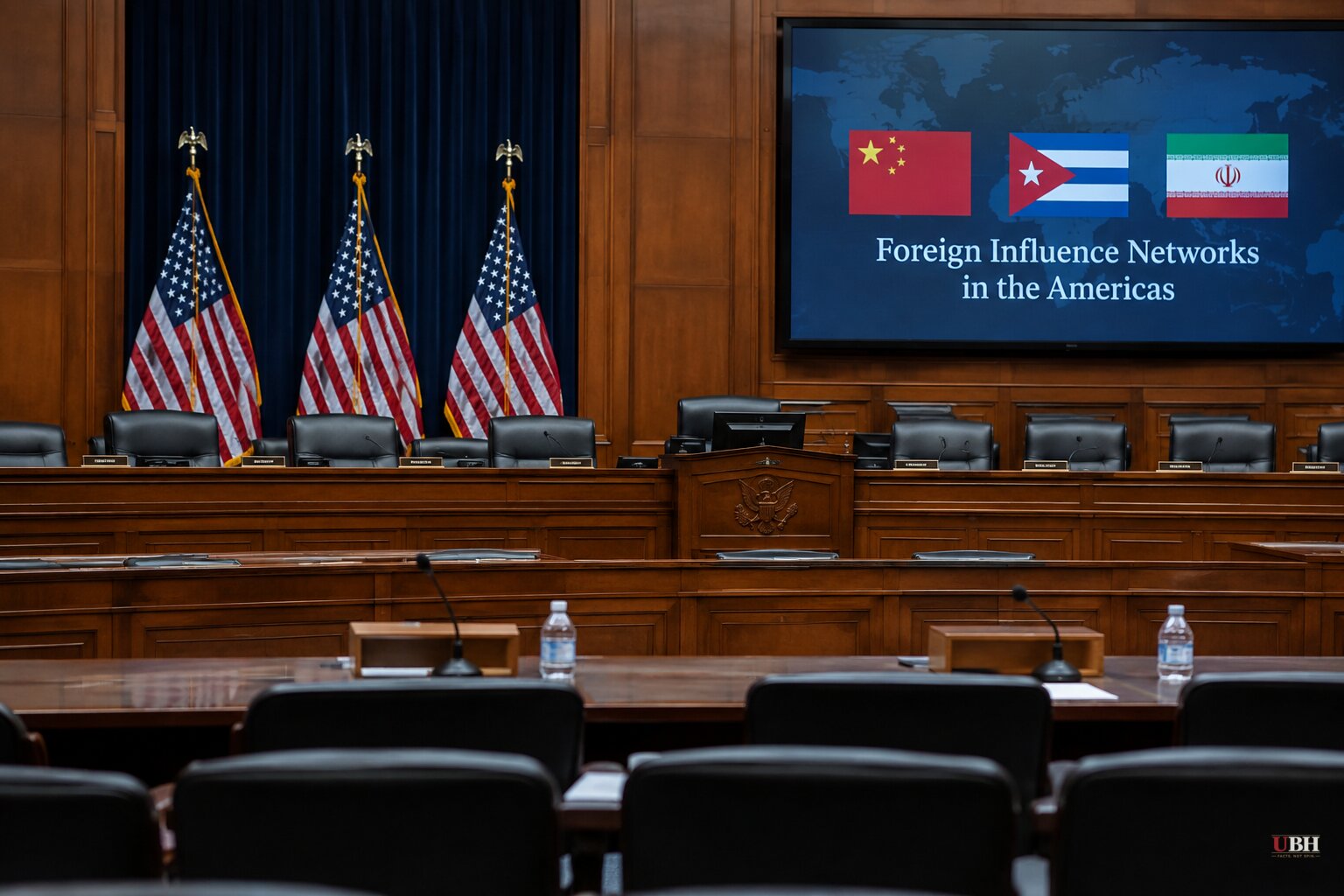
House Subcommittee Holds Hearing on Foreign Influence Networks Tied to China, Cuba and Iran
A Disrupted Panel, Then a Hearing
Last Tuesday, September 8, at the Institute of World Politics in Washington, a panel on Cuba's national security threat to the U.S. got interrupted mid-discussion. Olivia DiNucci, a D.C. organizer with the group CodePink, stood up holding a hand-painted banner reading "SANCTIONS KILL IN CUBA" and shouted about "global solidarity with Gaza and Cuba and ICE" before security removed her, according to Fox News Digital.
Christine Balling, a former advisor to U.S. Special Operations Command South who was leading the panel, called CodePink and groups like it "Trojan horses" that "burst in onto the scene" to "disrupt and destroy from within," she told Fox News Digital. Her co-panelist, Heritage Foundation senior fellow Mike Gonzalez, is a Cuban American who opposes the island's communist government.
Today, the House Foreign Affairs Committee's Subcommittee on South and Central Asia, chaired by Rep. Bill Huizenga (R-MI) with Rep. Sydney Kamlager-Dove (D-CA) as ranking member, is holding a hearing titled "Trojan Horses: Covert Foreign Malign Influence Operations in America," according to Legis1. Scheduled witnesses are Gonzalez, Matthew Johnson of the Jamestown Foundation, and Sam Lyman of the Bitcoin Policy Institute.
What the Hearing Is Actually About
The hearing's stated focus, per Legis1, covers foreign malign influence as defined under federal law: hostile efforts by a foreign government to shape U.S. political, military or economic policy through overt or covert means, including election manipulation. Officers of China's Ministry of Public Security have been accused of creating fake social media accounts to harass Chinese dissidents and spread propaganda, according to Legis1.
Lyman, a former senior advisor and speechwriter to Treasury Secretary Scott Bessent, told Fox News Digital the threat has grown because "social media acts as a gain-of-function for mind viruses that are incubated overseas." Gonzalez told Fox News Digital adversaries "take advantage of the open nature of our society to infiltrate and influence America," citing K-12 schools, universities, government agencies, lobbying firms and museums as vectors.
The hearing also touches a parallel track already underway. The House Ways and Means Committee has subpoenaed three nonprofits tied to Neville Roy Singham, an American-born tech businessman now based in Shanghai, over their funding network, according to Ground News's coverage tracker. No charges have been filed against Singham or the nonprofits; the subpoenas seek financial records, not a completed finding of wrongdoing.
The Part Critics Would Flag
CodePink describes itself as an anti-war organization, not a foreign proxy. DiNucci's shouted references to Gaza, Cuba and ICE reflect a documented, long-standing set of left-wing positions on U.S. sanctions and immigration enforcement that predate any specific foreign-influence allegation. Protesting a panel discussion, however disruptive, is constitutionally protected speech, and holding a viewpoint sympathetic to Cuba's government is not itself evidence of taking direction from a foreign state.
On the legal record: the Treasury Department is investigating whether CodePink violated U.S. embargo laws through its Cuba caravans, but that investigation has not concluded and no charges have been announced. Legis1 reported that as of August 2026, investigations into alleged Beijing support for CodePink and campus protest networks were "ongoing" — allegations, not proven facts. Balling's own framing of CodePink's tie to the National Network on Cuba, described in CommStrader's account as "the largest pro-regime coalition in the U.S.," is an affiliation claim, not a criminal finding.
The Government Cut Its Own Watchdogs
The same federal government now worried enough to hold a congressional hearing on foreign influence has spent the past year dismantling the agencies built to track it. The FBI's Foreign Malign Influence Task Force, the State Department's Global Engagement Center, and the Foreign Malign Influence Center at the Office of the Director of National Intelligence were all shut down, according to Legis1. Director of National Intelligence Tulsi Gabbard announced the ODNI center's functions would be "reduced and absorbed into other intelligence components."
Separately, Rep. Anna Paulina Luna has introduced a bipartisan bill addressing foreign influence disclosure, according to Legis1, though details of its provisions weren't specified in available reporting.
A Ground News review of coverage on the hearing found that every outlet tracked reporting on it leaned right, with no left-leaning outlets picking up the story as of last week. This gap is notable given the hearing's bipartisan witness list and Kamlager-Dove's role as ranking Democrat.
What's Unresolved
No verdict exists yet on whether CodePink violated the Cuba embargo, whether Beijing actually supported the group's activities, or whether the Singham-linked nonprofits did anything illegal with their funding. Those are open investigations, not settled findings. What is settled: three federal offices built to answer exactly these questions no longer exist in their original form, and today's hearing is asking Congress, not those disbanded agencies, to fill the gap.
Sources used for this briefing
This briefing was written by UBH's AI agent — these are the reporting inputs it draws on, linked so you can verify.


