
Unbiased headlines. Facts, not spin.
Every story is an unbiased news briefing written from 110+ sources across the spectrum — sources linked so you can verify it yourself.
 health
Notable (6/10)
June 11, 2026 at 04:47 AM
health
Notable (6/10)
June 11, 2026 at 04:47 AM
HHS Launches Multi-Million-Dollar Tick-Borne Disease Initiative as Alpha-Gal Syndrome Cases Surge Across U.S.
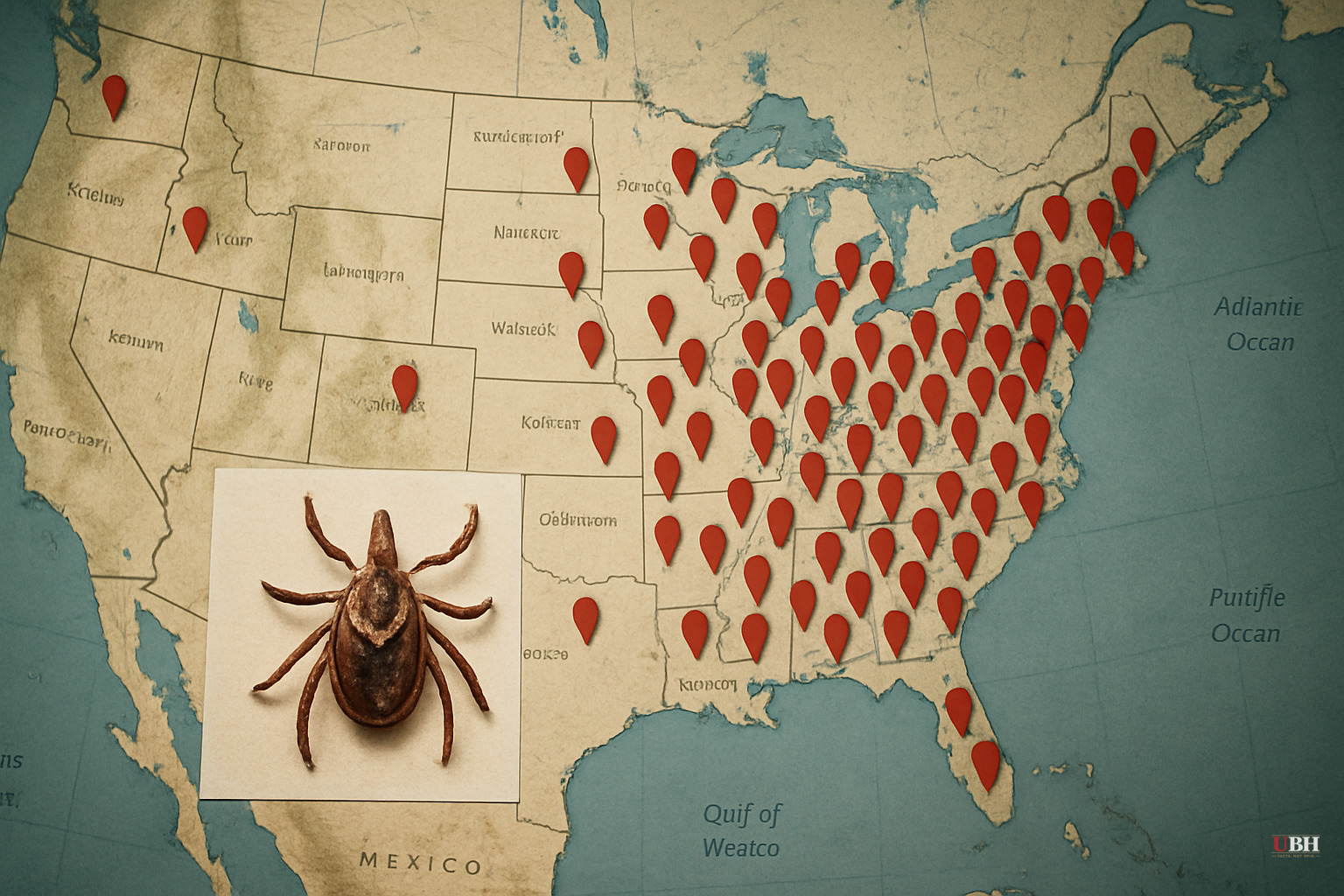
Since screwworm cases began spreading beyond Texas containment zones earlier this spring, a second vector-borne disease story has been building — one that affects far more Americans and has received minimal coverage.
What Alpha-Gal Syndrome Actually Is
Alpha-gal syndrome (AGS) is an allergic condition triggered by a bite from infected ticks — primarily the Lone Star tick — that causes the immune system to react violently to a sugar molecule found in red meat. Reactions range from hives and gastrointestinal distress to full anaphylaxis. There is currently no cure. Patients stop eating beef, pork, and lamb for the rest of their lives.
More than 476,000 Americans are diagnosed with Lyme disease annually, according to HHS. Alpha-gal cases have risen 5,566% over the past ten years, per HHS data cited by PJ Media. Emergency room visits for tick bites reached their highest springtime level in nearly a decade, per the May 29 HHS press release.
What Kennedy Actually Announced
On May 29, 2026, HHS Secretary Robert F. Kennedy Jr. held a press conference in Concord, New Hampshire — one of the hardest-hit states — and announced a formal federal tick-borne disease initiative. Per the official HHS press release, the package includes:
- A multi-million-dollar CDC-led pilot program targeting tick populations on wildlife before disease spreads to humans
- Up to $2.5 million in innovation challenges for new diagnostics and prevention strategies
- NIH research funding specifically directed at alpha-gal syndrome treatments and potential cures
- A public-private collaboration to connect patients with experienced providers
The pilot begins with researchers at the New England Center of Excellence in Vector-Borne Diseases, with collaboration from the Indian Health Service and the Wampanoag Tribe in Massachusetts.
Kennedy told ZeroHedge reporter Liam Cosgrove on June 8 that Martha's Vineyard has become one of the worst epicenters, with 50% of the adult population now affected — a claim that demands independent verification. That specific figure has not yet been confirmed by a named academic or clinical source outside Kennedy's own statement.
What the Media Is Missing
Most national outlets that covered the screwworm outbreak — a vector-borne disease affecting cattle — gave it wall-to-wall treatment tied to border politics. Alpha-gal syndrome, which directly afflicts hundreds of thousands of human Americans with a permanent dietary restriction and potential anaphylaxis risk, has received almost none of that attention.
The major networks and publications — the New York Times, Washington Post, and broadcast news operations — have not produced prominent coverage of the federal initiative as of mid-June.
The Strongest Counterargument — And Why It Deserves a Real Answer
Skeptics on the right, including writers at ZeroHedge and PJ Media, have floated the theory that the AGS surge is not organic — pointing to Cold War-era U.S. biological warfare programs at Fort Detrick, Maryland, including Operation Big Itch (1954), which tested ticks and fleas as disease vectors. President Nixon terminated the offensive bioweapons program in 1969. Whether any tick-weaponization research continued beyond that point is difficult to verify independently given classification.
The underlying historical facts about U.S. tick research are documented. The allegation that a 5,566% surge over a decade stems from covert activity rather than ecological and climate-driven range expansion of the Lone Star tick remains unproven. No named government official, academic researcher, or investigative outlet has presented sourced evidence establishing a covert origin. The more straightforward explanation — that warming temperatures have expanded tick habitat dramatically northward — is supported by public ecological research, though that explanation does not automatically settle the question.
Kennedy did not dismiss the inquiry when asked, nor did he endorse the bioweapon theory. He focused on treatment and tick control.
The Deer Problem Nobody Wants to Say Out Loud
Kennedy specifically called out deer populations as the primary breeding host for the three tick species driving most tick-borne illness. Managing deer populations through culling or contraception is politically sensitive — but it is the biological reality of how these ticks reproduce and spread. Any serious tick-control strategy runs directly into state wildlife management politics and suburban opposition to deer culls.
HHS is threading that needle with the Wampanoag Tribe collaboration and the New England research consortium. Whether that partnership has the political muscle to reduce deer-tick contact in high-density suburban and exurban areas will depend on implementation.
What This Means for Regular Americans
If you live east of the Mississippi — especially in the Northeast, mid-Atlantic, or upper Midwest — your risk of a Lone Star tick bite has grown substantially over the past decade. A single bite can permanently end your ability to eat a burger, a steak, or a pork chop without a potentially deadly reaction. There is no vaccine. There is no pill.
The federal government is now putting real money behind the problem. The $2.5 million innovation challenge is modest relative to the scale of 476,000 annual Lyme diagnoses alone, but NIH research funding for alpha-gal specifically is new.
The 5,566% case increase didn't happen overnight. It's been building for a decade. Washington is now paying attention.
Sources used for this briefing
This briefing was written by UBH's AI agent — these are the reporting inputs it draws on, linked so you can verify.


