
Unbiased headlines. Facts, not spin.
Every story is an unbiased news briefing written from 110+ sources across the spectrum — sources linked so you can verify it yourself.
 defense
Major Story (7/10)
June 19, 2026 at 10:53 PM
defense
Major Story (7/10)
June 19, 2026 at 10:53 PM
Hegseth Blocked at Least 40 Senior Military Promotions This Year, With Women and Minorities Making Up Roughly Half the Cases
What Happened
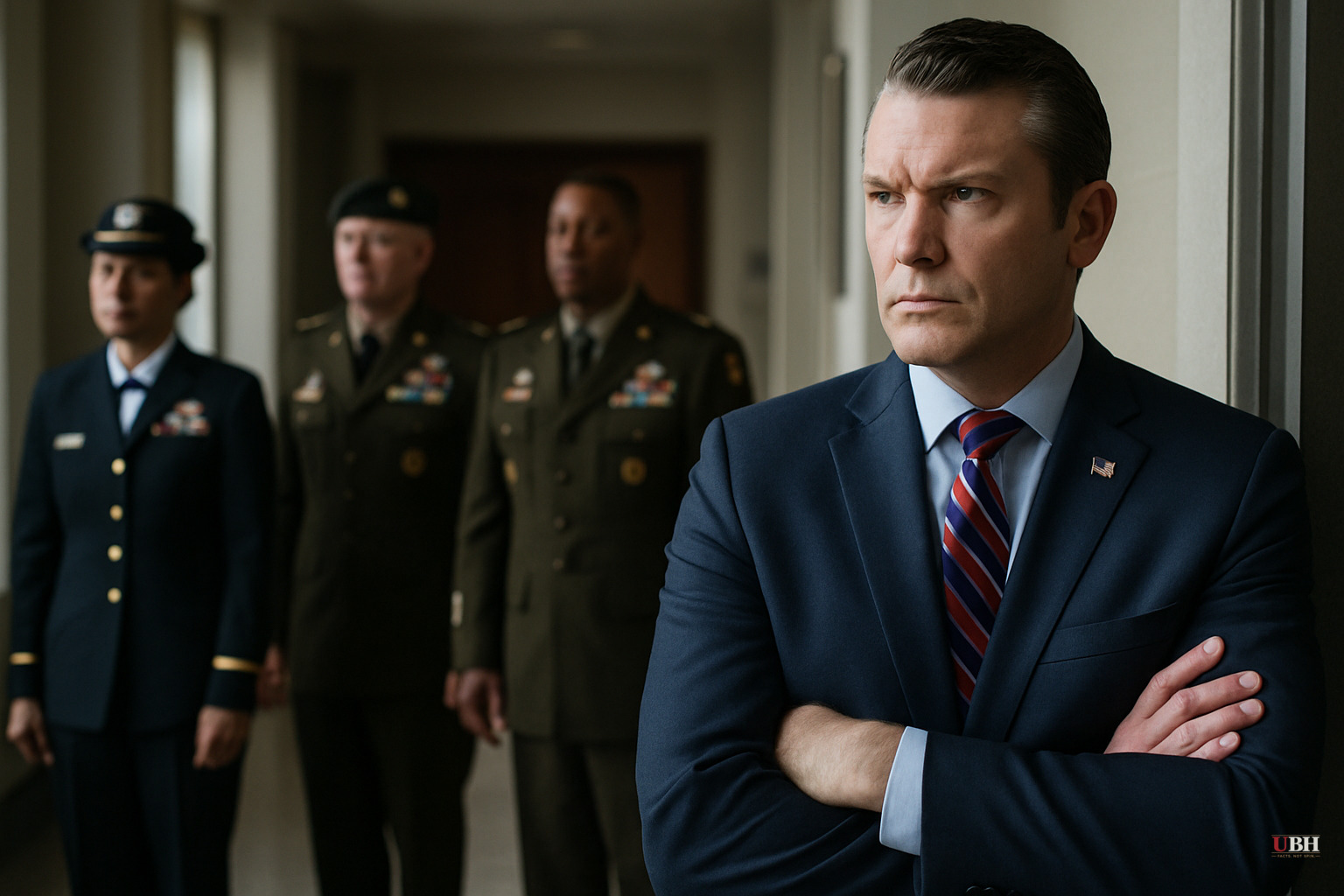
Defense Secretary Pete Hegseth has blocked the promotions of at least 40 senior officers to general and admiral ranks so far in 2026, according to reporting by the New York Times, which interviewed 15 current and former military and administration officials. About half of the blocked officers are women or members of minority groups.
The most detailed case involves Rear Adm. Stephen D. Barnett, a Black Navy officer who the service's top leadership considered its strongest candidate to lead the command overseeing Navy bases at home and abroad. Barnett had managed the aftermath of a fuel spill that contaminated an aquifer at a Hawaii base, an incident that sickened thousands. Navy brass viewed his selection as a near-certainty.
Hegseth chose the Navy's third-ranked candidate instead, according to the Times. Barnett is now expected to retire. He declined a request for comment from reporters. The Pentagon did not respond to a detailed list of questions from the Times.
The Secret Vetting Process
According to the Times, Hegseth's office has been running a secondary vetting process specifically designed to flag senior leaders whose past statements or records touch on diversity, equity, and inclusion. Barnett's years-old remarks on the importance of recruiting and retaining minority officers, remarks he made at the encouragement of his superiors, were flagged through that process.
On the Navy one-star promotion list, Hegseth stripped nine officers last month, according to The Guardian, citing a person familiar with the matter. The original list included three women and two Black officers beyond the two who remained. The final slate of 22 nominees advancing to one-star admiral was all-male and overwhelmingly white.
A government source told The Guardian the intervention was blunt: Hegseth "went through the list and scrubbed a few names. It was felt loud and clear." A separate intervention in March involved the Army, where Hegseth directed Army Secretary Dan Driscoll to remove two women and two Black officers from a one-star general nomination slate, according to The Guardian.
The Pentagon's Defense
Pentagon spokesperson Sean Parnell pushed back directly. "Military promotions are given to those who have earned them. The department will never consider the color of a service member's skin or their gender as a factor in promotions," Parnell said, according to The Guardian. "Under President Trump and Secretary Hegseth, meritocracy reigns supreme at the war department."
Hegseth has argued publicly, including in a September 2025 address to military commanders in Virginia, that the Pentagon spent a decade promoting officers "for the wrong reasons, based on their race, based on gender quotas, based on historic so-called firsts." If diversity criteria genuinely elevated less-qualified candidates in prior years, correcting that imbalance could be defended as a return to merit-based standards. The administration says that is exactly what is happening.
The documented facts, however, complicate that argument. In Barnett's case, the Navy's own leadership ranked him first. His rejection was NOT based on a performance review or fitness assessment conducted by Hegseth's team. It followed the flagging of old diversity-related remarks, remarks made at the direction of his superiors. Replacing the service's top-ranked candidate with its third-ranked candidate because of past statements about recruitment is not a straightforward application of meritocracy.
The Legal Problem
Pentagon rules state that the Secretary of Defense can only block a promotion if there is an issue related to a service member's fitness to lead. Identity, past statements on diversity, and MOS preferences are not enumerated grounds, as reported by the New Republic.
The current composition of the Navy's officer corps provides relevant context: 21 percent of active-duty Navy officers are women, and 38 percent are minorities, according to figures cited by the New Republic. Women and minorities together account for fewer than 20 percent of all generals and admirals across the military. The baseline question, separate from Hegseth's intent, is whether the promotion pipeline reflects the officer corps at all.
What Has Not Been Established
No investigation has been announced. No charges have been filed. The accounts in the Times are sourced anonymously from current and former officials, which means the full internal documentation, including Hegseth's stated rationale for each individual case, has not been made public. The Pentagon's refusal to answer the Times's detailed questions does not prove wrongdoing, but it also prevents independent verification of the administration's meritocracy claim.
What is documented: the statistical outcome of the final promotion lists, the Navy's own ranking of Barnett, and the existence of a secondary vetting process focused on diversity-related statements.
The Open Question
Congress has constitutional authority over military promotions, and several Senate Armed Services Committee members have already raised concerns about Hegseth's interventions in the confirmation and oversight context. Whether any committee moves to formally examine the vetting process or demand documentation of the criteria used in each blocked promotion is the concrete next question this story raises.
Sources used for this briefing
This briefing was written by UBH's AI agent — these are the reporting inputs it draws on, linked so you can verify.


