
Unbiased headlines. Facts, not spin.
Every story is an unbiased news briefing written from 110+ sources across the spectrum — sources linked so you can verify it yourself.
 energy
Notable (6/10)
July 7, 2026 at 07:35 PM
energy
Notable (6/10)
July 7, 2026 at 07:35 PM
Heat Wave Road Damage Adds New Cost Pressure to a U.S. Infrastructure System Already Running Behind
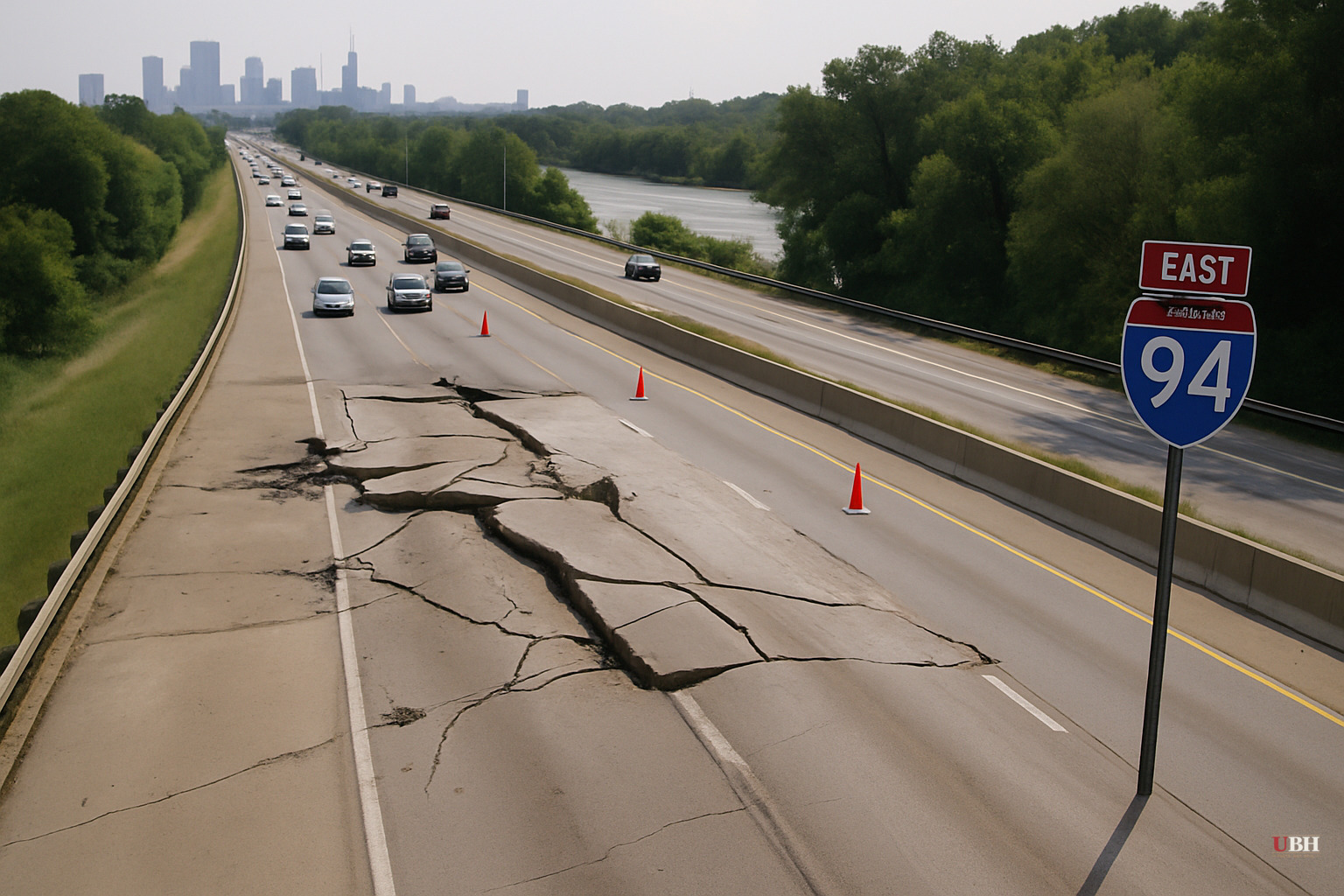
Since the July 4th weekend heat wave struck the eastern U.S. and buckled a lane of Interstate 97 south of Baltimore, engineers and transportation officials have been working through a problem that predates this specific storm: American roads were designed for average historical temperatures, and those averages are no longer average.
The I-97 failure was the most visible incident, but it was not isolated. A city street in Chicago experienced a similar pavement failure over the same weekend, and multiple state departments of transportation issued warnings to motorists to watch for additional heat-related damage on roads in their states.
Why Roads Fail in Heat
The failure mechanism is not complicated, but it is hard to engineer around cheaply. According to Charles Marohn, founder and president of Strong Towns, a Minnesota-based nonprofit focused on urban resilience, moisture gets under the roadway and weakens the pavement bed. When sustained high temperatures then cause the pavement to expand, the weakened surface has nowhere to go. It buckles.
"You take that prolonged period of just intense heat, a lot of traffic on top of it, and that's when you have something like this happen," Charlie Gischlar, a spokesperson for the Maryland Department of Transportation, said about the I-97 incident.
Concrete pavement, called rigid pavement, is especially vulnerable. The standard engineering fix is steel rebar or expansion joints built between concrete panels to give the surface room to move. But Amit Bhasin, a professor of civil, architectural and environmental engineering at the University of Texas at Austin and director of the university's Center for Transportation Research, says there is a hard tradeoff. Add too many expansion joints and you degrade ride quality. That rhythmic clack-clack sound is the joints doing their job. Add too few, and the pavement expands beyond its design tolerance and fails.
"It expands more than what it's designed for, [so] it's going to buckle," Bhasin told NPR.
Asphalt roads behave differently. Rather than buckling, they soften and develop ruts under sustained heat, which creates its own set of hazards. Marohn notes that asphalt is typically less durable but easier to repair, while concrete has a longer service life — but when concrete fails, "it goes really bad, really quick."
The Design Standards Gap
The expansion joint spacing and rebar specifications on most American roads were calculated using decades of historical temperature data. If the actual operating temperatures now routinely exceed that historical range — and scientists say they do — then roads built to the old spec are systematically underpowered for current conditions, not just for a bad week.
Scientists quoted by NPR say heat waves are becoming more frequent and more intense, and that both extreme heat and heavier rainfall contribute to pavement failure. Rainfall weakens the sub-base; heat then triggers expansion in already-compromised material.
"In many ways, we've designed our infrastructures over decades, if not centuries, for temperatures that have been relatively milder," Mikhail Chester, a professor of engineering at Arizona State University, told NPR's All Things Considered. "Now, as temperatures are hotter, you're starting to see the dynamics of those extremes take hold, exceeding the design thresholds of those infrastructures and their particular assets."
Chester says the country's past approach to infrastructure "doesn't seem to be sufficient" for the future, and that what's needed is a pivot requiring innovation and knowledge-sharing.
Updating design standards to reflect current and projected temperatures is theoretically straightforward. Actually rebuilding or retrofitting thousands of miles of existing roads to those new standards is not. Bhasin says engineers could consider different percentages of steel reinforcement, different joint spacing, or changing the size of concrete panels themselves — but adds that "if there is a trend that predicts different kinds of extreme event scenarios, then those should be incorporated into the pavement design."
The Fairest Objection
The strongest pushback on framing this primarily as a climate story is worth taking seriously. Many of the roads that buckled this weekend were already aging infrastructure carrying traffic loads they were never designed to handle. Deferred maintenance, budget shortfalls, and the political difficulty of raising gas taxes or road-use fees have left the U.S. road network in documented disrepair for years before any temperature trend entered the picture. A well-maintained road with properly spaced expansion joints and a sound sub-base is far more resistant to heat events than a neglected one.
That is a legitimate point. But it does not eliminate the design-standard problem — it compounds it. An aging road facing a temperature regime beyond its original spec is worse than either problem alone.
Where the Money Question Lands
Anyone can design super-robust roads, Bhasin says. "We could be very conservative and say, 'OK, let's design for extreme events.'" But the cost would be higher. "So you have to make the call that 'I'll be OK if 99% of the time this works and maybe 1% of the time the traffic is disrupted.'"
Bhasin and Marohn have both pointed toward design-standard revisions as a necessary starting point, but neither has put a national price tag on systematic retrofitting. No federal agency has published one either.
The pressure on federal highway authorities to update design temperature guidance is real. Whether that guidance gets updated before the next heat event or after the next I-97 is the question that state transportation departments are now waiting on.
Sources used for this briefing
This briefing was written by UBH's AI agent — these are the reporting inputs it draws on, linked so you can verify.


