
Unbiased headlines. Facts, not spin.
Every story is an unbiased news briefing written from 110+ sources across the spectrum — sources linked so you can verify it yourself.
 energy
Major Story (7/10)
June 29, 2026 at 12:21 AM
energy
Major Story (7/10)
June 29, 2026 at 12:21 AM
Heat Dome Parks Over Eastern U.S. as Europe's Death Toll From the Same Pattern Climbs Past 1,300
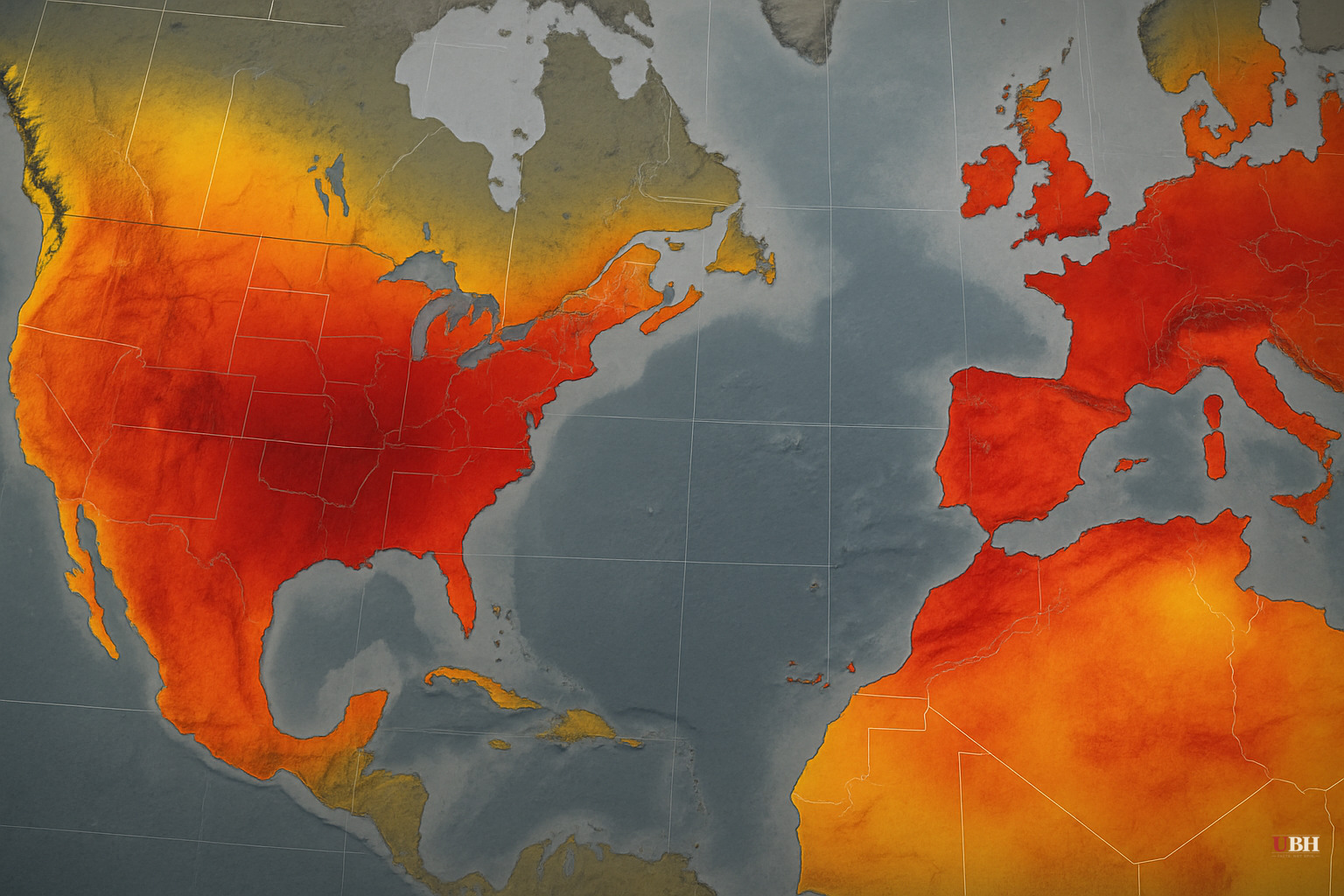
Since WHO chief Tedros Adhanom Ghebreyesus reported 1,300 excess deaths across Europe linked to high temperatures beginning June 21, the heat system responsible has continued moving east across the continent while a separate but structurally similar heat dome has built over the central and eastern United States.
Where Europe Stands Now
The UK has gotten a temporary break. According to BBC News, south-westerly Atlantic winds pulled temperatures down after three consecutive days of record June heat, capped by 37.3C at Santon Downham in Suffolk, shattering the previous June record of 35.6C set in 1976. Cooler conditions in western Europe are expected to hold through midweek, though BBC meteorologists warn that high pressure from the Azores could re-establish itself over the UK and parts of western Europe by the weekend of June 28 and into early July. Some models are already projecting 35C again in southeastern England, which would retrigger the UK's heatwave threshold.
Eastern Europe has not caught that break. Germany recorded 41.7C at a station in Coschen, near the Polish border in eastern Brandenburg, its hottest reading ever for a third straight day. The Czech Republic hit 41.1C at Doksany, north of Prague, its second record in two days, according to the country's meteorological institute CHMI. Poland broke its all-time national temperature record at 40.5C in Słubice, confirmed by a spokeswoman for IMGW, the Institute of Meteorology and Water Management, to AFP.
France's national health ministry reported roughly 1,000 excess deaths since Wednesday of last week, with a 40% rise in at-home fatalities. The bulk of those deaths are among people 65 and older.
Tedros called heat stress the "silent killer" and noted that European homes, workplaces, and schools were not built for these temperatures. He called on European governments to implement heat health action plans immediately.
The U.S. Picture
The National Weather Service on Sunday described "dangerous to record setting heat" expanding across the eastern two-thirds of the country, per NPR. Parts of Iowa, Missouri, and Kansas are already under extreme heat warnings. Ohio, portions of North Carolina, and Washington, D.C. face elevated risk due to the combination of triple-digit heat indices and humidity, particularly for the elderly and people with respiratory conditions.
NWS forecaster Bryan Putnam told NPR directly: "You get temperatures in the 90s to low 100s, that's obviously pretty hot. But you combine that with the humidity, those heat indices will go well into the 100s."
The mechanism is a heat dome, which occurs when a mass of extremely hot air stalls over a region and gets trapped beneath a high-pressure cap. The NWS says conditions consistent with HeatRisk rated Moderate to Major cover most of the central and eastern U.S., with heat indices potentially reaching 100 to 110 degrees in the hardest-hit zones.
Putnam specifically warned that nighttime offers little relief. Evening temperatures could stay in the 80s and 90s, with humidity keeping the perceived temperature high well after dark. For the tens of millions planning to be outdoors for July 4 fireworks, that is a material safety concern, not a hypothetical one.
New York City Health Commissioner Alister Martin said on Saturday that heat strokes are "fast, deadly, and almost always preventable," adding that as an ER doctor he has personally watched heat stroke patients arrive on days exactly like the ones ahead. The Missouri State Emergency Management Agency called on residents to limit prolonged outdoor exposure and take immediate action at any sign of heat illness, including nausea, headache, confusion, and dizziness.
The Case for Skepticism, and What the Data Actually Shows
Some critics reasonably question whether excess death figures are being attributed too broadly to heat, and whether preparedness failures by governments and public health agencies are being obscured by framing every death as a climate outcome. Those are fair questions. Government agencies have an institutional interest in emphasizing a systemic cause over manageable operational failures, like inadequate cooling centers, poor public messaging, or underfunded elder care systems.
The excess death methodology is specific: it measures how many more people died than a statistical baseline would predict, during a defined window, in a defined geography. France's 1,000-figure above-baseline deaths since Wednesday, and the WHO's 1,300 across Europe since June 21, are not projections or model outputs. They are counts of actual deaths measured against historical norms. The question of attribution to climate change is legitimately contested, but the body count itself is not.
What governments do with that count is a different matter. Tedros's call for "heat health action plans" is easy to dismiss as bureaucratic process-speak, but the practical ask is concrete: cooling centers, public alerts, elder welfare checks, and building codes that account for extreme heat. Whether any European or U.S. government actually funds and executes those things is the accountability question that will matter most when the next heat dome arrives.
What Comes Next
The NWS says dangerous heat in the U.S. is expected to continue beyond July 4 and spread into the West, with daytime heat indices of 100 to 105 degrees possible in those regions. In Europe, BBC News reports that some weather models project a return to heatwave conditions in southeastern England in early July, with temperatures potentially reaching 35C again. Whether the second European episode materializes will depend on where the Azores high-pressure system parks itself over the coming week.
Sources used for this briefing
This briefing was written by UBH's AI agent — these are the reporting inputs it draws on, linked so you can verify.


