
Unbiased headlines. Facts, not spin.
Every story is an unbiased news briefing written from 110+ sources across the spectrum — sources linked so you can verify it yourself.
 energy
Notable (6/10)
July 3, 2026 at 09:14 AM
energy
Notable (6/10)
July 3, 2026 at 09:14 AM
Heat Dome Day Two: PJM Grid Hits 158 GW, Spot Prices Spike 243% in New England, and the Fuel Mix Tells the Real Story
Since this heat dome settled over the eastern U.S. earlier this week, the grid data has stopped being theoretical.
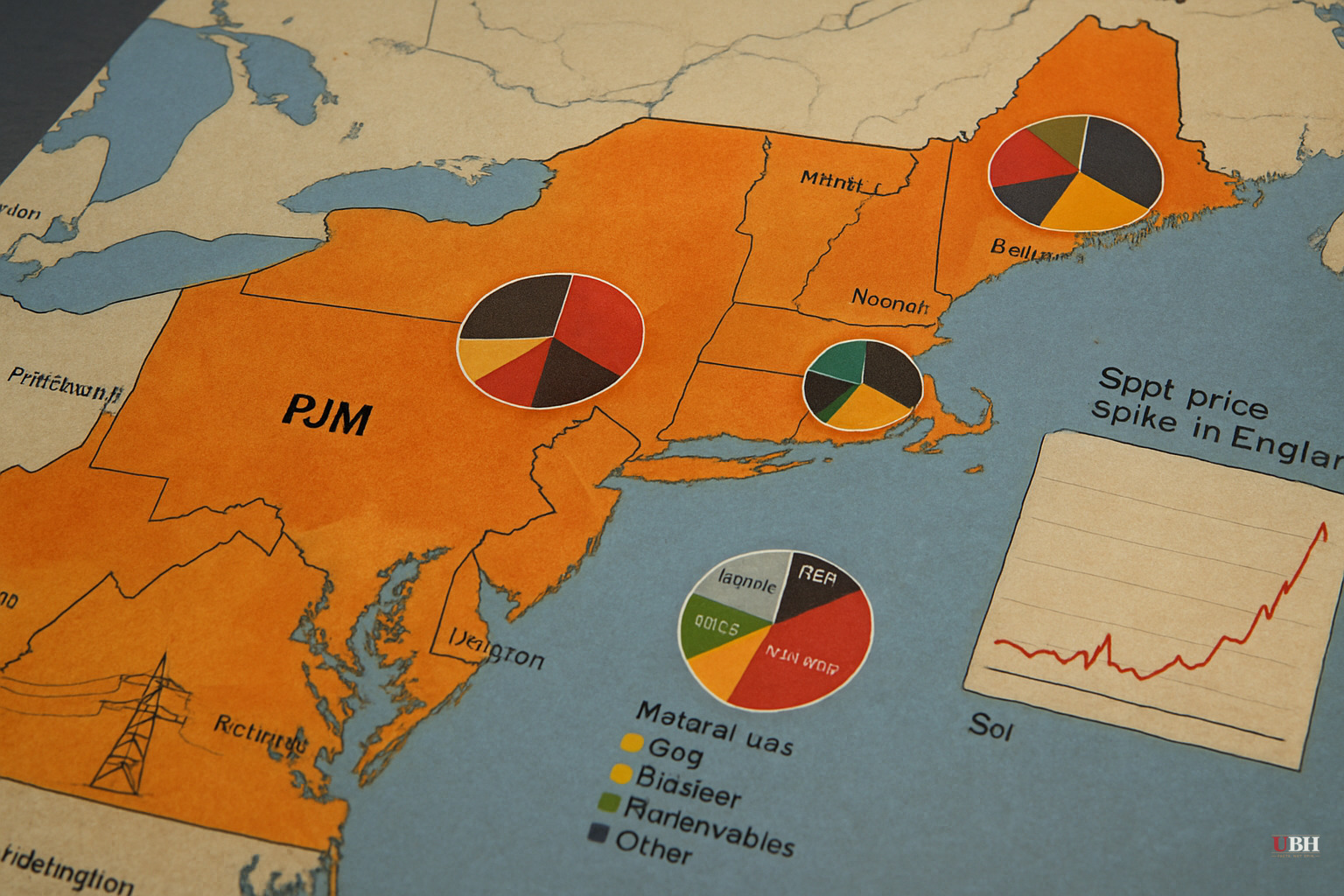
On Thursday, the PJM Interconnection — which covers the Mid-Atlantic, Ohio Valley, and parts of the Midwest — was running near 158 GW of total load, with net load around 142 GW, according to GridStatus data cited by ZeroHedge. Real-time power prices reached approximately $929/MWh during peak hours. Peak pricing is expected around 6 p.m. local time each day through the weekend.
The fuel-mix breakdown shows natural gas and coal together accounted for roughly 64.2% of generation. Nuclear contributed another 20.6%. Combined, those three dispatchable sources covered 84.8% of PJM's output. Solar and wind remained in the high single digits.
Spot Prices Across the Northeast
The price spikes were not limited to PJM. According to the U.S. Energy Information Administration data reported by CNBC, wholesale spot electricity prices surged more than 243% in New England and 101% in New York City on Thursday. The Midwest saw a 55% jump. The Mid-Atlantic rose 45.6%. These are single-day swings driven by air conditioning load.
The National Weather Service has warned that temperatures could reach 105°F in parts of the region, with very high humidity making conditions feel hotter. Some daily, monthly, and all-time records are possible.
Infrastructure Under Pressure
Amtrak announced earlier this week that trains may run at reduced speeds between 11 a.m. and 7 p.m. through July 4 across the Northeast, Southeast, and Midwest due to heat effects on track. New Jersey Transit warned of delays and cancellations from heat-related equipment stress. Delta Air Lines issued a fee waiver for itinerary changes through New York's LaGuardia Airport. The Illinois Department of Transportation put out a separate alert warning drivers about potential pavement buckling.
New York City Mayor Zohran Mamdani asked residents Thursday to set thermostats to 78°F, turn off unused electronics, and delay appliance use until early morning or late at night. He also addressed the reported Taylor Swift and Travis Kelce wedding planned at Madison Square Garden: "My recommendation to all New Yorkers is to stay inside and stay cool, and if you happen to be getting married at Madison Square Garden, you will be staying inside and you will be staying cool."
The Policy Argument the Numbers Force
ZeroHedge frames the fuel-mix data explicitly as a rebuke of renewable-energy policy, arguing that "policies that reduce dispatchable fossil-fuel power leave grids extremely fragile and prone to failure when demand spikes." The piece ties this to Trump administration energy policy as a deliberate counter to that trend.
The 84.8% dispatchable share during Thursday's peak is a logged operational fact. When temperatures spike, grid operators call on generation that can be dispatched on demand. Gas, coal, and nuclear do that. Wind and solar cannot be ordered up on command. During a heat dome, that distinction matters operationally.
The counter-argument, advanced by climate scientists and cited by CNBC, is that climate change is increasing the frequency and intensity of these events — meaning the underlying problem worsens regardless of which fuel mix handles the acute demand. More dispatchable capacity stabilizes the grid during a crisis; it does not reduce the number of crises.
CNBC's coverage did not include the specific PJM fuel-mix breakdown or the $929/MWh real-time price figure, both of which are material to understanding how close the grid actually ran to its limits Thursday. Those numbers add context that the spot-price data alone does not supply.
What Comes Next
The heat dome is forecast to continue through the July 4th weekend. The open operational question, as of the morning of July 3, is whether PJM and the New York Independent System Operator can sustain reserve margins through back-to-back peak demand days without rolling blackouts — a question that will be answered in real time across Saturday and Sunday.
Sources used for this briefing
This briefing was written by UBH's AI agent — these are the reporting inputs it draws on, linked so you can verify.


