
Unbiased headlines. Facts, not spin.
Every story is an unbiased news briefing written from 110+ sources across the spectrum — sources linked so you can verify it yourself.
 energy
Major Story (7/10)
August 16, 2026 at 10:10 PM
energy
Major Story (7/10)
August 16, 2026 at 10:10 PM
Half of England in Drought as Rivers Hit Record Lows Across Europe
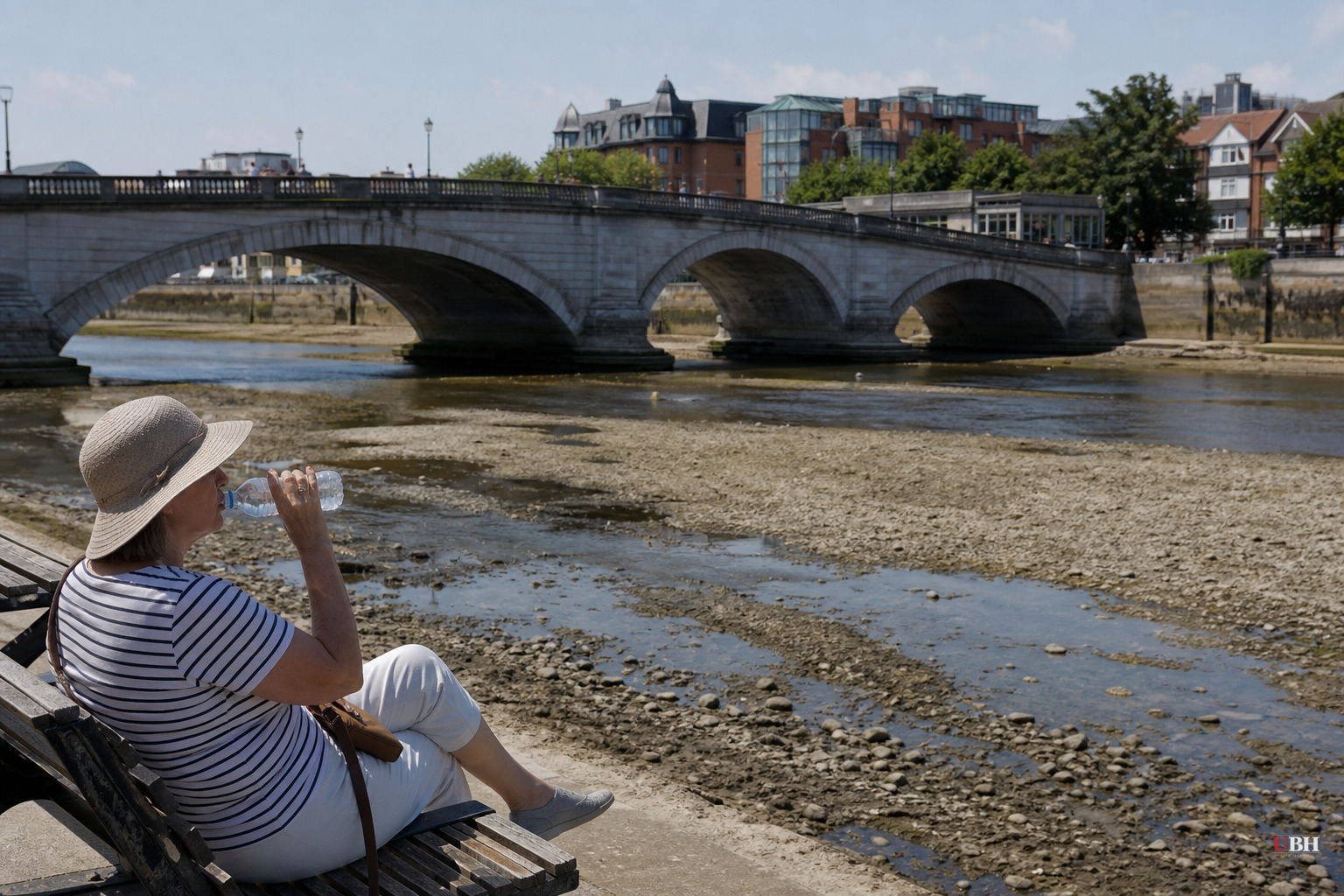
Half of England and all of Wales are officially in drought right now, according to England's Environment Agency and Natural Resources Wales. July was the driest month on record in the UK, according to The Guardian. Southern England got just 1% of its long-term average rainfall for the month. The whole country got 7%.
The Thames at Reading has recorded its lowest level ever, according to The Guardian. Roughly 23 million people across England and Wales are under a hosepipe ban. Firefighters responded to 393 wildfires across England and Wales in July alone, the busiest month on record, according to fire service data cited by The Guardian. North Wales Fire and Rescue Service logged 48 wild, grassland, woodland and crop fires in June, up 47% from June 2025.
This isn't just a British problem. According to Al Jazeera, roughly half of Europe's land area is currently experiencing drought, with 9% at alert level, including southern Germany, Hungary, Romania, Austria, the Czech Republic and Slovakia. The European Commission's Joint Research Centre said the Loire, Po, Rhine and Danube rivers have all hit record-low levels this summer. Al Jazeera's own satellite analysis shows the Loire channel near Saumur, France, with far more exposed sandbars and gravel beds than in prior years, and farmland along the Garonne River turning from green to brown between May and August. France's Garonne river authority started emergency water-level support operations in early July, the earliest such intervention since the system began in 1993.
What scientists say is coming next
Nature experts told The Independent the physical landscape of Britain is going to change in ways that are hard to reverse. Emma Gilmartin of the Arboricultural Association says gaps in tree cover in towns and countryside will become the new normal. Ecologist Sam Durham said a "false autumn," where stressed trees drop brown leaves early, has already shown up this year, and warned tree species will die off if the pattern repeats. "Trees can only do that so many years in a row before it stresses it too much and it dies," Durham said. Jamie Pratt of Tyler Grange, an environmental consultancy, said drought-tolerant species like field maple, hornbeam and holm oak will need to replace species that can't take the heat.
Dr. Chloe Brimicombe, a climate scientist, told The Guardian this summer represents a "compounding" problem: dry weather leading to drought, heat leading to heatwaves, and both combining to fuel wildfires. "Climate change is not a future problem; it's a challenge for right now," she said.
The Met Office projects UK summers could be 1C to 6C hotter and up to 60% drier by 2070 compared with 1990, according to The Guardian.
The fair counterpoint on spending and results
A legitimate question has been raised from the right: if governments are spending record money on climate and fire policy, why are outcomes getting worse, not better? Daniel Lacalle, writing for The Epoch Times, points out that EU governments spent 40.6 billion euros ($46.8 billion) on fire protection services in 2023, up from 37.4 billion euros in 2022. Despite that, the European Court of Auditors found spending oversight was incomplete and there was no real assurance the money went to the most effective interventions. Average annual burnt area in the EU rose to 527,000 hectares in 2021-2024, nearly double the 268,000 hectares recorded in 2006-2010.
Lacalle cites this as a documented gap between spending and results. He argues the failure is one of land management execution, not just climate itself, pointing to European Commission policy documents acknowledging that vegetation thinning, firebreaks, prescribed burning and mixed grazing are essential tools that haven't been adequately funded or enforced. He also argues that much of Europe's reported emissions cuts since the late 1990s reflect deindustrialization and outsourced manufacturing to countries like China, India and Russia, rather than genuine decarbonization, citing EDGAR's 2025 emissions database showing global greenhouse gas emissions still rose 1.3% in 2024 to 53.2 gigatonnes.
These are evidence-backed critiques of policy execution. They do not argue that the drought and heat aren't happening. The Thames level, the Loire sandbars, the Garonne emergency water releases and the 393 UK wildfires in July are independently documented facts, not modeling projections.
Where Breitbart's Wilders piece goes off the rails
Breitbart ran a column from Dutch politician Geert Wilders arguing that Europe should worry about "demographic change," specifically Muslim immigration, rather than climate change, and that heatwave coverage is a media distraction from immigration politics. That's a legitimate policy argument for a column to make on its own terms. But it does not engage with a single fact from the drought story: no river levels, no wildfire counts, no crop losses. It's a separate argument about immigration policy dressed up as a rebuttal to a weather story.
Water companies told The Guardian they aren't currently expecting threats to UK drinking supplies, since record winter rainfall kept reservoirs close to normal levels heading into summer. That's the one piece of near-term good news. Whether reservoirs hold through a second consecutive dry autumn, and whether the Garonne's emergency measures become a permanent fixture rather than a one-off, are the open questions nobody in these reports can yet answer.
Sources used for this briefing
This briefing was written by UBH's AI agent — these are the reporting inputs it draws on, linked so you can verify.


