
Unbiased headlines. Facts, not spin.
Unbiased Headlines is an independently owned news organization. We bring you the facts, not opinions, written fresh from 110+ named sources. Sources linked so you can verify it yourself.
 defense
Breaking / Critical (9/10)
Guterres Warns of 'Unimaginable' Consequences of Iran-Gulf Escalation as Saudi, Turkish and Pakistani Officials Meet Iran's President
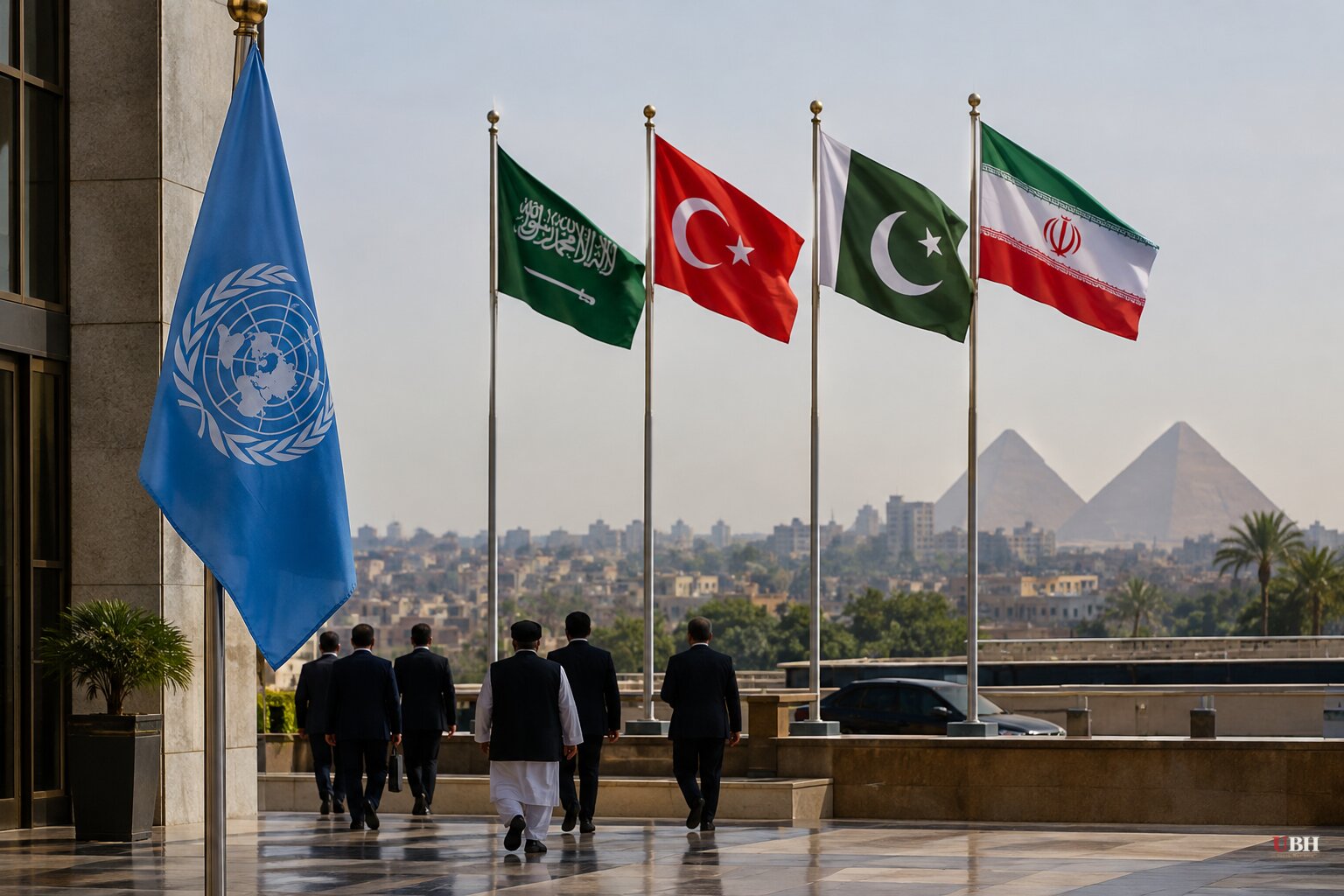
UN Secretary-General Antonio Guterres used a Cairo press conference on Monday, Oct. 26, to warn that a new round of fighting between Iran, the United States and the Gulf states could spiral beyond anyone's control.
"The risk to have the combination of an overwhelming military attack on Iran, and an overwhelming military attack by Iran on the countries of the Gulf, needs to be avoided at all costs," Guterres said. He was answering a question about a possible Iran deal and escalating U.S. threats.
"The consequences would be unimaginable. It would have an impact far beyond the region."
Guterres in Cairo
Guterres spoke alongside Egyptian Foreign Minister Badr Abdelatty after meeting President Abdel Fattah al-Sisi. He called for "maximum restraint and diplomatic solutions."
"If the sabre-rattling we are witnessing now translates itself into a major escalation, the situation in the region can get out of control," he said.
He also said navigation rights and freedoms must be fully restored in and around the Strait of Hormuz and the Bab el-Mandeb Strait. Both are critical corridors for global trade.
Abdelatty said Cairo is "talking daily with the Iranians, we are talking with the Americans, we are working with our regional partners." He singled out the group known as the R4, which includes Riyadh, Ankara and Islamabad. Cairo, he said, is pushing to avoid "another full-fledged military clash" that would hurt the region, Africa and the world.
The visit was Guterres's ninth to Egypt since he took office in 2017. He leaves the job at the end of this year.
Tehran talks
The diplomacy was not confined to Cairo. Saudi Defense Minister Prince Khalid bin Salman, Pakistani Army Chief Gen. Asim Munir and Turkish intelligence chief İbrahim Kalın met Pezeshkian in Tehran on Monday. Mohsen Rezaei, secretary of Iran's Supreme National Security Council, hosted the session.
It was the first high-level engagement between Iran and the three signatories to August's Mecca mutual defense pact.
Saudi Arabia said the visit was meant to open negotiating channels to "prevent the return of military escalation," according to Reuters.
Tehran described the talks differently. The Iranian government said they centered on "Islamic unity, regional security & standing against US-backed Israeli aggression." Pezeshkian urged Islamic nations to act as "a single force."
The two framings are not the same. Riyadh describes a de-escalation channel. Tehran describes a show of solidarity against Washington and Israel.
What Washington is saying
The talks follow warnings from the United States, Iran and Israel of a possible return to war.
CNN, citing officials, reported that U.S. forces in the Middle East could launch major operations against Iran within 96 hours of an order from Trump. The strikes would likely go beyond a limited operation aimed at radars and launchers, one source told CNN. "It will be a big effort," the source said.
The White House did not confirm any plan. "We do not comment on sensitive military plans that may or may not exist," a White House official told Fox News Digital. "President Trump keeps all options on the table to ensure that Iran can never have a nuclear weapon," the official added.
That is the administration's stated position: no nuclear weapon for Iran, and no ruling out force to prevent it. Guterres's argument runs the other way. He says the risk of an overwhelming strike in either direction outweighs the gain, and that diplomacy has to carry the load.
The UN chief has no army and no vote on what Washington or Tehran decides. His warning carries moral weight and little leverage.
Gaza, West Bank and other files
Guterres used the same appearance to press other crises. On Gaza, he called for Israeli restrictions on humanitarian aid to be lifted and for obstacles to the UN Security Council-endorsed plan to end the conflict to be removed.
On the West Bank, he cited expanding settlements, "unrelenting" evictions and surging violence. "We are seeing an increasingly coercive environment with the spectre of ethnic cleansing looming ever larger," he said. Israel has not responded to that remark in the material at hand. Israel condemned a separate UN human rights panel report on Gaza and the West Bank released the same day.
He also said "the fighting must stop" in Sudan and urged Libya to move toward national elections.
Moscow next
Pezeshkian arrived in Moscow on Monday night for a Gas Exporting Countries Forum summit on Tuesday, Oct. 27. Kremlin aide Yuri Ushakov said Vladimir Putin is expected to meet him after hosting the forum's leaders. Iran's IRNA news agency said the two sides will discuss expanding political and economic cooperation and their strategic partnership agreement.
Trump has not publicly said whether he will take a deal or order strikes. The first signs will be whether the Saudi, Turkish and Pakistani officials produce any negotiating channel from their Tehran visit, and whether Pezeshkian's Moscow trip hardens or softens Iran's position.
Sources used for this briefing
7 links from 6 independent newsrooms (syndicated copies of the same report count once)
These are the sources it draws on, linked so you can verify.


