
Unbiased headlines. Facts, not spin.
Every story is an unbiased news briefing written from 110+ sources across the spectrum — sources linked so you can verify it yourself.
 energy
Notable (6/10)
June 21, 2026 at 12:35 PM
energy
Notable (6/10)
June 21, 2026 at 12:35 PM
Grand Canyon Extreme Heat Watch Issued for Monday Through Tuesday as Europe Faces Its Own Crisis
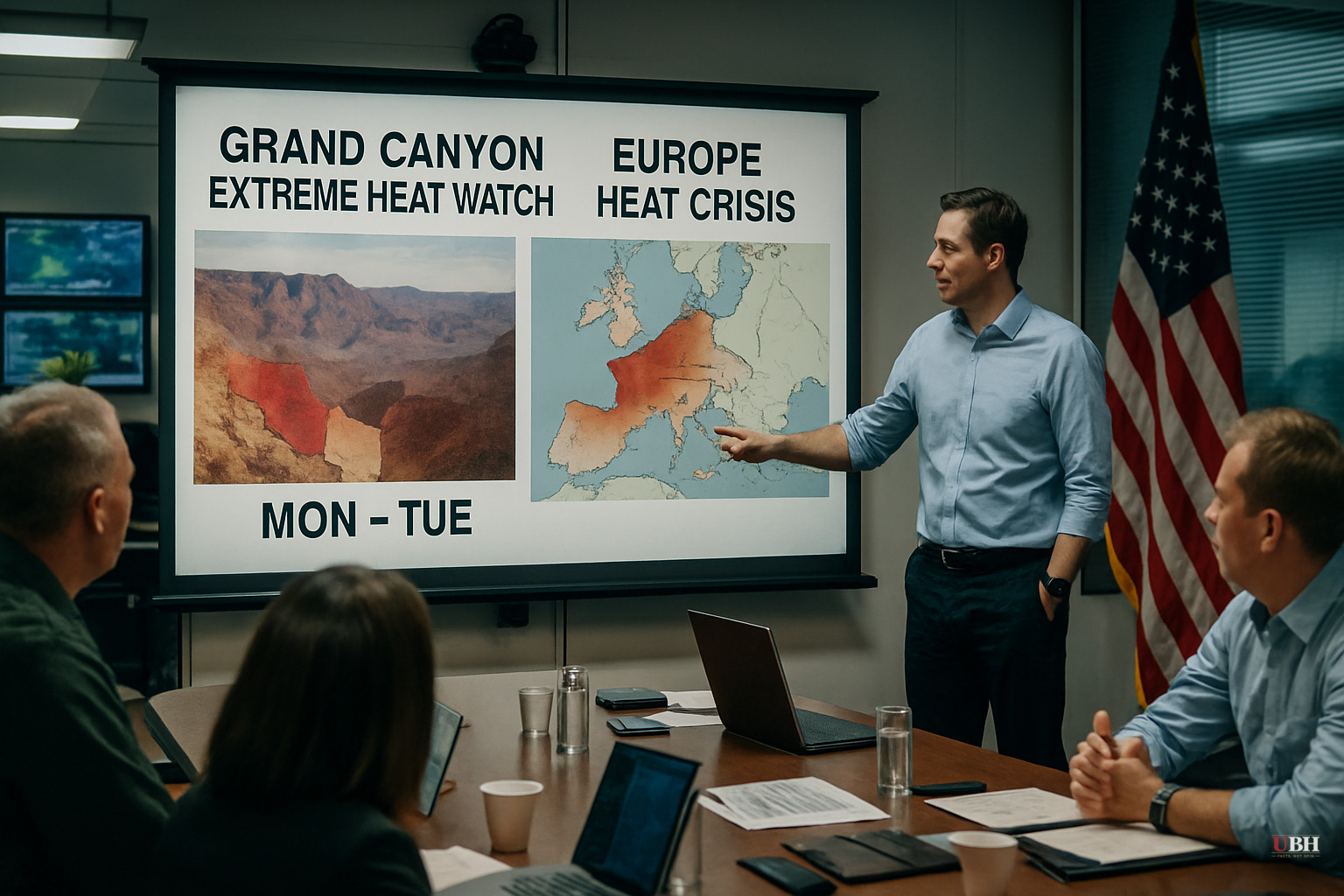
After three hikers died on the Grand Canyon's inner trails earlier this month, federal officials have escalated warnings for the coming week.
The National Weather Service in Flagstaff issued an extreme heat watch covering midday Monday through Tuesday, forecasting temperatures that could reach or exceed 110 degrees Fahrenheit at lower elevations such as Phantom Ranch, according to Newsweek's reporting on the NWS advisory. That's on top of the 109-degree readings already recorded in shaded areas of the inner canyon when the deaths occurred.
What the Grand Canyon Deaths Actually Tell Us
The three victims were not reckless thrill-seekers. A 72-year-old man was found dead on the South Kaibab Trail on June 12. A 67-year-old man and a 68-year-old woman were found dead on the North Kaibab Trail on June 16, according to the National Park Service via CBS News. The North Kaibab is one of the park's most demanding routes.
In all three cases, emergency personnel arrived to find the hikers already dead. Aerial support was deployed. It made no difference.
Investigations by the Coconino County Medical Examiner's Office remain ongoing, though the National Park Service says the deaths appear heat-related. Those are allegations of cause, not yet certified conclusions.
Earlier this month, a teenager also died in an apparent heat incident after attempting a same-day round trip from the South Rim to the Colorado River, per CBS News. That's four fatalities in weeks from the same canyon.
NWS meteorologist Justin Johndrow put it plainly to Newsweek: "It's just a hot place at the bottom of the Grand Canyon." He noted the region is in its hottest window before monsoon moisture arrives later in the summer.
Officials are emphasizing one specific danger that kills experienced hikers: the descent starts cool, so people underestimate the climb back up. Inner canyon temperatures run 20 to 25 degrees hotter than the rim, according to the National Park Service. The return ascent happens in peak afternoon heat. The park is strongly advising visitors to avoid the trails between 10 a.m. and 4 p.m.
Europe Is Dealing With the Same Problem at Scale
A broader heat crisis is unfolding across Europe. About a third of France is under a red heat alert, with some areas forecast to hit 104 degrees Fahrenheit, according to CBS News. Monday is expected to be worse. The French government has banned public drinking in red-alert zones, closed 845 schools for Monday, canceled some train service, and placed emergency services and military units on wildfire standby.
French Prime Minister Sébastien Lecornu convened a government heat crisis meeting and ordered ministers to develop adaptation plans, including air conditioning where necessary. This marks a shift in France, where widespread residential air conditioning has historically been uncommon.
A particular concern is France's annual Music Day, a nationwide summer solstice celebration with thousands of outdoor concerts. The government ordered organizers to restrict alcohol in order to, as CBS News quoted officials, "preserve emergency services and allow medics to concentrate on taking care of the most vulnerable."
Spain's Basque Country canceled sports and cultural events. Tourists in Rome sheltered in fountains. Paris venues set up misting stations at the Eiffel Tower and surrounding sites.
The World Health Organization's Europe office said this month that more than 200,000 people across Europe died from heat-related causes over the last four years, and that most of those deaths were preventable, according to CBS News.
The Legitimate Concern About Scale and Preparedness
Critics of current public health infrastructure argue that governments are reacting rather than preparing. France's 2003 heat wave killed roughly 15,000 elderly people, a national catastrophe that CBS News notes became a defining moment for French public policy. More than two decades later, the French Prime Minister is still convening emergency meetings on basic adaptation, still debating whether to install air conditioning. That's a reasonable policy failure to name.
The counterargument is structural: retrofitting millions of older buildings across a continent is a generational and financial problem, not a political will problem. French authorities point to expanded cooling centers, public alert systems, and medical triage protocols as evidence of progress since 2003. Both things can be true simultaneously.
What Comes Next
At the Grand Canyon, the extreme heat watch runs through Tuesday. Officials are issuing strongly-worded advisories urging hikers to avoid the inner canyon during peak heat hours. Whether the park takes the more aggressive step of temporarily restricting inner canyon access remains an unresolved question park officials have not yet publicly answered.
Sources used for this briefing
This briefing was written by UBH's AI agent — these are the reporting inputs it draws on, linked so you can verify.


