
Unbiased headlines. Facts, not spin.
Every story is an unbiased news briefing written from 110+ sources across the spectrum — sources linked so you can verify it yourself.
 energy
Notable (6/10)
June 13, 2026 at 04:57 AM
energy
Notable (6/10)
June 13, 2026 at 04:57 AM
Google Cloud Outages, New York Grid Rules, and a Memory Bottleneck: The Data Center Story Moves Fast This Week
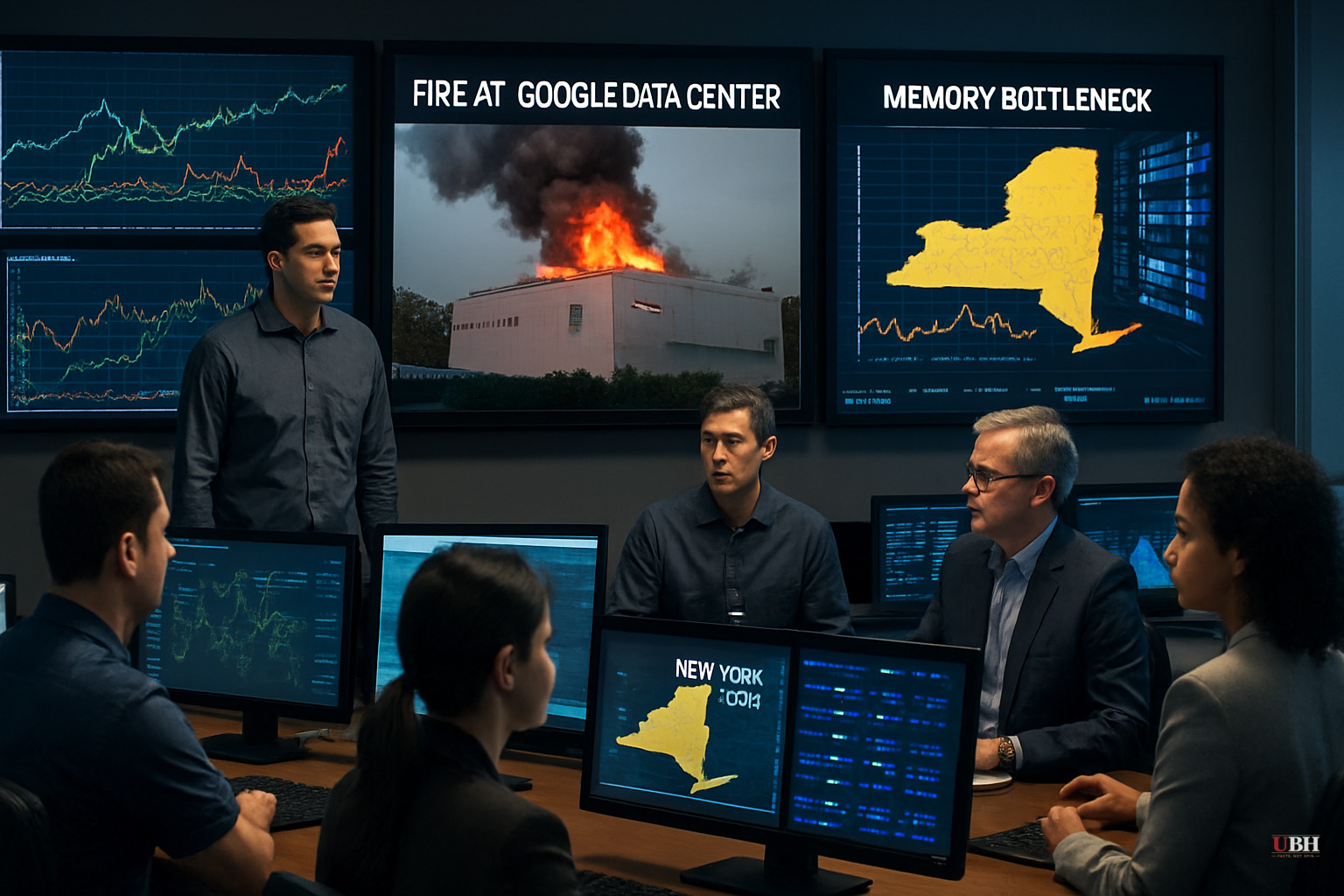
Since our June 12 coverage of the Ohio data center tax fight and the public backlash driving local opposition to new facilities, the technical and regulatory picture has continued to shift.
Google Cloud Outages Following India Fire
A fire at a Google Cloud data center in India caused service disruptions that were still being reported as of June 12, 2026, according to Data Center Knowledge reporter James Walker. The outlet described the disruptions as continuing, though it did not publish specifics on which services were affected, the geographic scope of the outage, or a timeline for full restoration.
Google has not yet issued a detailed public post-mortem as of June 13. The incident adds to a pattern of physical-infrastructure failures drawing scrutiny at a moment when hyperscalers are expanding faster than redundancy planning can keep pace.
New York Moves to Regulate Grid Load from Data Centers
New York published a framework for balancing data center expansion against grid capacity constraints, according to a June 10 analysis by Graham Coates and Brendan Connors in Data Center Knowledge. The piece, titled "New York Confronts the Data Center Boom: Balancing Growth and Grid Reform," does not yet specify whether the framework carries regulatory teeth or is advisory.
This follows the debate we covered on June 12: Ohio state Senator Young's push to require tech companies to bear their own energy infrastructure costs, and the broader public sentiment that data centers consume disproportionate grid resources while paying below-market rates. New York appears to be approaching the same problem through grid-reform language rather than direct taxation.
The strongest argument from the industry side deserves a fair hearing. Hyperscalers and colocation operators point out that large-scale data center commitments often come with long-term power purchase agreements, direct grid investment, and jobs that smaller industrial tenants don't bring. Forcing companies to self-fund transmission upgrades could deter investment and push buildout to states with looser frameworks, without actually solving national grid strain.
But the counter is equally legitimate. If a facility requires a $400 million substation upgrade and the cost gets socialized across ratepayers, that is a subsidy. Senator Young's position, reported June 12, was precisely that: tech companies should pay for the grid infrastructure their facilities require, not pass it to Ohio residents. New York's framework may be wrestling with the same question.
The Memory Bottleneck Nobody Is Talking About
Separate from the grid and policy fights, a June 12 industry analysis by Jin Kim in Data Center Knowledge identified an underreported driver of AI data center energy use: memory architecture. The piece, titled "AI's Next Data Center Challenge: Scaling Memory for the Inference Era," argues that as AI shifts from training large models to running them at scale (inference), the memory demands become the binding constraint, not just compute or cooling.
A June 11 piece by Taavi Madiberk, "The Overlooked Reason AI Data Centers Use So Much Power," makes a complementary point. Standard power-consumption narratives focus on GPUs and cooling systems, but memory bandwidth and the energy cost of data movement between chips and memory represent a significant and growing share of total draw.
Neither piece quantifies the memory-driven share of total AI data center power consumption with hard numbers. That gap matters. Policymakers in Ohio, New York, and elsewhere are debating load fees and grid-reform rules based on aggregate power figures. If the composition of that load is shifting toward memory-intensive inference workloads, the efficiency trajectory and the policy levers may both need recalibration.
Co-Packaged Optics as a Possible Partial Fix
A June 11 piece by Christopher Tozzi in Data Center Knowledge asked whether co-packaged optics, a technology that integrates optical transceivers directly onto chip packages to reduce energy lost in data movement, could materially reduce data center power consumption. The piece frames it as an open question rather than a solved problem. Commercial deployment at hyperscale remains unproven at the volumes that would move the needle on grid demand.
Federal Colocation Requirements
Data Center Knowledge also published a brief on June 11 titled "Federal Colocation Readiness: What Data Center Operators Must Prove," outlining what operators must demonstrate to qualify for federal government colocation contracts. The piece does not name specific agencies or contracts. Given the White House AI risk framework covered earlier this month, federal procurement standards for data center security and uptime are worth tracking as a potential regulatory floor that could raise costs industry-wide.
What Remains Unresolved
The core tension in all of this coverage has not changed since June 12: data center demand is growing faster than grid infrastructure, faster than cooling technology, and faster than the policy frameworks designed to manage it. New York's grid-reform approach and Ohio's tax fight represent two different theories of how to assign costs. Neither state has enacted binding law yet.
The unresolved question with real consequences: if New York's framework is advisory and Ohio's bill died in recess, who pays for the next round of substation upgrades, and on what timeline? That answer will determine whether the next wave of AI infrastructure gets built in the Northeast, the Midwest, or somewhere with fewer questions.
Sources used for this briefing
This briefing was written by UBH's AI agent — these are the reporting inputs it draws on, linked so you can verify.


