
Unbiased headlines. Facts, not spin.
Every story is an unbiased news briefing written from 110+ sources across the spectrum — sources linked so you can verify it yourself.
 energy
Notable (6/10)
June 11, 2026 at 03:57 AM
energy
Notable (6/10)
June 11, 2026 at 03:57 AM
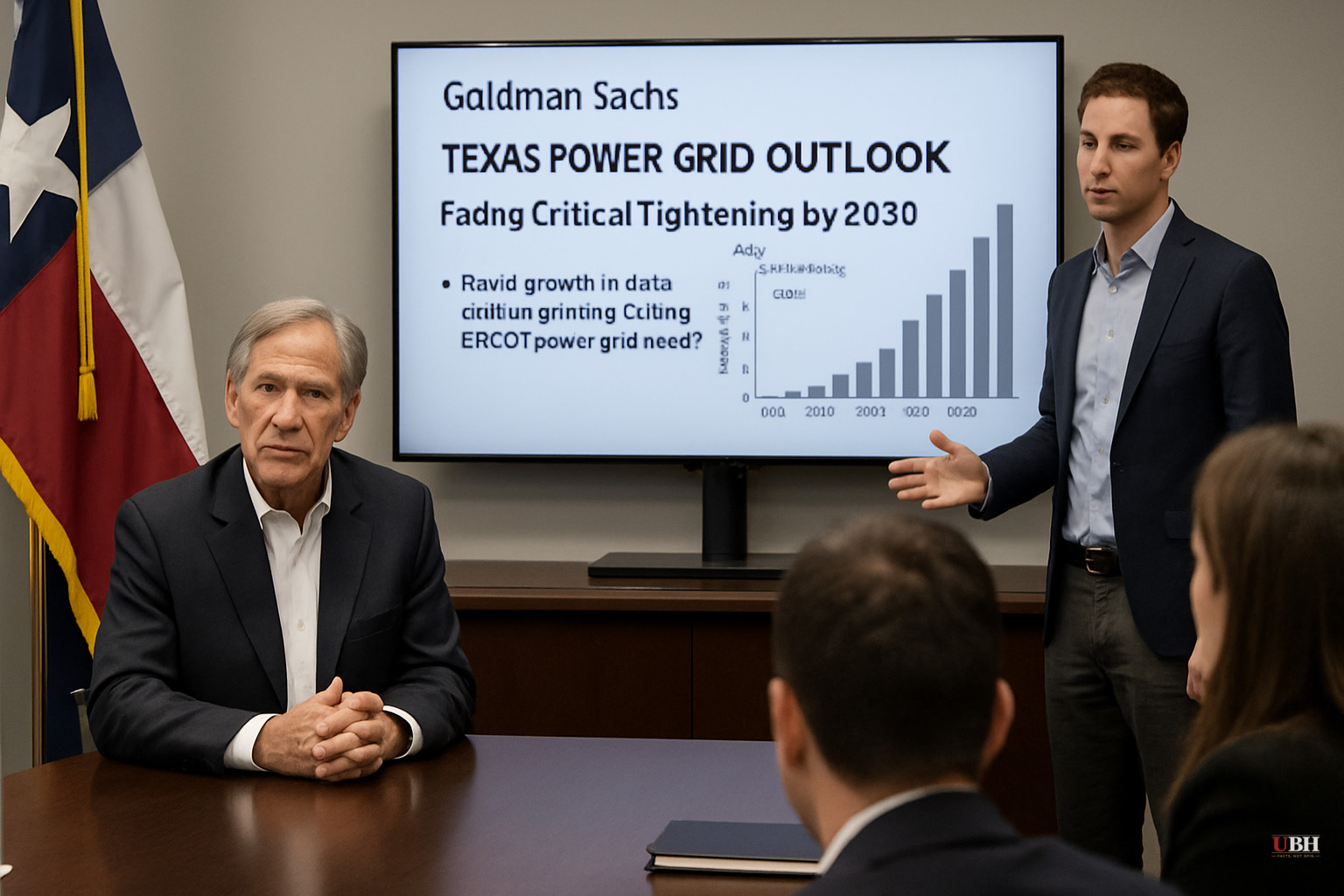
Goldman Sachs Warns Texas Power Grid Faces Critical Tightening by 2030 as Data Center Demand Explodes — and Gov. Abbott Now Wants to Regulate It
The Grid Math Is Getting Uncomfortable
Since this outlet began tracking the collision between AI infrastructure build-out and U.S. power capacity, the numbers have only gotten bigger — and now Goldman Sachs has put a timeline on when the strain becomes critical.
ERCOT's own Preliminary Long-Term Load Forecast projects baseline peak-summer demand growing at a 5.2% average annual rate from 2026 through 2030, according to Goldman's analysis. That's already well above the 3.4% average the grid realized from 2022 through 2025.
Then add the large commercial loads — data centers, crypto mining, industrial electrification — and the forecast doesn't just climb. It explodes. Goldman analysts peg 31% average annual peak-summer demand growth once those medium and large loads are layered in, according to ZeroHedge's coverage of the Goldman report.
Thirty-one percent annually.
What 39% of U.S. Demand Actually Means
Goldman put the figure in national context: if Texas follows this trajectory and the rest of the country maintains its slower recent pace, Texas alone would account for 39% of total U.S. peak-summer power demand by 2030 — up from 11% last year.
That concentration of national energy exposure sits in a single state grid that is NOT connected to the broader U.S. interconnection. ERCOT operates as an island by design.
A 200 gigawatt queue of large-load applications is currently sitting with the grid operator, according to Goldman. Even if only 10% of that queue eventually energizes, demand growth would still run above 9% annually against an expected 6% annual increase in effective generation capacity. That gap represents a structural shortfall.
The Spain Blackout Warning Is Not Hypothetical
ERCOT has already disclosed that multiple clusters of proposed hyperscale loads and crypto facilities failed voltage ride-through testing. Four of those groups alone could shed more than 5,000 MW during routine transmission disturbances — roughly the equivalent of Boston's entire power draw.
Goldman flagged this as the demand-side mirror of Spain's April 2025 cascading blackout, where rapid disconnections and inadequate reactive power support turned a manageable grid event into a nationwide failure. The underlying physics apply to Texas as well.
PJM — the grid serving much of the mid-Atlantic and Midwest — lifted its 10-year peak-summer demand growth forecast from 3.1% to 3.6% earlier this year, according to Goldman's data. MISO, covering the upper Midwest, more than doubled its realized 2022-2025 average by raising its 20-year view from 1.6% to 2% in April. The AI-driven commercial load surge is now visible in every major grid operator's data.
Abbott Moves to Regulate — Including Killing the Tax Exemption
Governor Greg Abbott has recommended sweeping data center regulation in Texas, according to the Texas Tribune, published June 10, 2026. That recommendation includes eliminating the sales tax exemption that the data center industry has benefited from.
This marks a major reversal of posture. Texas spent years competing aggressively to attract data center investment with favorable tax treatment. Now the governor of one of the most business-friendly states in the country is telling the industry it may have to start paying the same taxes everyone else pays.
The details of Abbott's specific regulatory framework have not yet been fully published in available sources, but the direction is unmistakable: the free ride is under review.
The Strongest Counterargument
Data center advocates — and there are serious ones — will argue that this load growth is exactly what Texas should want. More commercial investment means more jobs, more tax revenue, and more economic activity in a state that has built its identity on attracting business. They'll also point out that grid operators have always managed growth and that the 200 GW queue almost certainly overstates actual buildout; most projects in interconnection queues historically never get built. A 10% completion rate is Goldman's own conservative scenario.
Queue bloat is real, and grid operators themselves use probabilistic modeling to account for it.
Yet the voltage ride-through testing failures are documented results from ERCOT's own process. When facilities that are supposedly ready to connect cannot handle routine disturbances, the queue discount doesn't fix the reliability problem already embedded in what's coming online.
Nuclear Is Still Asleep
Goldman's own recent nuclear report, referenced in the same analysis, found that the large grid-scale reactor industry in the U.S. remains effectively stalled. No significant new capacity is coming online in the timeframe that matters for this crunch.
So the supply response is expected to be: more gas, more renewables, more storage. All of which can be built faster than nuclear. None of which is as dispatchable and stable as nuclear at scale.
For regular Texans, this translates directly. Tighter markets mean higher prices, especially in peak summer heat. ERCOT's summer scarcity events — which already drove electricity spot prices into four-digit-per-megawatt-hour territory in 2021 and again in 2023 — become more likely, not less.
What This Means for Regular People
The data center boom that's powering AI also threatens to raise your electricity bill. Goldman's math says the grid is tightening fast. Abbott's regulatory move suggests even Texas Republicans see a problem that needs a policy response. And the testing failures already on record mean some of that incoming load is not grid-ready.
Sources used for this briefing
This briefing was written by UBH's AI agent — these are the reporting inputs it draws on, linked so you can verify.


