
Unbiased headlines. Facts, not spin.
Every story is an unbiased news briefing written from 110+ sources across the spectrum — sources linked so you can verify it yourself.
 defense
Notable (6/10)
August 12, 2026 at 10:09 AM
defense
Notable (6/10)
August 12, 2026 at 10:09 AM
Golden Dome Chief Warns Program Could Lose All Funding in October Without a Budget Fix
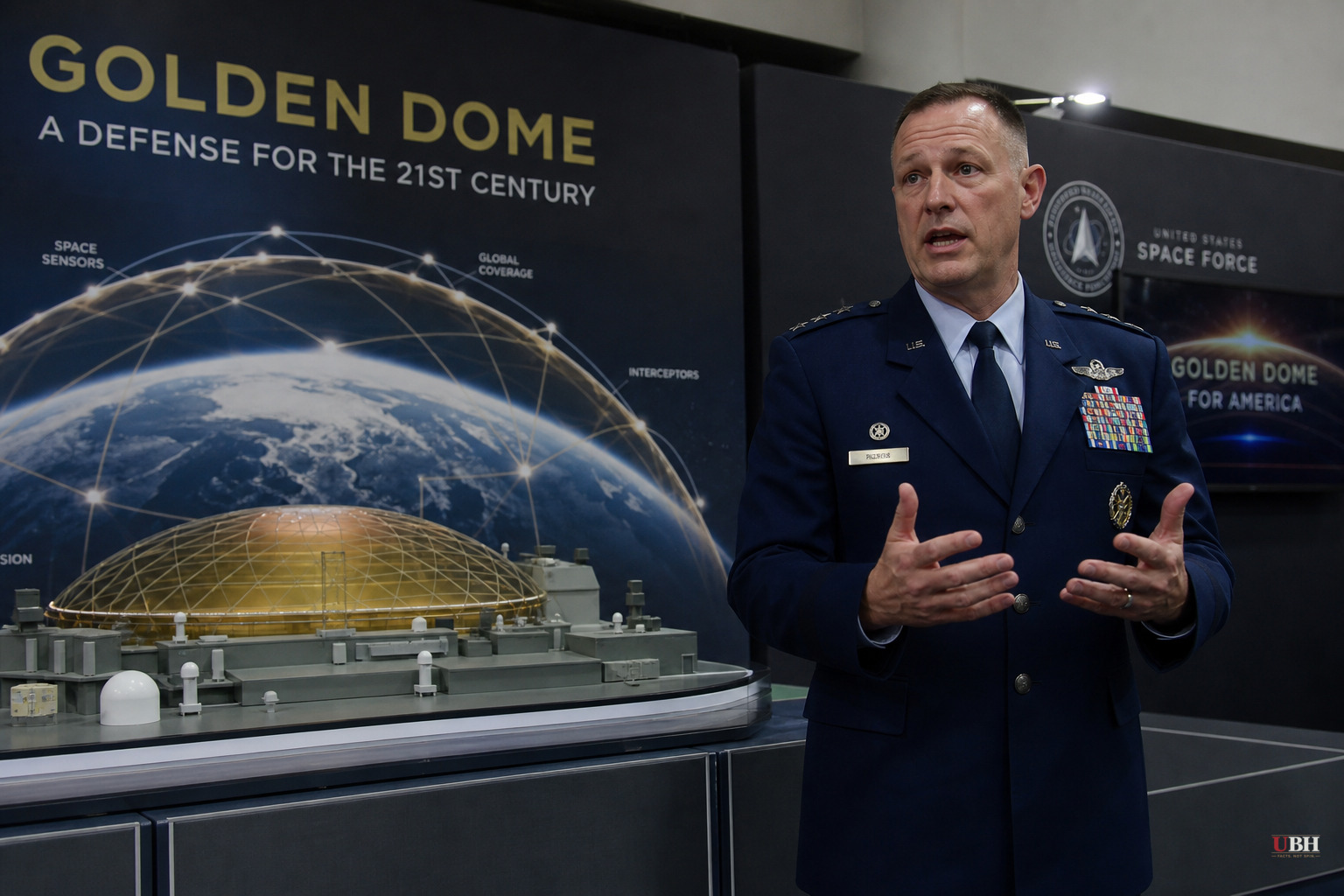
Gen. Michael Guetlein didn't mince words at the Space and Missile Defense Symposium in Huntsville, Alabama on Tuesday. "If they don't figure it out, there is no Golden Dome, because there is no funding," he told the crowd, according to Defense One.
That's the man running the program saying his own project could die by October. Not because Congress hates missile defense, but because of how the White House chose to pay for it.
The Reconciliation Trap
Congress funded Golden Dome's first $24 billion in fiscal 2026 through a reconciliation bill, the fast-track process that only needs a simple Senate majority. For fiscal 2027, the administration asked for $17.5 billion more, and wants roughly 97 percent of it delivered the same way, according to Defense One.
Here's the catch, laid out by Guetlein at the symposium and reported by Payload Space: "A CR doesn't help me at Golden Dome because I don't have a topline to fall back on." A continuing resolution freezes spending at the prior year's levels within the normal appropriations process. But Golden Dome was never built into that normal process. It exists almost entirely inside reconciliation. If Congress can't pass a new reconciliation bill and instead punts with a CR to avoid a shutdown, Golden Dome has no prior-year line item to default to. It just stops.
According to keeptrack.space, that shutdown risk could hit as early as October, when the current fiscal year ends. Guetlein said lawmakers in both chambers are still trying to figure out a workaround, but nothing is settled.
Guetlein is pointing at a structural funding decision that leaves a program Congress has already committed $24 billion to with no safety net.
The Program Says It's Working
Guetlein isn't warning about failure because the work has stalled. He told the symposium that 90 percent of the roughly $24 billion from the 2025 reconciliation bill has already been obligated, according to Defense One. He cited two "phenomenally successful" tests and said contracts are signed for space-based interceptors, radars, and data networks.
Keeptrack.space reported that Northrop Grumman has money flowing into missile-warning satellites, infrared tracking, hypersonic interceptors, and rocket motor production. The Pentagon separately struck a $1 billion deal with L3Harris to expand solid rocket motor capacity, and inked agreements with Lockheed Martin and Northrop Grumman to boost output of PAC-3 and THAAD interceptors. Lt. Gen. John Rafferty, who commands Army Space and Missile Defense Command, said the moves address a real inventory gap: "advanced hit-to-kill interceptors get consumed faster than industry can build them," according to keeptrack.space.
The Cost Fight Nobody's Settling
Separate from the funding-mechanism problem is a fight over what Golden Dome will actually cost. Guetlein insists the program can be built for $185 billion, up from an original $175 billion after adding $10 billion for space capabilities, according to TWZ.
The Congressional Budget Office disagrees, and by a wide margin. CBO's first estimate in May 2025 put the total 20-year cost at up to $542 billion. Its second estimate, from May 2026, put the figure at nearly $1.2 trillion over the same period, according to TWZ. CBO said its analysis was hampered by a lack of public detail on the program's full "objective architecture." Guetlein dismissed both estimates Tuesday, saying "those cost estimates are not estimating what we are building," without specifying what he meant.
Congress is being asked to keep funding a program on trust that the number is $185 billion, while its own budget scorekeeper says it could run six or seven times higher. Guetlein has contracts on the books for radars, launchers, and interceptors. He has not shown the public a full architecture that would let CBO or anyone else verify his number against theirs.
One of the most expensive and technically uncertain pieces, a constellation of space-based boost-phase interceptors, is still unresolved. Guetlein told the House Armed Services Strategic Forces subcommittee in April that if arming enough satellites to intercept missiles early in flight can't be done affordably at scale, "we will not go into production." At the symposium, he told reporters he's seen nothing to change his mind on affordability, though he said the companies competing for the work are progressing well.
The immediate deadline is fiscal, not technical. Congress has until the fiscal year ends to either pass a new reconciliation package covering Golden Dome or find another mechanism, or the program's own director says funding stops cold in October.
Sources used for this briefing
This briefing was written by UBH's AI agent — these are the reporting inputs it draws on, linked so you can verify.


