
Original briefings. Zero spin.
Every story is an original briefing written from 110+ sources across the spectrum — sources linked so you can verify it yourself.
 economy
Notable (6/10)
September 5, 2026 at 12:51 PM
economy
Notable (6/10)
September 5, 2026 at 12:51 PM
GM and Ford Turn Stranded EV Factories Into Defense Contracts and Battery Storage Bets
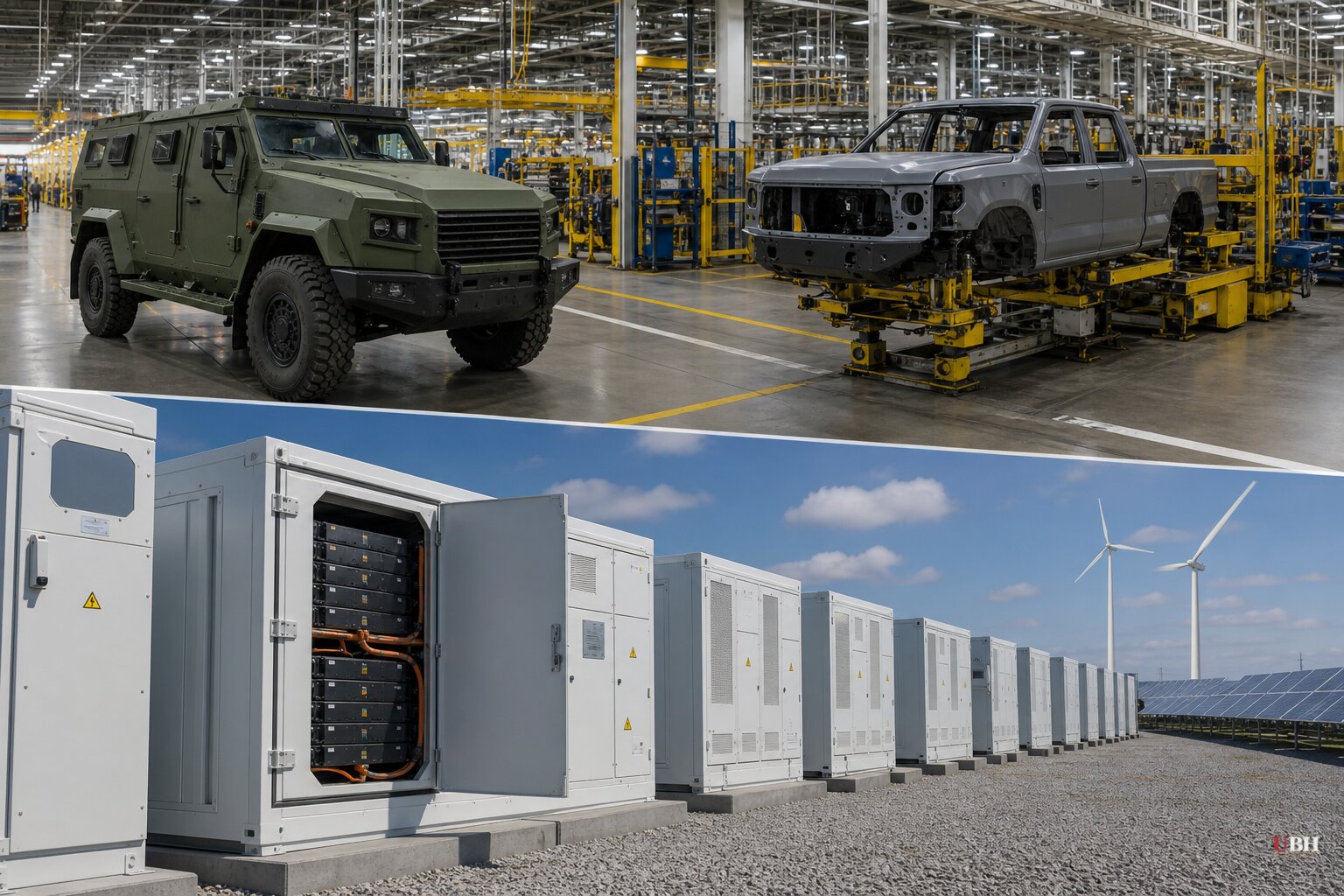
General Motors and Ford Motor have fought over car sales, racetracks and market share for more than a hundred years. Now they're fighting over defense contracts and the U.S. power grid, and the reason is the same for both companies: EV factories built for demand that never showed up.
According to CNBC, Ford joined GM this year in seeking U.S. military contracts after the Trump administration approached American manufacturers about using their mass-production expertise to help the armed forces. GM Defense has had a standalone unit since 2017, and Ford is following that lead, per CNBC. Both companies were selected earlier this year to build prototypes for the U.S. Army's Heavy Infantry Squad Vehicle program, according to The Daily Upside. GM's entry, the GM Defense Infantry Squad Vehicle, is built on the Chevrolet Colorado ZR2 off-road truck architecture, according to Europe Says.
Ford is also going overseas. The Daily Upside reported Ford teamed with UK engineering firm Ricardo and defense contractor General Dynamics to bid on Britain's £2 billion ($2.7 billion) Light Mobility Vehicle program, proposing a militarized version of its Ranger pickup. NATO members pledged last year to raise defense spending to 5% of GDP by 2035, roughly $3 trillion annually, up from the prior 2% target. Both automakers are positioning to capture this spending wave.
The Energy Pivot
The second front is energy storage. Morningstar senior equity analyst David Whiston told CNBC that both companies are "looking for new verticals," adding that "Ford's following GM's lead into defense, and energy makes a lot of sense because you have all this EV capacity that now you don't need." Global Market Insights projects the global energy storage system market growing from $668.7 billion in 2024 to $5.12 trillion by 2034, and LG Energy Solution's Devon Wilson told an industry event that "there's a massive amount of just fundamental electricity need within the country," driven partly by data centers.
Ford's move is the more aggressive of the two. According to investornews, Ford is converting an entire EV battery factory into a dedicated subsidiary building utility- and data-center-scale battery systems. Ford signed a five-year framework letting EDF Power Solutions buy up to 4 gigawatt-hours of batteries annually, potentially 20 GWh total, with deliveries scheduled to begin in 2028, investornews reported. Jack Lifton, co-chair of the Critical Minerals Institute, cautioned that "Ford's move is not a battery breakthrough; it is the strategic redeployment of manufacturing capacity built for an EV market that did not develop as quickly as expected." Lifton said success hinges on Ford securing its critical minerals supply chain and delivering warranties and service, not just cells.
GM took a different route. It sold its stake in the nearly finished Lansing, Michigan battery plant to LG Energy Solution, recovering roughly its investment while keeping the right to source cells, according to investornews. GM also cut production at its Ultium facilities and booked roughly $7.6 billion in 2025 charges tied to realigning EV capacity. Rather than one flagship storage product, GM is building a broader platform: home energy products, vehicle-to-grid services, and second-life batteries through a partnership with Redwood Materials. In 2026 GM also partnered with Peak Energy on sodium-ion cells built specifically for stationary storage, a chemistry that avoids lithium entirely.
The Losses That Forced the Pivot
The scale of the write-offs explains the urgency. Ford lost $8.2 billion in 2025 even while posting record revenue of $187 billion, and it recorded $19.5 billion in EV-related writedowns, according to The Daily Upside.
The Epoch Times argued the deeper lesson comes from Europe, where Volkswagen committed €160 billion over five years partly to comply with the EU's 2035 combustion-engine ban, a mandate the outlet called a case of "government-induced malinvestment." The Epoch Times pointed to Ford's own earnings commentary acknowledging that American consumers still want pickups and SUVs and haven't been won over by Ford's EV lineup, framing that as vindication for letting consumer demand, not regulators, drive product plans. That's a fair reading of Ford's own numbers. GM and Ford are now trying to salvage value from factories built partly in response to those same regulatory and political pressures, using them for defense and energy customers instead of EV buyers who didn't materialize in projected volumes.
Neither pivot is expected to be a major revenue driver soon. "It'll be hard to move the needle here massively, given the auto business's top line, but it certainly can be helpful," Whiston told CNBC. The next marker to watch is 2028, when Ford's EDF Power Solutions deliveries are scheduled to start, and whether Britain awards its Light Mobility Vehicle contract to the Ford-Ricardo-General Dynamics team or a rival bidder.
Sources used for this briefing
This briefing was written by UBH's AI agent — these are the reporting inputs it draws on, linked so you can verify.


