
Original briefings. Zero spin.
Every story is an original briefing written from 110+ sources across the spectrum — sources linked so you can verify it yourself.
 economy
Major Story (7/10)
Event date: August 28, 2026
economy
Major Story (7/10)
Event date: August 28, 2026
Factory Investment Boom Collides With AI-Driven Chip Shortage Pushing Up Consumer Electronics Prices
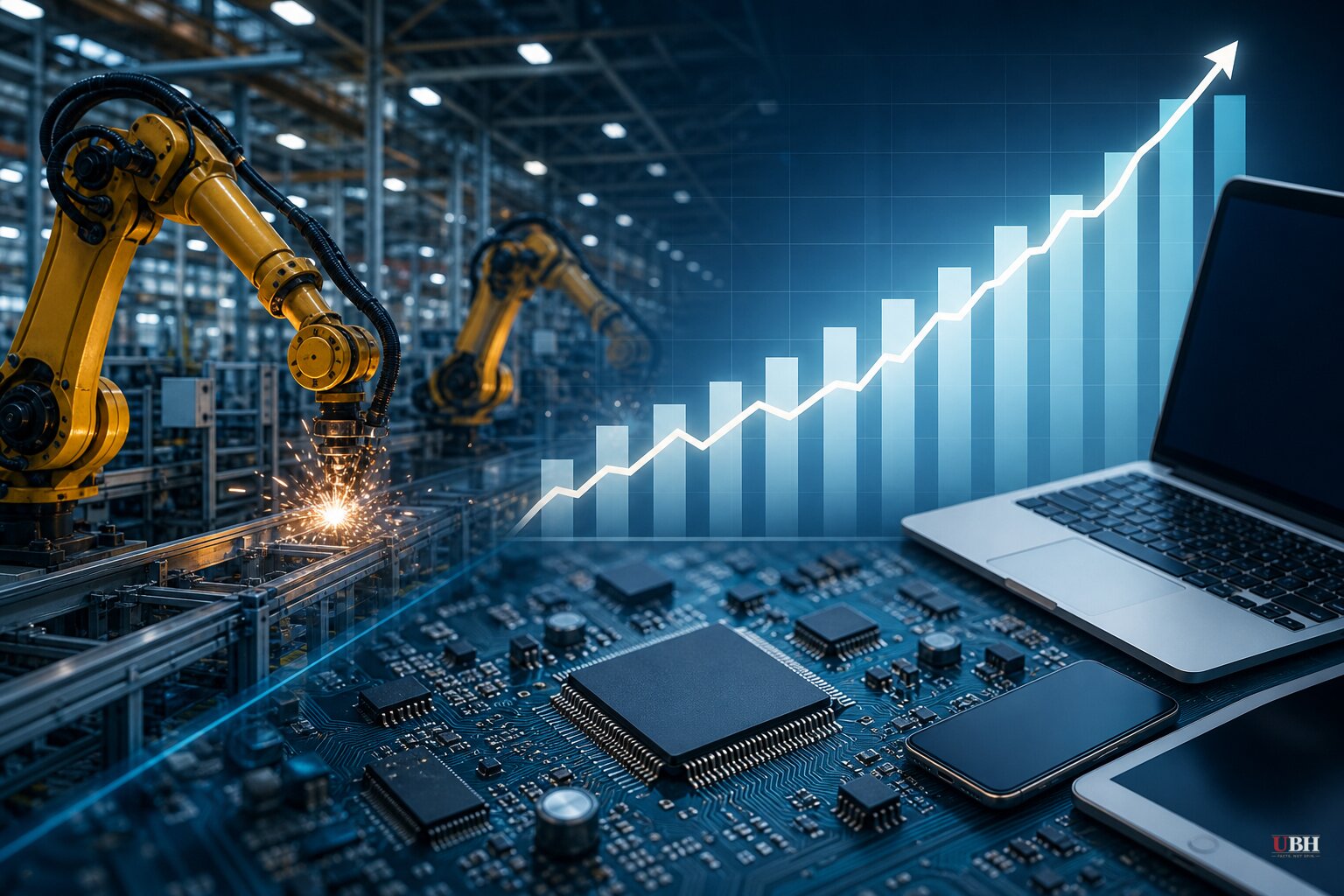
American factories are running hot right now, and it's not just because of AI data centers.
Federal Reserve data released this week show business-equipment production rose 0.8% in July and is up 6.6% from a year earlier. That's an acceleration: equipment output grew at a 12.7% annualized rate in the second quarter after a 7.6% pace in the first three months of the year, according to the Fed. Since December, business-equipment production has climbed 5.9%, roughly a 10% annual rate, on top of a 10.7% gain in 2025.
The gains aren't confined to computers and servers. Aerospace and transportation equipment rose 1.4% in July, electrical equipment gained 1.3%, fabricated metals climbed 1.2% and machinery rose 0.8%, per the Fed report. Primary metals output jumped 1.4%, reversing a June decline. Overall manufacturing output rose 0.2% in July despite a 2.1% drop in motor-vehicle production, and durable-goods output is up 3.9% year over year.
That breadth matters. It means the factory expansion isn't purely an AI story or a car-industry rebound. It's a genuine capital-spending cycle spreading across the industrial base.
The broader economy is accelerating too
S&P Global's Composite Purchasing Managers' Index hit 56 in August, up from 54.5 in July and the strongest reading since April 2022, S&P Global reported. "US business is booming," said Chris Williamson, chief business economist at S&P Global Market Intelligence.
Momentum has shifted somewhat from factories to services, which posted their strongest activity since December 2024, according to Williamson. Manufacturing growth actually slowed to its weakest pace since March, which Williamson attributed to a five-month-old war in Iran and global tariffs weighing on input costs and supply times.
Regional data back up the strength. The Philadelphia Fed's manufacturing index hit its highest level since April 2021, and the New York Fed's Empire State index posted its fastest growth since late 2021. The Atlanta Fed's GDPNow model is projecting 4% annualized growth for the third quarter, double the pace of the second quarter, according to Epoch Times' reporting on the data.
The other side of the AI boom: rising prices
The same AI infrastructure buildout driving factory output is also squeezing the supply of memory chips that go into ordinary consumer electronics, and it's shown up directly in inflation data.
A study by the Minneapolis Federal Reserve, released in late August, found that surging AI-related demand for memory and hardware has added about 0.4 percentage points to core inflation, roughly matching the 0.2 to 0.4 percentage point impact from tariffs. Video and information-processing equipment prices, which fell at a steady 6.5% annual clip from 2015 to 2019, are up 12.2% through July, according to the Minneapolis Fed. Core PCE inflation held at 3.3% year over year in July, the highest reading since 2023 outside the pandemic years.
Apple raised MacBook and iPad prices by 15% to 25% in June, and Lenovo, Dell and HP followed with their own increases, per reporting from The News International. The Minneapolis Fed's analysis found that even stripping tariffs out entirely, core inflation would still sit roughly a percentage point above the Fed's 2% target, suggesting AI-driven hardware costs are becoming a structural feature of the inflation picture rather than a passing spike.
Tariffs are clearly doing real damage too. Clothing and footwear inflation jumped from just 0.3% in December 2025 to 3.5% by July as import costs worked through to store shelves, according to The News International's reporting on the Minneapolis Fed data. Anyone arguing tariffs are the dominant inflation story right now has real numbers behind that claim on apparel specifically. But on the specific question of memory-chip and consumer-electronics prices, the Minneapolis Fed's own analysis puts AI demand on equal or greater footing with tariffs.
A policy report from the Abundance Institute, viewed first by Fox News Digital, warns that chipmakers are shifting capacity toward high-bandwidth memory for AI data centers, constraining the DRAM supply used in ordinary laptops and phones. Former Republican Rep. Patrick McHenry told Fox News Digital the effect is complicating the entire supply chain "from getting sand out of the ground" to finished chips, in ways consumers "cannot directly see" but are still paying for. The report's recommendation: Washington should avoid new tariffs or trade restrictions that would tighten chip supplies further.
Market researcher NIQ, speaking ahead of the IFA electronics trade show scheduled to take place in Berlin from September 4 through 8, said the shortage is concentrated in high-performance configurations, like devices with 256 or 512 gigabytes of memory, and that manufacturers are trimming budget-model lineups as a result. NIQ's Alexander Dehmel said this isn't a repeat of the 2020 supply collapse, but buyers should expect higher prices and longer waits for certain configurations.
Whether that pressure eases depends largely on how fast chipmakers can expand capacity for conventional DRAM alongside the AI-grade memory hyperscalers like Microsoft, Google, Meta and Amazon are buying up. No timeline for that rebalancing has been offered by any source cited here.
Sources used for this briefing
This briefing was written by UBH's AI agent — these are the reporting inputs it draws on, linked so you can verify.


