
Original briefings. Zero spin.
Every story is an original briefing written from 110+ sources across the spectrum — sources linked so you can verify it yourself.
 economy
Notable (5/10)
September 5, 2026 at 09:22 AM
economy
Notable (5/10)
September 5, 2026 at 09:22 AM
West Virginia Bets Data Center Tax Revenue Can Kill the State Income Tax
West Virginia Gov. Patrick Morrisey unveiled a plan this week that ties the state's push to abolish its personal income tax directly to a new industry the state is aggressively courting: massive data centers.
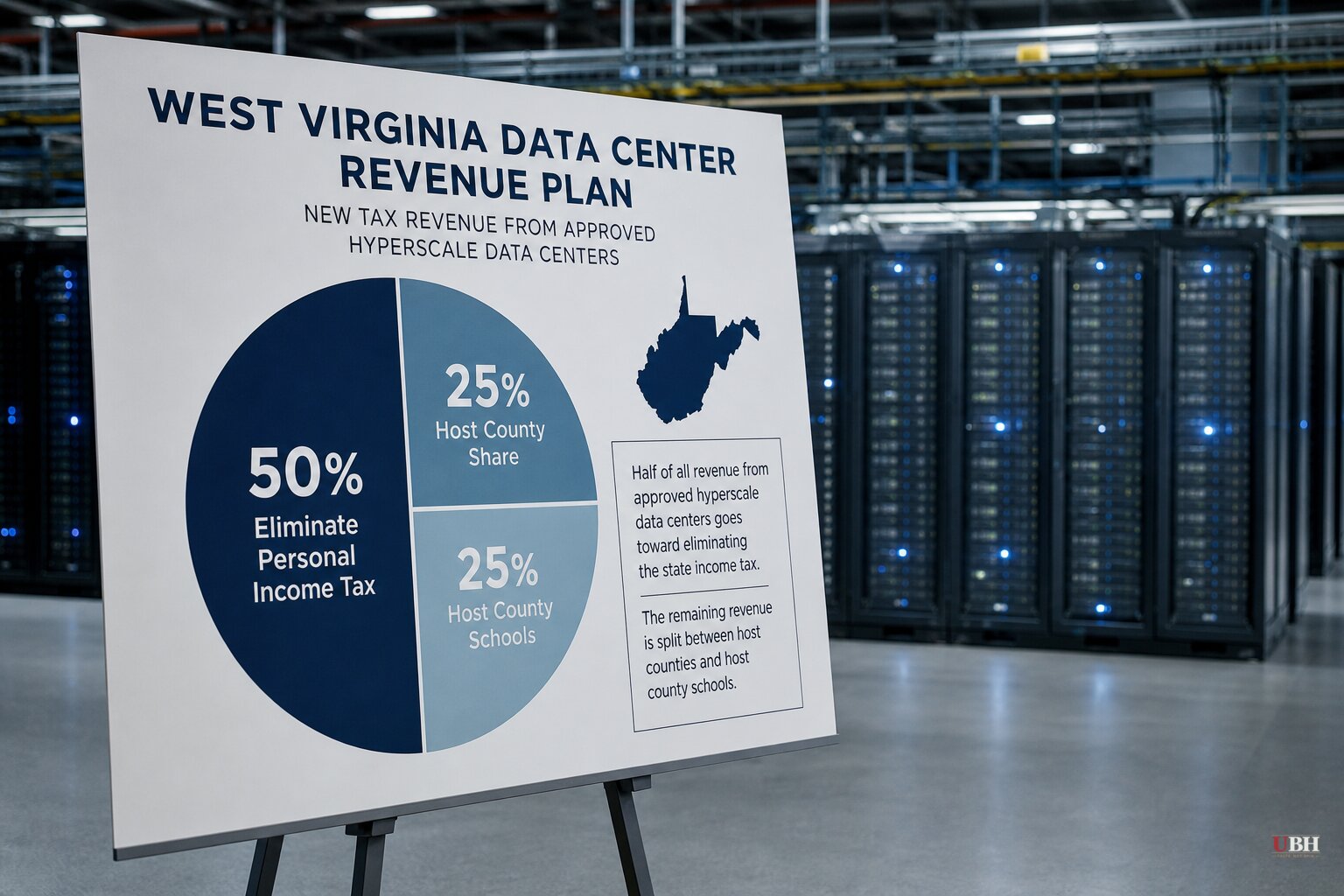
The plan lays out seven principles built on 2025 legislation aimed at reducing, and eventually eliminating, West Virginia's state personal income tax. Under the framework, 50% of revenue generated by data center projects approved through the state's High Impact Data Center Designation (HIDC) process goes straight toward cutting and ultimately zeroing out the personal income tax. That HIDC process was created under a separate 2025 state law.
"Today, as the world stands on the cusp of a new digital and economic frontier, West Virginia is stepping forward once again to lead, not by repeating the mistakes of other states, but by implementing a proactive, 20-year development strategy on our terms," Morrisey said in a statement obtained by Fox News.
Where the rest of the money goes
The income tax cut isn't the only thing on the table. Counties that actually host a data center get 30% of that project's revenue, earmarked for schools and local government. Another 10% gets split across all 55 of West Virginia's counties, whether they have a data center or not. The final 10% goes to infrastructure upgrades, including public water systems in a state that has struggled with aging water infrastructure since the coal industry's decline.
By law, none of the HIDC revenue flows into the state's general fund. Morrisey's office frames that as a guarantee the money can't get absorbed into routine budget spending and has to go where the plan says.
"This shared framework gives us the exact blueprint we need to attract billions in private investment, create thousands of high-paying construction and technology jobs, lower taxes for our citizens, and revitalize economically distressed regions, all while preserving the wild and wonderful state we call home," Morrisey said.
The fairness question
Critics, including ZeroHedge in its coverage of the rollout, have raised a key question. The rural, lower-income residents who'd actually be living near these data centers often don't pay state income tax in the first place. If half the revenue is dedicated to cutting a tax you don't owe, that slice of the deal does nothing for you directly.
A tax cut only benefits people who pay the tax, and the households closest to a sprawling server farm and its noise, water use, and traffic aren't necessarily the ones writing income tax checks to Charleston.
The plan's other three buckets are built to address that gap. The 30% going to host counties funds schools and local government, services that reach everyone regardless of tax bracket. The 10% split across all 55 counties and the 10% for infrastructure, including water systems, are aimed at communities that don't benefit from an income tax cut. Whether that money actually gets spent well and fast enough to offset the disruption of construction is a separate question the plan doesn't answer yet.
The backlash next door
The timing isn't an accident. In neighboring Loudoun County, Virginia, data center density has become a flashpoint, and that fight has spilled into West Virginia's Eastern Panhandle, particularly Jefferson and Berkeley counties near Charles Town.
Rep. Suhas Subramanyam (D-VA), whose district includes Loudoun County, has been blunt about it. "We are a cautionary tale for the rest of the country," he said in recent remarks, adding that if his district were a country, it would host more data centers than almost any other nation. That's the backdrop Morrisey is building against: a state trying to capture the same investment wave while promising residents it won't repeat Loudoun County's experience.
The unresolved piece is enforcement. West Virginia's 2025 law sets the revenue splits, but the actual pace of HIDC approvals and how quickly the personal income tax rate actually falls will depend on how many hyperscale projects get built and how much revenue they generate. No specific timeline for full elimination has been set, and no data center under this framework has yet been approved.
Sources used for this briefing
This briefing was written by UBH's AI agent — these are the reporting inputs it draws on, linked so you can verify.


