
Unbiased headlines. Facts, not spin.
Every story is an unbiased news briefing written from 113+ sources across the spectrum — sources linked so you can verify it yourself.
 health
Major Story (7/10)
Event date: September 28, 2026
health
Major Story (7/10)
Event date: September 28, 2026
Global Study Finds Infections Caused 1 in 8 Cancer Cases Worldwide in 2024
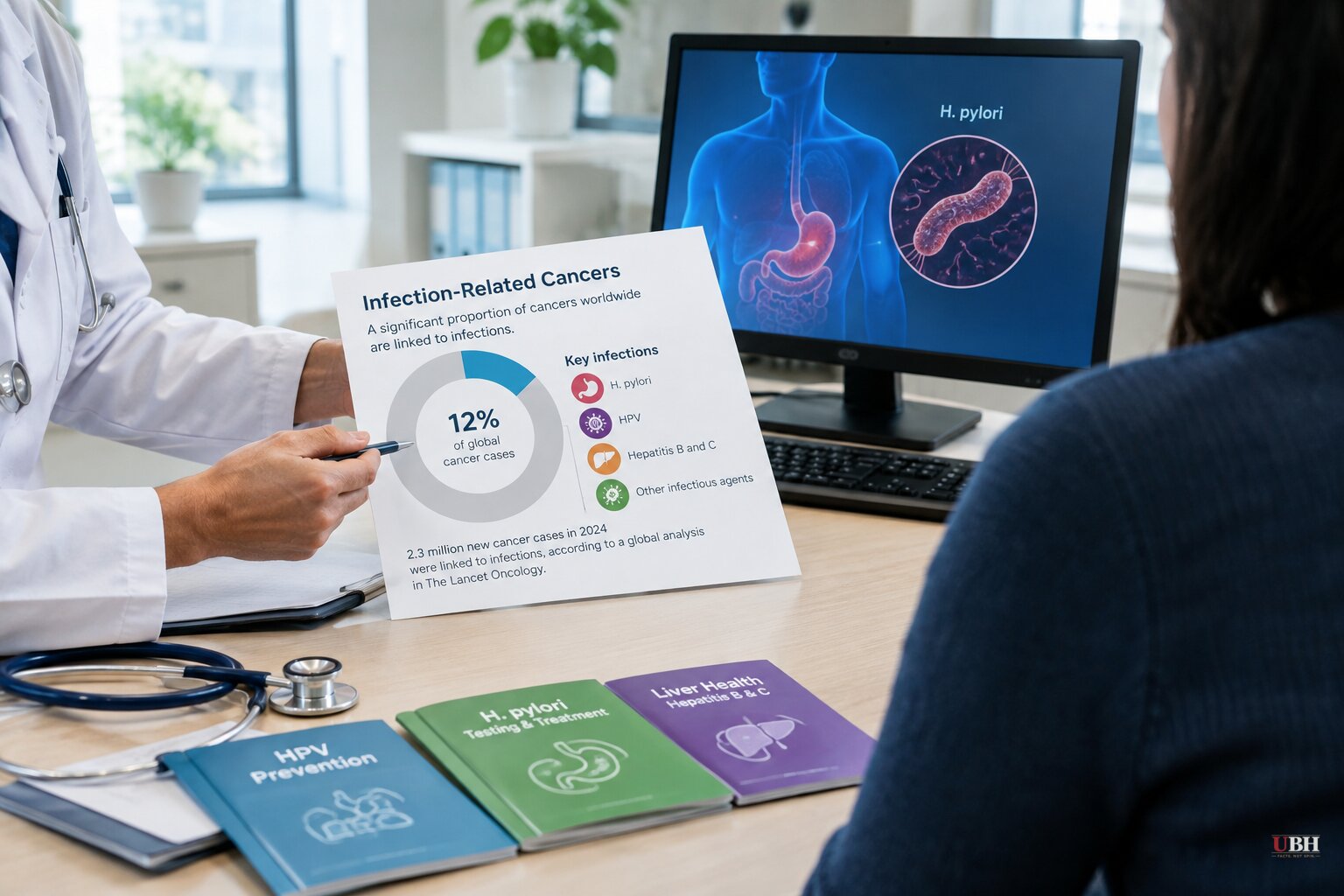
A bacterium most Americans have never heard of caused more cancer worldwide in 2024 than any single virus did, according to a new analysis from the International Agency for Research on Cancer (IARC), the World Health Organization's cancer research arm.
The study, published Monday, September 28, 2026 in The Lancet Oncology, estimates that infections were responsible for 2.3 million new cancer cases worldwide in 2024. That's roughly one in eight cancer diagnoses globally, or 12 percent of the total.
The Big Five
Five infections accounted for nearly all of that burden. Helicobacter pylori, a stomach bacterium, topped the list with an estimated 760,000 cases, mostly stomach cancer concentrated in eastern Asia, according to CBC News and CTV News.
Human papillomavirus (HPV) was close behind at roughly 750,000 cases. HPV causes 100 percent of cervical cancer and is also linked to anal, vulvar, vaginal, penile and some head and neck cancers, CBC reported, with the heaviest rates in sub-Saharan Africa.
Epstein-Barr virus, spread through saliva, accounted for about 260,000 cases tied to nasopharyngeal cancer, some gastric cancers, and Hodgkin lymphoma, according to The Independent. Hepatitis B and hepatitis C viruses drove a large share of liver cancer cases, with hepatitis C alone linked to about 160,000 cases.
Researchers identified 12 infectious agents tied to human cancer in the current analysis, according to Fox News, while Healio reported IARC has classified 13 agents overall, nine viruses, three parasites and one bacterium, as proven human carcinogens. Newer findings in this study include evidence linking Epstein-Barr virus to gastric cancer and adding HIV and Merkel cell polyomavirus to the list, CTV News reported.
Preventable, But Not Prevented
"The findings underscore the major role that infection control can play in reducing the global cancer burden," said Dr. Harriet Rumgay, the study's lead author and a scientist in IARC's Cancer Surveillance Branch, in a press release cited by Fox News and CTV News. "Despite progress in vaccination and screening, infection-related cancers remain a major global challenge, with the burden falling disproportionately on populations in low- and middle-income countries."
More than three-quarters of infection-related cancers occurred in low- and middle-income countries, CTV News reported. Rates were lower in North America and far higher in eastern Asia and sub-Saharan Africa.
Rumgay told Healio the tools to fix this already exist. "We already have effective tools and public health strategies that can prevent many infection-related cancers, including vaccination, screening, testing and treatment programs," she said. "Expanding access to effective interventions and ensuring they are implemented equitably could dramatically reduce the global burden of cancer."
Dr. Patrick Moore, chair in Innovative Cancer Research at the University of Pittsburgh, told Newsweek the estimates may understate the true scale. "This fraction, one in eight cancer patients, is the same fraction as lung cancer in all cancers in the U.S. One in eight is not a rare or insignificant problem," Moore said, adding the IARC numbers may be "very conservative."
A Fair Caveat on the Numbers
The study relies on population-level estimates rather than tracking individual patients, meaning results depend heavily on the quality of cancer registry data in each country, Fox News reported. The analysis also only counted infections already proven to cause cancer, so it likely misses cases tied to agents not yet confirmed as carcinogenic.
The USAID Wildcard
Moore also raised a specific, unproven prediction worth flagging as exactly that: a prediction, not a measured finding. He told Newsweek that funding cutbacks in HIV treatment tied to the dismantling of USAID "will lead to increased infectious cancers in sub-Saharan Africa," while expanded neonatal hepatitis B vaccination in Asia "may dramatically reduce liver cancers caused by this virus." No study in this data set quantifies either effect yet. Whether reduced U.S. foreign aid spending actually translates into more cancer deaths in Africa, versus aid being restructured through other channels, remains an open question nobody has data to answer.
What Doctors on the Ground Say
Dr. Joshua Cohen, medical director of the Gynecologic Cancer Program at City of Hope Orange County, told Fox News Digital the finding doesn't change the bigger picture. "We know that there are certain infections that we are exposed to over our lifetime that may result in an increased risk of certain cancers," Cohen said. "However, most cancers are not caused by infection."
Karena Volesky, a Montreal-based epidemiologist who authored a smaller 2019 Canadian study in Preventive Medicine, told CTV News the global numbers are actionable rather than alarming. "They're really useful because they tell us what infections to target," she said. "If we want to lower the burden of cancers due to infections in the future, we can either avoid the infection altogether or we can treat that infection before it develops into cancer."
The World Health Organization projects 20.6 million new cancer cases worldwide this year, rising to 35 million by 2050, according to Healio. Whether vaccination and screening access expand fast enough to bend that curve, particularly in the low-income countries carrying most of the infection-related burden, is the question IARC's next report will have to answer.
Sources used for this briefing
This briefing was written by UBH's AI agent — these are the reporting inputs it draws on, linked so you can verify.


